Demetrius, son of the Seleucid king Seleucus IV, did not escape from a locked Roman prison in 162 BCE. He escaped from something politically more unusual: the comfortable but compulsory life of a royal hostage.
By then Demetrius had spent much of his youth in Rome. He had a household, friends among the Mediterranean elite, enough freedom to attend dinners and go hunting, and a close relationship with the Greek historian Polybius. None of that meant he was free to return to the Seleucid kingdom. When Antiochus IV died and left a child, Antiochus V Eupator, on the throne under the regent Lysias, Demetrius asked the Roman Senate to let him go home and press his own dynastic claim. The Senate refused.
The result was one of the best-documented political escapes of the Hellenistic world. Polybius was not merely a later historian of the episode: he says that Demetrius consulted him, that he advised bold action, and that he helped arrange the plan through Menyllus of Alabanda. Their solution depended less on physical force than on creating a believable explanation for Demetrius's absence long enough for a ship to carry him beyond Roman reach.
The escape succeeded. Rome did not realize what had happened for several days. By the time the Senate met, Demetrius had already passed the Straits of Messina. Later in 162 BCE he reached the eastern Mediterranean and appeared at Tripolis on the Phoenician coast. Within months he had turned flight from hostage status into a bid for the Seleucid throne.
At a Glance
- Escape: from Roman hostage status, 162 BCE
- Departure point: Ostia, at the mouth of the Tiber
- Immediate destination: eastward by sea; later landfall and royal proclamation at Tripolis in Phoenicia
- Core planners: Demetrius, Polybius, Menyllus of Alabanda, and members of Demetrius's household circle
- Cover story: a dinner, a supposed hunting trip, and servants deliberately sent toward Anagnia and Cerceii
- Ship: a Carthaginian vessel that had carried sacred offerings and was openly chartered by Menyllus
- Departure party: Polybius reports eight men, five adult slaves, and three slave boys, apart from the ship's crew
- Detection delay: suspicion arose on the fourth day; the Senate met on the fifth
- Immediate result: no Roman pursuit; Demetrius continued east
- Longer result: Demetrius proclaimed himself king in 162 BCE and displaced Antiochus V and Lysias during the subsequent seizure of power
A Hostage, Not a Prisoner in a Cell
Demetrius's status originated in the unequal settlement that followed Rome's victory over his grandfather Antiochus III. The Peace of Apamea required the Seleucid monarchy to provide hostages. Antiochus III's son Antiochus—later Antiochus IV Epiphanes—was initially held in Rome. During the reign of Seleucus IV, Demetrius replaced his uncle as the royal hostage.
The exact year of that substitution is not stated consistently in modern reconstructions. A common chronology places it in 178 or 178/177 BCE; other scholarship places Demetrius in Roman hostage status from about 176/175. Polybius is more useful for Demetrius's lived situation than for an exact arrival date. He says Demetrius had been in Rome for many years, had arrived as a boy, and was twenty-three when he made his first major appeal after the death of Antiochus IV.
Royal hostage status did not resemble ordinary imprisonment. A high-ranking hostage could move through elite society while remaining a political guarantee whose departure required Roman permission. Polybius's narrative shows Demetrius dining socially, maintaining numerous attendants, keeping hunting dogs and nets, and habitually hunting wild boar around Cerceii. His problem was therefore not how to break through walls. It was how to make his normal movements conceal a permanent departure.
That distinction also explains why the escape could be accomplished without attacking guards. Demetrius had enough liberty to leave a banquet and travel to Ostia. What he did not have was the right to sail away from Italy and re-enter the dynastic struggle in Syria.
Why the Senate Would Not Release Him
Antiochus IV died in late 164 BCE. His young son Antiochus V Eupator was proclaimed king, while Lysias exercised effective control as guardian and regent. Demetrius immediately possessed a serious dynastic claim: he was the son of the previous king, Seleucus IV, whereas Antiochus V descended from Seleucus's brother.
Polybius says Demetrius appealed personally to the Senate. He emphasized his long Roman upbringing and argued that he had a better claim to the throne than Antiochus IV's child. Polybius gives his age as twenty-three. The senators, he says, were personally sympathetic but decided as a body to keep him in Rome and support the child king.
Polybius interprets the decision harshly. In his account, Rome preferred an inexperienced boy because a weak Seleucid government better served Roman interests than a vigorous adult ruler. Appian, writing centuries later, repeats essentially the same explanation.
The motive should not be treated as if a surviving Senate minute proves it. Polybius was close to Demetrius and directly hostile to what he considered an unjust detention. Modern scholars have divided over how literally to accept his explanation of Roman policy. Rome unquestionably refused Demetrius and continued dealing with Antiochus V's government; whether the sole or dominant motive was a deliberate preference for Seleucid weakness is an interpretation, even if it is an ancient and influential one.
The distinction becomes important because Demetrius did not escape after a single impulsive rejection. The Senate made a political choice, and he remained under Roman control after that choice.
The Crisis in Syria Creates an Opening
Roman intervention soon made the situation more volatile. The Senate sent Gnaeus Octavius and other commissioners east to enforce restrictions on Seleucid military power. Ancient sources describe Roman action against war elephants and warships. At Laodicea, Octavius was murdered.
The killing transformed the political atmosphere. Envoys representing Antiochus V and Lysias came to Rome and denied that the royal government had ordered the assassination. Polybius says the Senate gave them little satisfaction and avoided publicly committing itself.
Demetrius saw another opportunity and again considered asking for release. Polybius says he advised him not to repeat the same failed approach but to rely on himself and undertake an action worthy of someone seeking a throne. Demetrius nevertheless made another appeal after receiving contrary advice from the younger Apollonius. This time he asked at minimum to be released from the hostage obligation now that the Senate had chosen to leave Antiochus V on the throne.
The answer was again no.
Polybius's account is unusually candid because he places himself inside the conspiracy that followed. After the second refusal, Demetrius consulted Diodorus, his former foster-father, who had recently come from Syria and judged the moment favorable. Diodorus believed the Seleucid government was politically vulnerable and that Rome was unlikely to expend much effort rescuing Lysias after the Octavius crisis.
At that point, the problem changed from whether Demetrius should leave to how he could do so before Rome reacted.
Polybius and Menyllus Build the Exit
Demetrius told Polybius of the proposed escape and asked for practical help. Polybius turned to Menyllus of Alabanda, an envoy then in Rome on behalf of Ptolemy VI Philometor of Egypt. Menyllus could arrange maritime transport without making Demetrius appear to be arranging his own flight.
The ship he found was especially useful because its presence at the mouth of the Tiber had an innocent explanation. Polybius describes it as a Carthaginian vessel associated with the transport of traditional sacred offerings to Tyre. Menyllus openly chartered it as though he intended to use it for his own return journey. He could therefore load provisions, deal with the ship's officers and pay for passage without the preparations themselves revealing an escape plot.
Polybius says a month's provisions were put aboard. That does not prove an intended month-long nonstop voyage or an exact route; it shows that Menyllus prepared the vessel for a substantial journey.
Demetrius kept the circle small. Diodorus was sent ahead toward Syria to assess opinion. Apollonius was involved early, along with Apollonius's brothers Meleager and Menestheus. As the departure approached, additional trusted companions were brought in, but most of Demetrius's large household remained outside the plan.
The secrecy depended on giving those people a reason not to look for him.
The Banquet and the False Hunting Trip
A dinner at the house of a friend provided the first layer of cover. Demetrius normally invited his household when he dined at home, so eating elsewhere gave him a plausible reason to be separated from many of his attendants.
Polybius was ill and did not attend. According to his own account, he worried that the dinner might run too long and that Demetrius, who was young and enjoyed drinking, might jeopardize the timing. He therefore sent a short written warning urging sobriety, caution and decisive action.
Demetrius responded by pretending to feel ill and leaving the banquet with his friends. From his lodging he sent unsuitable servants away toward Anagnia and told them to bring the hunting nets and dogs to meet him at Cerceii. The story fitted an established habit: he really did hunt there.
His trusted companions separately instructed their servants to go ahead as well, telling them that the men would follow with Demetrius. To people in Rome, the group could appear to have departed for a familiar hunting trip. To people waiting inland, Demetrius was still expected to arrive.
The cover did not require everyone to believe the same thing indefinitely. It only had to keep the two groups from comparing information until the ship had gained enough distance.
Ostia Before Dawn
Demetrius and his companions traveled by night to Ostia. Menyllus had gone ahead and gave the ship's officers another plausible explanation. He said that he himself now had to remain in Rome, but that trusted young soldiers would sail in his place to carry information to his king.
The sailors had already been paid and had no obvious reason to object. Polybius says they did not know who their passengers really were.
Near the end of the night, the escape party reached the ship. Polybius gives a remarkably precise count: eight men, accompanied by five adult slaves and three slave boys. The wording indicates sixteen passengers in this group apart from the vessel's normal crew, although not every individual's name survives in the account.
The ship sailed as dawn was breaking.
There was no dramatic chase out of the harbor in Polybius. The strength of the plan was that no chase began at all.
Four Days Before Rome Understood
The hunting deception worked. Members of Demetrius's household who remained in Rome thought he had gone toward Cerceii. The servants sent inland expected him to join them. Neither group immediately interpreted his absence as flight.
Polybius attributes the eventual discovery to an almost accidental chain. A slave who had been flogged at Anagnia went looking for Demetrius at Cerceii, failed to find him, returned toward Rome and informed members of the household. Only on the fourth day after departure did serious suspicion arise.
On the fifth day the Senate met specially to consider the escape. By then, according to Polybius, Demetrius had already passed the Straits of Messina under favorable winds.
The Senate did not order an effective pursuit. Polybius says the senators concluded that Demetrius was too far ahead and that they could not stop him even if they wished to do so. They instead appointed commissioners, including Tiberius Sempronius Gracchus, to observe developments in Greece and Asia and assess how other kings responded to Demetrius's move.
This is the strongest evidence against a simple claim that Rome officially authorized the escape. The Senate had twice refused release and then convened after discovering that Demetrius had fled. At the same time, Rome's decision not to pursue him once he was far ahead helped turn a successful departure into durable freedom.
There is room for a narrower possibility: individual members of Mediterranean elite networks may have sympathized with Demetrius, and later reconstructions sometimes imply broader Roman connivance. But Polybius's detailed account names himself, Menyllus and Demetrius's circle rather than an official senatorial escape operation. An organized Senate plot to send Demetrius east is not established by the strongest surviving narrative.
From Flight to a Claim on the Throne
Polybius's surviving account becomes fragmentary after the ship clears Italy. Modern reconstructions generally place the escape in late spring 162 BCE and Demetrius's appearance at Tripolis later that year, probably by autumn. Some reconstruct a stop in Lycia and the recruitment of mercenaries before the Syrian landing.
The ancient sources disagree over how formidable his force had become. First Maccabees says Demetrius left Rome and arrived at a coastal city with only a few men. Second Maccabees describes him entering the harbor of Tripolis with a powerful force and ships. Those claims need not describe exactly the same moment: a tiny escape party could recruit support before or after reaching the eastern Mediterranean. But the evidence does not permit a precise troop count.
Tripolis mattered because there Demetrius could cease behaving like a fugitive and present himself as a king. Later chronology places his royal proclamation in 162 BCE, perhaps by October. The complete transfer of power took longer.
Antiochus V and Lysias still controlled the existing court. First Maccabees reports that as Demetrius moved into his ancestral kingdom, the army seized the boy king and his guardian and brought them toward him. Demetrius ordered that they not be shown to him, after which the soldiers killed them. Livy's surviving summary likewise connects their deaths to Demetrius's seizure of the kingdom.
The precise accession chronology is not as clean as older king lists suggest. Modern scholarship notes documentary evidence for Antiochus V continuing into early 161 BCE, including a reported last document dated 11 January 161. It is therefore safer to distinguish three events: Demetrius escaped Rome in 162; he presented himself as king after reaching Tripolis later in 162; and his consolidation over Antiochus V and Lysias extended into the transition to 161.
The Name “Soter” Came Later
Calling the fugitive prince “Demetrius I Soter” is convenient because that is how history remembers him. It is also anachronistic if applied to the moment he boarded the ship at Ostia.
“Soter,” meaning “Savior,” became associated with Demetrius after he had taken power and defeated the rebel ruler Timarchus in the east. The Oxford Classical Dictionary connects the title to that later success, not to the escape from Rome.
The distinction matters because the flight has often been read backward through the kingship that followed. At Ostia, Demetrius was not yet an established sovereign returning triumphantly to his capital. He was a royal claimant defying the state that had kept him as a hostage, sailing on a ship whose own crew did not know his real identity.
How Much of the Story Can We Trust?
Few ancient escape narratives offer a source as close to the planning as Polybius. That is both the greatest advantage and the largest caution.
Polybius was in Rome, knew Demetrius personally and presents himself as an adviser to the escape. He says Menyllus kept him informed while illness kept him from the final dinner, and his account includes mundane details—the servants sent inland, the hunting cover, the timing at Ostia, the passenger count, and the delayed discovery—that are difficult to explain as a generic later legend.
Yet he was not neutral. He believed Demetrius had been treated unjustly and portrays Roman policy as self-interested. His participation gives him unusual access while also giving him a reason to justify the decision he helped facilitate.
Other ancient traditions confirm the broad frame. Appian preserves the Senate's refusal and Demetrius's status as a twenty-three-year-old hostage. Livy's epitome remembers his secret flight from Rome and subsequent seizure of the kingdom. First and Second Maccabees independently place a small-party departure from Rome and the arrival at a coastal city or Tripolis before Antiochus V and Lysias fell.
The convergence makes the central escape unusually secure: Demetrius was retained by Rome, repeatedly failed to obtain release, secretly left Italy in 162 BCE and reached the Seleucid realm. The most granular mechanics—especially the dinner, hunting deception and Ostia embarkation—depend overwhelmingly on Polybius and should be presented as his exceptionally detailed near-contemporary testimony, not as details independently confirmed line by line.
Why the Escape Matters
The escape altered more than one man's custody status. Roman hostage-taking had helped shape Seleucid dynastic politics for years. Antiochus IV had once been the royal hostage; Demetrius replaced him; then Demetrius's continued detention helped leave him outside the kingdom when his father died. His uncle and later his young cousin ruled while he remained in Rome.
In 162 BCE that system failed at the point where personal networks became stronger than formal control. Demetrius used the social freedom of elite hostage status against the state that imposed it. Hunting habits became cover. Diplomatic connections supplied a ship. A historian held in Rome as part of another political settlement helped a Seleucid prince escape his own Roman obligation.
The plan did not require violence or a breach in physical security. It required Rome to misunderstand where Demetrius was for four days.
That delay was enough. By the time the Senate understood that a familiar hunting absence was actually flight, the hostage had crossed southern Italy by sea and was beyond practical interception. Within months he had turned that head start into a royal landing, and within the following political transition he had displaced the regime Rome had preferred to keep in power.
Evidence discipline
What the record supports
Status labels distinguish secure conclusions from uncertainty and rejected claims. Color is never the only signal.
MYTH
Demetrius escaped from a Roman prison cell.
He was a high-status royal hostage with substantial social and physical freedom. The constraint was political custody and the prohibition on leaving Roman control, not ordinary incarceration.
Sources: SRC-001, SRC-006MYTH
The Senate officially released Demetrius or authorized his departure.
Polybius says the Senate repeatedly refused release and held an emergency meeting after discovering the flight. It abandoned pursuit only after Demetrius had gained too much distance.
Sources: SRC-001, SRC-003DISPUTED
Rome kept Demetrius because the Senate deliberately preferred a weak child ruler in Syria.
Polybius explicitly gives this as the Senate's motive and Appian repeats it, but Polybius was personally aligned with Demetrius and modern scholarship has debated whether Roman policy can be reduced to that single motive.
Sources: SRC-001, SRC-002, SRC-009WELL-SUPPORTED
Polybius personally helped plan the escape.
Polybius says Demetrius asked for his help, that he brought Menyllus into the plan, and that he sent a last-minute warning note. His self-involvement makes him both exceptionally close evidence and an interested narrator.
Sources: SRC-001, SRC-009DOCUMENTED
The escape party consisted of sixteen passengers apart from the ship's crew.
Polybius reports eight men, five adult slaves and three slave boys at embarkation. The count is unusually precise, although individual identities are incomplete.
Sources: SRC-001UNKNOWN
Demetrius landed at Tripolis with exactly the same tiny group that left Ostia.
First Maccabees emphasizes a few men, while Second Maccabees describes a strong force and fleet at Tripolis. Modern reconstructions allow recruitment between Italy and the Syrian coast, so no exact Tripolis force size is secure.
Sources: SRC-004, SRC-005, SRC-007MYTH
Demetrius became fully established king immediately upon escaping in 162 BCE.
The escape, the proclamation at Tripolis and the final displacement of Antiochus V and Lysias were distinct stages. Documentary chronology allows the consolidation to extend into early 161 BCE.
Sources: SRC-007, SRC-008MYTH
Demetrius already bore the title Soter when he escaped Rome.
The familiar epithet belongs to his later kingship and is associated in modern scholarship with his defeat of Timarchus, not the moment of escape.
Sources: SRC-006Evidence diagram
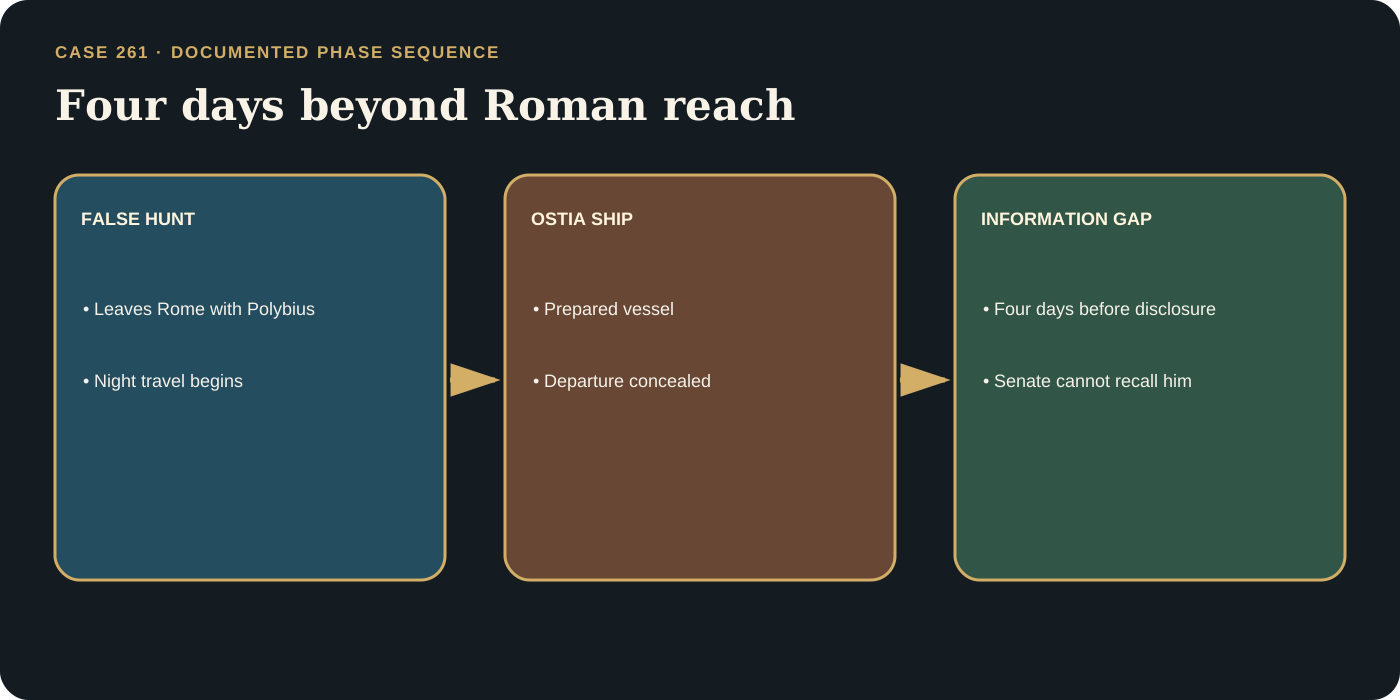
Four days beyond Roman reach
Polybius records an information gap that carried Demetrius from a false hunting trip to a secretly prepared ship at Ostia.
Polybius records an information gap that carried Demetrius from a false hunting trip to a secretly prepared ship at Ostia.