Pablo Escobar did not escape from an ordinary prison. When he surrendered to Colombian authorities on June 19, 1991, he entered La Catedral, a specially arranged detention facility in the hills above Envigado. His surrender formed part of President César Gaviria’s sometimiento a la justicia policy, which offered benefits to major offenders who submitted to Colombian courts. The political setting mattered just as much. Decree 303 of 1991 had promised qualifying submitters protection from extradition for pre-surrender crimes, and on the day Escobar gave himself up Colombia’s Constituent Assembly approved a constitutional prohibition on extraditing Colombians by birth.
La Catedral was supposed to place Escobar under lawful custody while protecting him from enemies who might attack a conventional prison. In practice, the state’s control inside the compound deteriorated badly. Escobar and his associates exercised extraordinary influence over access, guards, communications and daily life. Investigations after the escape showed that the arrangement had become less a secure prison than a custody system hollowed out by corruption.
By July 1992, that contradiction could no longer be contained. Gerardo “Kiko” Moncada and Fernando Galeano, important figures in the Medellín trafficking organization, were killed after going to La Catedral. The killings convinced the government that it had to take direct control and move Escobar and the other inmates.
On July 21, troops surrounded the prison. Three senior officials entered to deal with the transfer and were held hostage. During the resulting crisis, Escobar and nine other prisoners disappeared from custody. By the morning of July 22, ten men were gone.
At a Glance
- Date: Night of July 21–22, 1992.
- Place: La Catedral, Envigado, Antioquia, Colombia.
- Prisoners at the start of the operation: 15 — Escobar and 14 other detainees.
- Fugitives: 10 — Escobar and nine others.
- Prisoners left behind: 5.
- Government officials held hostage: 3.
- Immediate trigger: Government action after evidence of grave criminal activity inside La Catedral, above all the Moncada and Galeano killings.
- Best-supported escape explanation: A compromised custody system, including cooperation by guards and soldiers, enabled the fugitives to pass through the prison’s security during a confused transfer crisis.
- Tunnel / weak-wall stories: Widely repeated, but the strongest judicial and disciplinary record does not establish one cinematic physical route as the controlling explanation.
- Fatality during the retaking: Prison guard Sergeant Olmedo Mina was killed during the Army assault; the circumstances were litigated for years.
- Aftermath: The escape triggered a renewed hunt for Escobar and accelerated the fragmentation of the Medellín Cartel.
The surrender that created La Catedral
Escobar’s imprisonment grew out of a negotiated legal strategy rather than a conventional arrest. Beginning in 1990, the Gaviria government issued decrees intended to persuade traffickers and other major offenders to submit to Colombian justice. The program offered sentence reductions and procedural benefits. Decree 303 of January 1991 specifically protected qualifying submitters from extradition for crimes committed before they surrendered, provided they fulfilled the required sentence.
Escobar’s calculations had long been dominated by extradition. The Medellín Cartel’s campaign against extradition had included assassinations, bombings and kidnappings. On June 19, 1991, as the Constituent Assembly approved language prohibiting extradition of Colombians by birth, Escobar surrendered in Medellín.
He was flown to La Catedral. The prison sat in the hills above Envigado, close to Escobar’s political, social and criminal base. The later Supreme Court record describes the internal guard as civilians designated through the municipality, while the Army maintained external security. Escobar and the other men were nevertheless legal detainees. They had been questioned judicially and were subject to detention orders without release.
That distinction is important because La Catedral has often been described as though it were merely a private mansion with no legal meaning. It was a prison in law. The scandal was that the state’s practical custody became radically weaker than its formal authority.
A prison whose prisoner controlled too much
The mythology surrounding La Catedral often begins with luxury: football, elaborate rooms, expensive furnishings, parties and privileged visitors. Some of those details are documented; others grew with repeated retelling.
The more important fact is institutional. Escobar retained a degree of practical control incompatible with meaningful imprisonment.
Investigations after the escape found irregular visitors, improper communications, weapons and extensive corruption around the security system. A 1993 El Tiempo investigation based on Procuraduría testimony reported that Army personnel responsible for the external perimeter had been receiving money, food, vouchers and other benefits for months.
The Supreme Court’s later reconstruction exposed the internal problem as well. It described municipal guards who were passive toward the prisoners or actively supportive of them during the July crisis. In the appeal before the Court, one convicted guard was identified by witnesses as remaining at Escobar’s side and supporting his directives while three government officials were being held.
La Catedral therefore cannot be understood simply as “comfortable.” The central defect was custodial capture: people who were supposed to control the prisoners had become dependent on, intimidated by or cooperative with them. That defect became impossible to ignore once murder entered the prison.
Moncada and Galeano
In early July 1992, Gerardo Moncada and Fernando Galeano went to La Catedral. They did not come out alive.
Colombia’s Truth Commission identifies their killings inside the prison as the event that precipitated the government’s decision to retake control. Contemporary reporting before Escobar’s escape also documented the disappearance of the two men after they had been summoned to the facility.
Later accounts provide different versions of the motive and the killings themselves. Stories about hidden money, unpaid contributions to Escobar’s organization, torture, dismemberment and attempts to destroy the bodies appear in various combinations. Some come from later participants in the trafficking world, some from investigative journalism, and some from popular retellings.
The essential fact does not depend on resolving every gruesome detail. Two powerful cartel associates entered a state prison controlled in practice by Escobar’s organization and were killed. The episode demonstrated that La Catedral was not merely failing to restrain a prisoner; it had become a site from which serious criminal violence could be carried out. The government decided to move the inmates.
July 21: the state tries to take control
The Colombian Supreme Court’s 2001 decision in the case of a municipal guard gives the clearest judicial chronology of the transfer crisis. On the afternoon of Tuesday, July 21, Army personnel arrived at La Catedral by order of the national government. Escobar was there with fourteen other prisoners. The mission was to replace the existing internal guard, take control of the installation and move the detainees to a military unit while investigations into abuses and crimes inside La Catedral continued.
The operation quickly became confused. Later administrative litigation found serious disagreements over what the Army had actually been ordered to do and how the transfer was supposed to proceed. The military encountered a prison in which the internal guard, prison authorities and detainees had developed relationships that did not resemble a normal maximum-security institution.
At approximately 9 p.m., Vice Minister of Justice Eduardo Mendoza de la Torre, national prisons director Hernando Navas Rubio and acting prison director Jorge Armando Rodríguez González entered the compound. They met with Escobar. They were then prevented from leaving.
Three government hostages
The later Supreme Court judgment treats the detention of those officials as criminal hostage-taking and identifies all three by name. That matters because public accounts have not always agreed. The Truth Commission’s concise narrative refers to two officials, while some early international reporting said four. The judicial file underlying later convictions consistently centers on three: Mendoza, Navas and Rodríguez.
The Court described the officials as being held from around 9 p.m. until the Army entered the next morning. It also described an armed environment inside the prison and municipal guards cooperating with the inmates. John Jairo Velásquez Vásquez, known as “Popeye,” was specifically described in the case record as carrying a compact automatic weapon while the officials were detained.
The government’s operation had changed character. What began as a transfer of people already in state custody had become a hostage crisis inside the prison itself.
During that delay, Escobar disappeared from the scene. The Supreme Court record places his disappearance at approximately 1 a.m. on July 22.
Ten fugitives
The cleanest number in the entire case is also one of the numbers most often distorted in later summaries. There were fifteen detainees when the operation began. Ten escaped.
The Supreme Court names them as Pablo Escobar; his brother Roberto; Gustavo González Flórez; Otoniel González Franco; Luis Carlos Aguilar Gallego; John Jairo Velásquez Vásquez; Jhony Rivera Acosta; Alfonso León Puerta Muñoz; Eduardo Avendaño Arango; and Luis Fernando Henao Giraldo. Five other prisoners remained behind and were in custody when the Army regained control.
Contemporary reporting from the Washington Post also said that Escobar escaped with nine other cartel members. A later Centro Nacional de Memoria Histórica account instead says Escobar escaped with eight others. Because the Supreme Court judgment supplies the actual ten-person list, it controls the denominator. The stable arithmetic is therefore:
15 prisoners → 10 fugitives + 5 left behind.
Tunnel, wall or compromised perimeter?
The physical escape route is where the documentary record becomes less tidy. Popular retellings often say Escobar used a tunnel prepared in advance. Others say the fugitives kicked through a deliberately weak rear wall made of plaster. Some versions add disguises, darkness, fog and a carefully chosen route through the hills.
Pieces of those stories appear in journalism, but they do not combine into one secure reconstruction. Immediately after the escape, tunnel claims circulated. Contemporary reporting noted that Escobar himself telephoned reporters and suggested he was hiding in a prison tunnel; journalists at the time already treated the claim with skepticism.
The weak-wall story became especially prominent in later retrospective accounts. It may preserve a genuine detail about how some fugitives moved from the inner compound, but it is not the strongest explanation for how ten men escaped a prison surrounded by state forces.
The more consequential evidence concerns the people guarding the perimeter. A Procuraduría-based El Tiempo investigation reported that members of the military had been bribed before the escape and that an associate of Escobar negotiated with soldiers during the critical hours. Witnesses placed the passage of fugitives through the external security system in the early hours of July 22. Filiberto Joya Abril, a noncommissioned officer, became a central figure in the investigation.
In November 1992, six military personnel were convicted in a court-martial process for offenses connected with the escape. Joya received the heaviest sentence among them for disobedience, facilitating the flight of prisoners and bribery.
The strongest historical conclusion is therefore structural rather than cinematic. Escobar’s group escaped because the custody system had already been corrupted and because the government’s attempt to change that system collapsed into confusion.
A wall, passage or rear exit may have been part of the movement. It was not the decisive explanation.
The escape through a corrupted security system
Corruption at La Catedral was not invented after Escobar disappeared. The 1993 Procuraduría-based investigation described regular payments and benefits reaching soldiers and noncommissioned officers assigned to the prison’s external security. Witnesses described money, food, hygiene supplies and vouchers. Other testimony described improper movement of vehicles and visitors.
During the escape itself, the same compromised relationships became operational. Later evidence described negotiations with soldiers around the perimeter and promises of money in exchange for cooperation. Witnesses also reported fugitives appearing in different kinds of clothing, possibly to make identification more difficult in the confusion.
Those clothing details vary and should not be treated as a single confirmed disguise plan. The corruption does not vary in the same way. Criminal and disciplinary proceedings produced findings against security personnel for facilitating the escape.
That makes La Catedral a useful case study in the difference between physical security and functioning custody. A perimeter can have fences, posts and armed personnel and still fail if the people controlling those barriers are cooperating with the prisoner.
The retaking and the death of Olmedo Mina
By roughly 7 a.m. on July 22, the Army entered La Catedral and recovered the three government officials. The five prisoners who had not fled remained in custody.
The retaking produced another serious controversy. Sergeant Olmedo Mina, a prison guard, was killed. Several other guards were wounded. Years later, Colombia’s Council of State examined the operation in a civil-liability case brought by Mina’s family and others injured in the assault.
The evidentiary record contained sharply conflicting accounts. Prison guards said they had not fired on the soldiers and described the Army opening fire during the entry. Military witnesses offered different versions of the confrontation and of the threat posed by the prison guard.
The Council of State ultimately held the state liable for the harm arising from the retaking. That history makes one formulation especially important: Mina was killed during the Army assault after the escape crisis had developed. It is not responsible to write that Escobar or one of the fugitives shot him unless a source can establish that claim.
The confusion at La Catedral was therefore not merely political embarrassment. It had lethal consequences for people who did not escape.
The government’s humiliation
By daylight, one fact overwhelmed every official explanation: Pablo Escobar had escaped from a prison arrangement created to solve the political and security crisis surrounding Pablo Escobar. The submission-to-justice program had broader aims than his case and had already induced other traffickers to surrender. The government hoped that legal incentives could reduce the cycle of narcotics-related political violence without capitulating to every demand of criminal organizations.
La Catedral exposed the danger of confusing surrender with control. After the escape, the Procuraduría investigated senior civilian and military officials. Congress and the press examined the prison’s construction, its guard system, the failed transfer and the privileges granted to inmates. Military personnel faced prosecution for their role in the flight.
The physical contents of the prison became symbols of the scandal: comfortable rooms, communications equipment, weapons and evidence of irregular access. Yet the most important finding was not that Escobar had lived well. It was that the state could not reliably determine who entered, what the prisoners possessed, what crimes occurred inside or whether the detainees would still be present when the government ordered them moved.
Freedom without restored power
Escobar regained physical freedom, but not the strategic position he had held before surrender. The Moncada and Galeano killings had already widened fractures inside the Medellín trafficking world. Their associates and other enemies now had stronger incentives to work against him.
After the escape, Colombia strengthened the specialized search apparatus pursuing Escobar. The Truth Commission records a renewed Search Bloc drawing on the National Police, some Army and Air Force personnel, the DAS, prosecutors and oversight officials, with expanded United States assistance.
At the same time, Escobar’s enemies organized outside the law. Los Pepes — Perseguidos por Pablo Escobar — brought together figures linked to the Cali Cartel, the Castaño brothers and former Medellín associates. The Truth Commission later documented troubling relationships between members of that network, informants and elements of the state pursuit.
The aftermath therefore resists a clean story in which the Colombian state simply corrected its mistake. The escape did produce a more determined hunt. It also contributed to a pursuit environment in which legal state action overlapped with the violence of Escobar’s criminal enemies.
The last seventeen months
Escobar remained a fugitive for about seventeen months. He explored possibilities for another surrender, but the government would not recreate the La Catedral arrangement. Some of the men who escaped with him later returned to custody or were captured.
Escobar remained at large as the Search Bloc, U.S. intelligence support and information from his enemies narrowed his room to operate. On December 2, 1993, he was located in Medellín and killed while trying to flee across rooftops.
The Truth Commission’s later reconstruction of the final hunt preserves its own controversies, including disputes about the role of Los Pepes and about who fired the fatal shot. Those questions belong primarily to the subsequent manhunt, but they matter to the meaning of La Catedral: the escape did not simply restart the same pursuit that had existed before 1991. It produced a different and more complicated coalition of forces against him.
The mythology of La Catedral
La Catedral has become one of the most mythologized criminal sites in modern Latin American history.
The basic record already sounds improbable. A major trafficker surrendered after a campaign of terror directed partly against extradition. He entered a specially arranged prison. He retained extraordinary power inside it. Criminal associates were killed after entering. When the government tried to impose direct custody, three officials were held hostage and ten prisoners escaped despite a military cordon.
The story does not need a perfect secret tunnel to be extraordinary.
Yet later retellings often improve the physical escape for drama. A weak wall becomes a deliberately engineered escape panel. A tunnel becomes a guaranteed feature of the prison’s original construction. Weather and darkness appear at exactly the required moment. Every guard becomes either Escobar’s employee or a helpless spectator.
Some of those details may contain truth. The legal and disciplinary record identifies a simpler vulnerability with stronger evidence: corruption. That is less cinematic but historically more important.
Was La Catedral really a prison?
Yes — and that answer still requires qualification. Escobar was under formal detention. He and the other prisoners had legal cases pending and were subject to detention orders. Courts later prosecuted guards and soldiers for helping prisoners escape. The fugitives were not merely abandoning a private residence.
But calling La Catedral an ordinary maximum-security prison would be equally misleading. The institution represented a collapse between formal custody and practical custody. The Colombian state had the legal authority to confine Escobar but had allowed or lost too much of the operational authority needed to make the confinement meaningful.
That distinction explains the escape better than the nickname “Hotel Escobar.” The scandal was not fundamentally that a prisoner had comforts. It was that the government could not exercise dependable control over the prison it had created.
Why the escape matters
Escobar’s flight from La Catedral is often remembered as a colorful episode in a larger criminal biography. It deserves to stand as a historical event in its own right.
The escape exposed the limits of Colombia’s early-1990s strategy for reducing narcotics-driven violence through negotiated submission. It demonstrated how corruption could hollow out a detention system without changing its legal status. It generated judicial, disciplinary, congressional and administrative investigations across the Colombian state.
It also changed the balance inside the Medellín criminal world. The murders that preceded the escape widened the split between Escobar and former associates. The hunt that followed brought state agencies, U.S. support and criminal enemies into overlapping campaigns whose legality remains part of Colombia’s historical reckoning.
Most of all, the case shows why mechanism matters. Escobar did not simply outsmart a fortress. The fortress had already ceased to function as one.
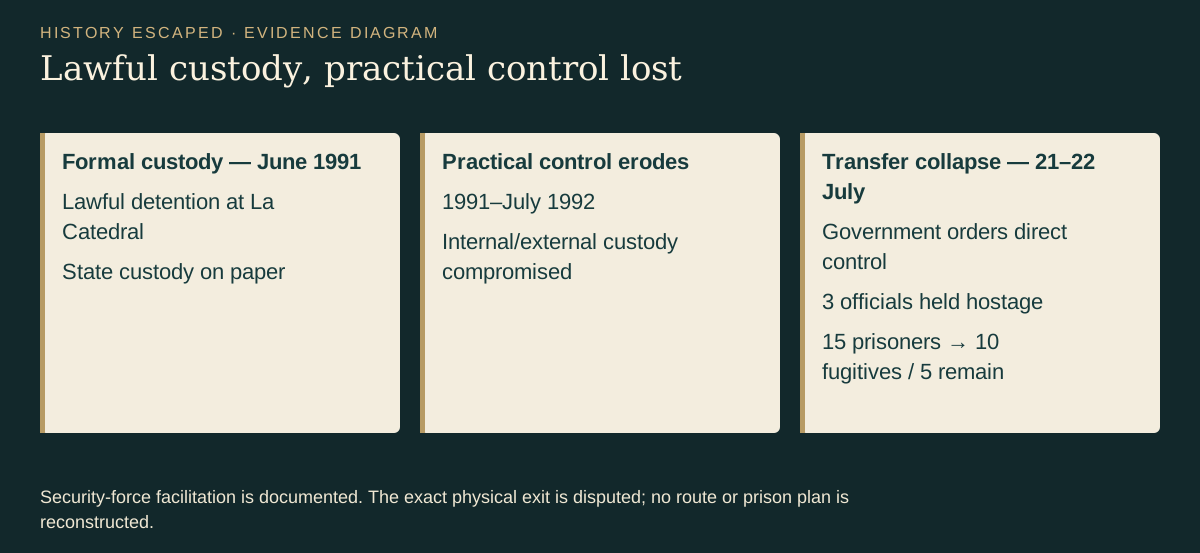
Evidence diagram
Lawful custody, practical control lost
Security-force facilitation is documented. The exact physical exit is disputed; no route or prison plan is reconstructed.
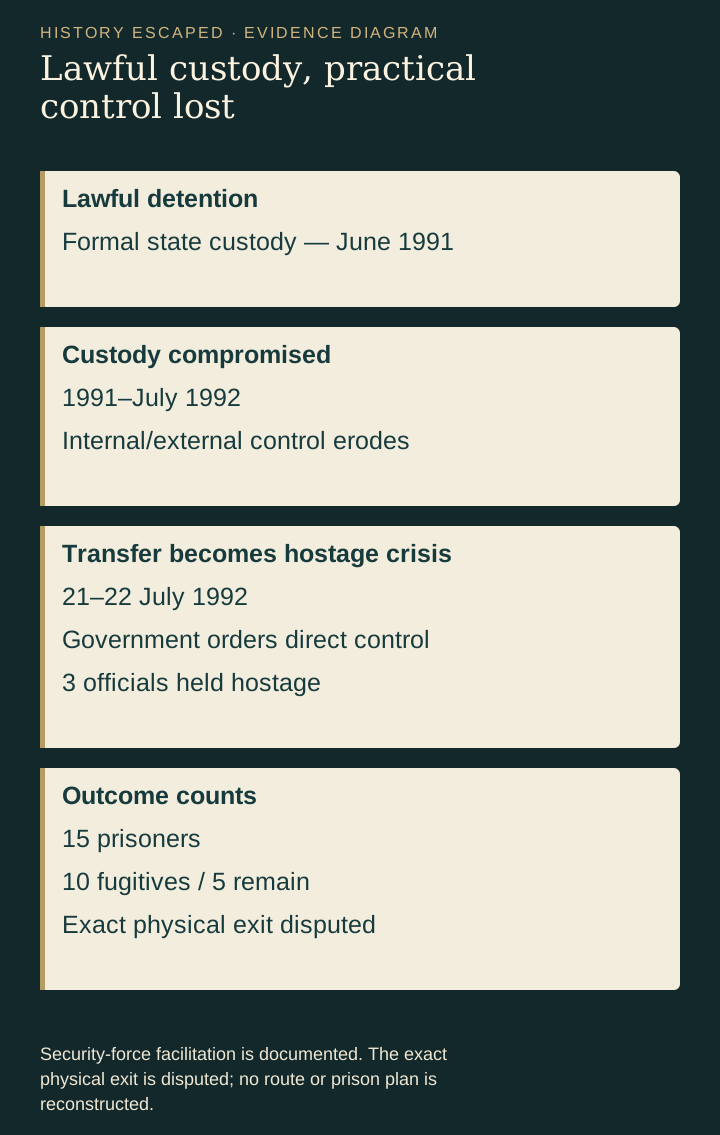
Security-force facilitation is documented. The exact physical exit is disputed; no route or prison plan is reconstructed.
Problem → response
Escape was a sequence of problems
Each response solved a practical obstacle while often creating the next one.
- 01→
Obstacle
Transition from negotiated custody to direct control
La Catedral’s existing guard arrangements and relationships had already been compromised when the government attempted to replace them.
Response
The government ordered an Army takeover and transfer, but the abrupt change produced a confused transition of authority.
- 02→
Obstacle
Hostage crisis
Three senior officials were detained after entering the prison.
Response
The Army’s mission shifted from custody transfer toward recovering the officials and retaking the installation.
- 03→
Obstacle
Corrupted security personnel
Investigations documented bribery and cooperation among personnel responsible for La Catedral’s security.
Response
The fugitives exploited compromised human security rather than defeating every physical barrier independently.
- 04→
Obstacle
Conflicting commands and poor coordination
Later Council of State litigation documented unclear instructions and serious operational confusion during the retaking.
Response
The confusion delayed reliable state control and contributed to the conditions in which the escape succeeded.
The final accounting
Outcome
Prisoners who escaped
Escobar plus nine other prisoners escaped La Catedral.
Prisoners remaining in custody
Five of the original fifteen detainees remained when the Army regained control.
Government hostages recovered
All three officials identified in the Supreme Court record were recovered alive.
Prison guards killed during retaking
Sergeant Olmedo Mina was killed during the Army assault.
Selected chronology
Selected chronology
Decree 303 strengthens submission-to-justice protections
The decree provided sentence benefits and non-extradition protection for qualifying submitters who fulfilled the required sentence.
Escobar surrenders
Escobar submits to Colombian authorities and is taken to La Catedral on the same day the Constituent Assembly approves a constitutional ban on extraditing Colombians by birth.
State control inside La Catedral deteriorates
Later investigations document corrupt security relationships, irregular access and Escobar’s continued authority inside the prison.
Moncada and Galeano are killed
The killings inside La Catedral precipitate the government decision to take direct control and transfer the prisoners.
Army arrives at La Catedral
Government forces move to replace the prison’s internal guard and transfer the fifteen detainees.
Three officials become hostages
Mendoza, Navas and Rodríguez are held after entering the prison.
Escobar disappears from the hostage scene
The Supreme Court record places Escobar’s disappearance from the immediate scene at approximately this time; the exact physical exit remains disputed.
Army regains the prison
The three officials are recovered and five prisoners remain; Escobar and nine others have escaped.
Escobar is killed in Medellín
After roughly seventeen months as a fugitive, Escobar is located and killed while trying to flee a Medellín hideout.
Evidence discipline
What the record supports
Status labels distinguish secure conclusions from uncertainty and rejected claims. Color is never the only signal.
DOCUMENTED
Escobar escaped with nine other prisoners.
The Colombian Supreme Court names ten fugitives in total, and contemporary international reporting also says Escobar fled with nine companions.
Sources: SRC-001, SRC-006MYTH
Only nine prisoners escaped in total.
Some later histories compress the group, but the Supreme Court supplies a ten-person fugitive list: Escobar plus nine others.
Sources: SRC-001, SRC-003DISPUTED
Four government officials were held hostage during the transfer crisis.
Some early reports gave other numbers, but the later Supreme Court record identifies three officials as the hostages central to the criminal case.
Sources: SRC-001, SRC-013DISPUTED
Escobar’s escape depended on a prebuilt secret tunnel.
Tunnel stories circulated immediately, but the strongest judicial and disciplinary evidence emphasizes compromised guards and soldiers and does not establish one tunnel as the controlling mechanism.
Sources: SRC-006, SRC-008, SRC-001LATER CLAIM
Escobar kicked through a deliberately weak plaster wall prepared as his escape route.
The weak-wall account is prominent in later journalism and entertainment-oriented retellings, but it is not required by the judicial record and does not explain the documented passage through compromised security.
Sources: SRC-014, SRC-008DOCUMENTED
Corrupt soldiers helped enable the escape.
A 1992 military proceeding convicted six personnel of offenses connected to the escape; later investigations and litigation preserve the same corruption context.
Sources: SRC-010, SRC-008, SRC-009MYTH
La Catedral was not legally a prison because Escobar controlled it.
Escobar and the other inmates were formally detained under judicial orders, and later prosecutions treated their departure as an escape from lawful custody.
Sources: SRC-001, SRC-004WELL-SUPPORTED
The Moncada and Galeano killings precipitated the government transfer decision.
The Truth Commission and contemporary reporting identify the killings as the central trigger for government intervention.
Sources: SRC-002, SRC-007MYTH
Escobar’s escape by itself ended the Medellín Cartel.
The escape accelerated fragmentation and the state pursuit, but Escobar remained a major fugitive until December 1993.
Sources: SRC-002, SRC-012