Two prison escapes made Joaquín “El Chapo” Guzmán one of the most notorious fugitives of the early twenty-first century. They are often remembered as feats of ingenuity: a laundry cart in 2001, then an extraordinary tunnel in 2015. The surviving record points somewhere more troubling. Neither escape was an individual triumph over an impregnable prison; both depended on systems that had already been compromised.
The first breakout came from Puente Grande, a federal maximum-security prison in Jalisco, on 19 January 2001. Contemporary official reporting described Guzmán passing electronic doors, cameras and motion sensors with the help of prison personnel before leaving in a laundry vehicle. Later retellings have challenged the famous cart story, sometimes claiming that he simply walked out. What is far less uncertain is the scale of institutional assistance: years later, a federal judge sentenced 59 people for varying roles in the escape and the corruption around it.
Fourteen years later, after Guzmán had been recaptured and placed in the Altiplano maximum-security prison, the physical mechanism was much clearer. An externally constructed tunnel reached the shower area of his cell. Official surveillance review recorded him disappearing from camera view at about 8:52 p.m. on 11 July 2015. The spectacle of the tunnel became the dominant image of the escape, but it could obscure the organization behind it: property acquisition, financing, coordination, a location-tracking device, transportation and failures inside the prison all mattered.
The most careful reconstruction therefore has to resist two opposite simplifications. The escapes were not magical demonstrations of one prisoner’s cleverness, but neither does every institutional failure prove that every official accused afterward knowingly joined a conspiracy.
At a Glance
- Escape 1: Puente Grande federal prison, Jalisco — 19 January 2001
- Escape 2: Federal Social Readaptation Center No. 1 “Altiplano,” State of Mexico — 11 July 2015
- 2001 mechanism: staff-enabled movement; concealment in a laundry/service cart or vehicle is well supported but not beyond dispute
- 2015 mechanism: externally built tunnel reaching the shower area of Guzmán’s cell
- Freedom after 2001: a little over thirteen years, ending with recapture on 22 February 2014
- Freedom after 2015: 181 days, ending with recapture on 8 January 2016
- Final outcome: extradited to the United States in 2017; convicted and sentenced in 2019 to life imprisonment plus 30 years
Puente Grande Before the Escape
Guzmán had been arrested in 1993 and was eventually confined at Puente Grande. The prison was designed as a high-security institution, but its formal safeguards did not necessarily describe its real internal condition. By the time of the escape, there were already warnings that corruption and lax discipline had weakened the facility.
The U.S. State Department’s human-rights report for Mexico later noted that prison employees had approached a Jalisco human-rights body after resisting corruption and suffering mistreatment. It also recorded that the National Human Rights Commission warned federal public-security authorities about lax conditions at Puente Grande only days before Guzmán escaped. Mexican reporting based on state human-rights archives has similarly described guards who complained that they were pressured to join a corrupt internal system.
Those warnings matter because the 2001 escape is sometimes reduced to its final prop. A cart could conceal a man, but it could not by itself open controlled doors, neutralize institutional vigilance or create permission to move through spaces that should have been restricted. The broader escape mechanism was corruption and staff assistance.
Contemporary accounts also described Guzmán enjoying privileges inconsistent with maximum-security confinement. Later court reporting portrayed a prison environment in which employees accepted payments and normal restrictions had eroded. It is difficult to reconstruct every individual favor with equal confidence, but the later prosecutions make the central point unusually secure: Puente Grande had been penetrated deeply enough that the prisoner did not have to defeat the institution alone.
The 2001 Escape: Cart, Truck, or Walk-Out?
The official version that emerged in 2001 was specific. According to the State Department report, Guzmán moved through electronically controlled doors, past cameras and motion sensors, reached a service area and then left in a laundry truck. Later U.S. Justice Department summaries continued to describe him as escaping in a laundry cart.
That account is supported by the prosecution of Francisco Javier Camberos Rivera, a prison employee repeatedly identified as one of the principal facilitators. In 2006, reporting on the federal judgment said Camberos received the longest sentence among the defendants named in the escape case: 25 years and eight months.
Yet the cart story should still be stated with a qualification. Later journalistic accounts have claimed that Guzmán left more openly, sometimes describing him in a guard uniform or simply walking through the prison with corrupt assistance. Those versions are not as firmly rooted in the contemporary official record used here, but their persistence means the cart should not be treated as an eyewitness-proven object around which every step can be reconstructed.
The strongest formulation is narrower. Guzmán escaped Puente Grande with extensive help from prison personnel. Concealment in a laundry or service cart and departure in a prison vehicle is the best-supported contemporary reconstruction of the final exit, but the exact choreography remains disputed.
What the 2001 Convictions Establish
The criminal case eventually demonstrated how misleading it would be to frame the escape as a one-man stunt. In 2006 a federal judge sentenced 59 people for differing degrees of responsibility in bribery and the prisoner’s escape. They included personnel at multiple levels of the institution.
Puente Grande director Leonardo Beltrán Santana was among those convicted. His initial sentence of 18 years and four months was later reduced, and he was released in 2010 after approximately nine years in custody. Camberos received a substantially longer sentence.
The number 59 should not be confused with earlier procedural counts. Contemporary reports referred to 33 people charged with conspiracy, 50 guards and former officials being tried, and larger groups temporarily detained or placed under investigation. Those figures described different moments and different legal categories; they are not competing estimates of one fixed denominator.
What survived those procedural changes was a judicial finding of broad institutional responsibility. That is much more important historically than whether Guzmán spent his final minutes inside the prison beneath sheets, inside a cart, or walking beside an accomplice.
Thirteen Years Free, Then Back to Maximum Security
Guzmán remained a fugitive for more than thirteen years after Puente Grande. During that period he became one of the principal leaders of the Sinaloa Cartel and a major target of Mexican and U.S. law enforcement. His freedom was not a neutral epilogue to the escape: the organization he led was associated with large-scale narcotics trafficking, corruption and violence.
Mexican authorities recaptured him on 22 February 2014 in Mazatlán, Sinaloa. He was returned to federal custody and placed in Altiplano, formally the Federal Social Readaptation Center No. 1 in Almoloya de Juárez.
The choice of Altiplano carried an obvious expectation. Mexico had recovered a prisoner who had already escaped one maximum-security institution through corruption; the new confinement was supposed to prevent a repetition. Instead, less than seventeen months later, he escaped again.
The 2015 Plan Was Built Outside the Prison
Unlike the contested final movement at Puente Grande, the central physical fact of the 2015 escape is documented beyond serious dispute. A tunnel was constructed from property outside the prison to the shower area of Guzmán’s cell.
Mexican prosecutors later described a network that negotiated for property, directed construction and organized transportation after the escape. U.S. court records added another layer. In the case of Guzmán’s wife, Emma Coronel Aispuro, the Justice Department said court documents showed that she participated in planning meetings, helped coordinate money for the escape and assisted with the acquisition of property near the prison.
Those records also describe a watch containing a GPS tracking function being delivered to Guzmán. The stated purpose was to give the external team a more accurate location for the cell. That detail is historically important because it helps explain how an excavation from outside the secure compound could be aligned with the prisoner’s location without requiring speculative tunnel geometry.
Mexican official reporting described the tunnel as approximately one and a half kilometres long. It was substantial enough to require planning, time and money. Detailed dimensions and engineering specifications add little to the historical explanation and are unnecessary here. The significant point is that an external organization constructed a route that bypassed the prison perimeter and reached the one part of the cell that surveillance did not directly show.
The Camera Did Not Show Everything
Mexican officials released surveillance footage after the escape. Their detailed review placed Guzmán in his cell during the evening of 11 July 2015 and described him repeatedly moving between his bed and the sanitation area. At approximately 20:52:15, he entered the shower area and did not return to view.
The camera had privacy blind spots around the toilet and shower. Officials emphasized that these spaces existed to preserve a measure of privacy for the prisoner. The tunnel terminated behind the shower area, where the camera could not directly show what Guzmán was doing.
That fact quickly became a simple explanation for the escape: the tunnel exploited a blind spot. But the camera blind spot explains only the final disappearance from view. It does not explain the months of external construction, the coordination needed to reach the correct cell, the support waiting beyond the tunnel or the institutional response after Guzmán stopped reappearing.
The more revealing historical question is what happened after personnel could no longer see a maximum-security prisoner who had a documented history of escape.
Inside Conspiracy or Institutional Failure?
The first official investigations treated the prison’s internal failures with suspicion. Mexican prosecutors brought cases against public servants and described conduct that allegedly favored the escape. Senior prison personnel, guards and monitoring staff were among those prosecuted at different stages.
Outside the prison, the case for deliberate coordination is strong. Prosecutors identified people involved in obtaining the property, organizing construction and arranging Guzmán’s movement after he emerged. Later U.S. records concerning Coronel further support a deliberate external planning network.
Inside the prison, however, the evidentiary picture became more complicated. A later final judgment involving two Federal Police monitoring employees, Emanuel Galicia Conchillos and Jaime Galindo Hernández, rejected the prosecution’s claim that they had joined a common plan with Guzmán. The judge nevertheless concluded that their response was seriously imprudent.
According to 2024 reporting on that judgment, the court found that Guzmán remained apparently unobserved for roughly 28 minutes after conduct that should have prompted greater attention. The monitoring officers did not have authority to activate every prison response themselves, and the court found deficiencies in the training and procedures relevant to the prosecution’s theory. Even so, the judge found the delay sufficiently serious to impose criminal liability.
That distinction matters. A failure can facilitate an escape without proving that the person who failed was a paid conspirator. The 2015 record supports both deliberate outside assistance and grave internal breakdowns; it does not support converting every omission into proven intentional collaboration.
The Escape Beyond the Tunnel
Mexican prosecutors reconstructed an organized movement after Guzmán left the tunnel. The external group had arranged transportation and safe locations, and prosecutorial statements described a coordinated effort to move him beyond the immediate search area.
The details of that network are relevant only to a point. The historical significance is that freedom did not begin when Guzmán simply stepped out of a hole. It depended on a support structure waiting beyond the prison, just as the 2001 escape had depended on people inside Puente Grande.
The two escapes therefore invert each other. In 2001, the decisive assistance is most clearly documented inside the prison institution. In 2015, the most securely documented intentional planning took place outside Altiplano, while the internal record includes both prosecutions and later findings that narrowed some of the original conspiracy claims.
181 Days
Guzmán remained free for 181 days after the Altiplano escape. Mexican authorities eventually located him in Los Mochis, Sinaloa. On 8 January 2016, federal forces recaptured him after an operation in the city.
The recapture ended the second fugitive period before it could become anything like the thirteen-year interval after Puente Grande. One year later, on 19 January 2017, Mexico extradited him to the United States. The date fell exactly sixteen years after the Puente Grande escape.
In 2019, a federal court in New York sentenced Guzmán to life imprisonment plus 30 years after his conviction on organized-crime, narcotics and related charges. The two famous escapes had prolonged his freedom, but neither produced durable escape from custody.
What the Two Escapes Actually Prove
The laundry cart and the tunnel are memorable because each turns a complicated institutional failure into one physical object. Both objects can mislead when they become the whole story.
Puente Grande is best understood as a corruption-enabled escape. The exact final vehicle is less certain than popular memory suggests, but the involvement of prison personnel is much more certain. The later mass convictions make that distinction clear.
Altiplano is best understood as a planned external engineering and logistics operation that met a vulnerable point in the prison and benefited from a delayed response. The outside planning network is well supported. Claims about intentional internal conspiracy require more discrimination because later judicial findings rejected at least part of the prosecution’s original theory.
Neither escape is a persuasive story of a lone prisoner defeating maximum security by brilliance. Each was a networked event. The historical lesson lies less in the cleverness of the route out than in how formal security can fail when corruption, assistance, weak oversight and delayed response create a path through it.
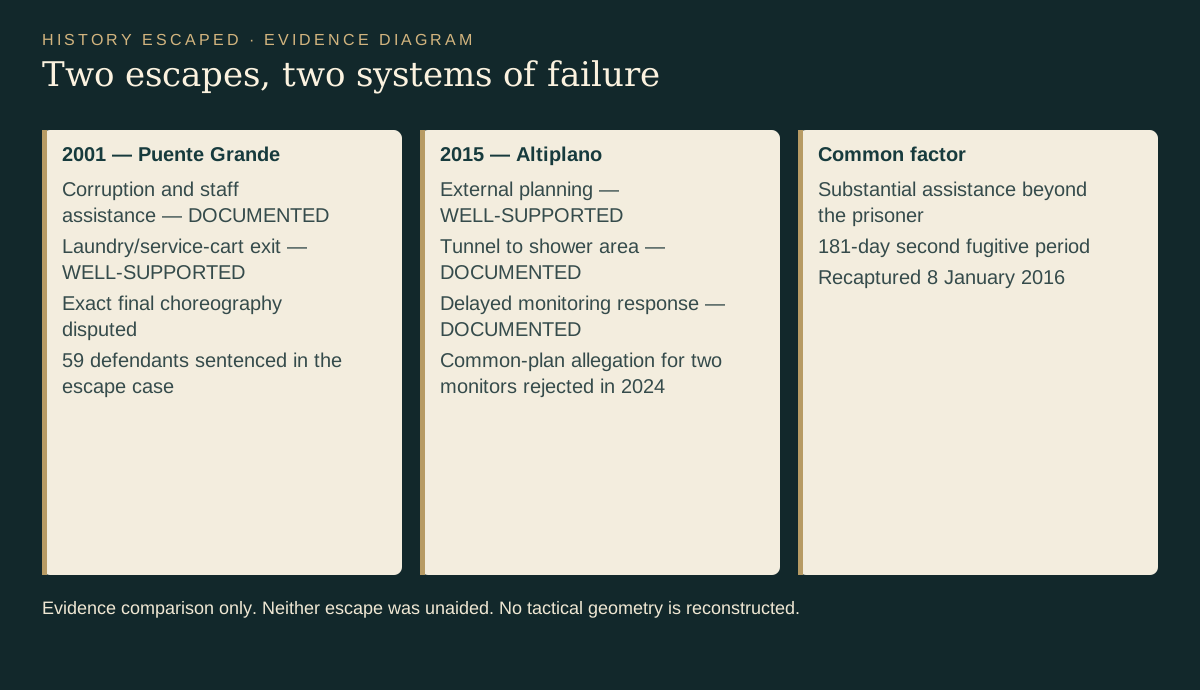
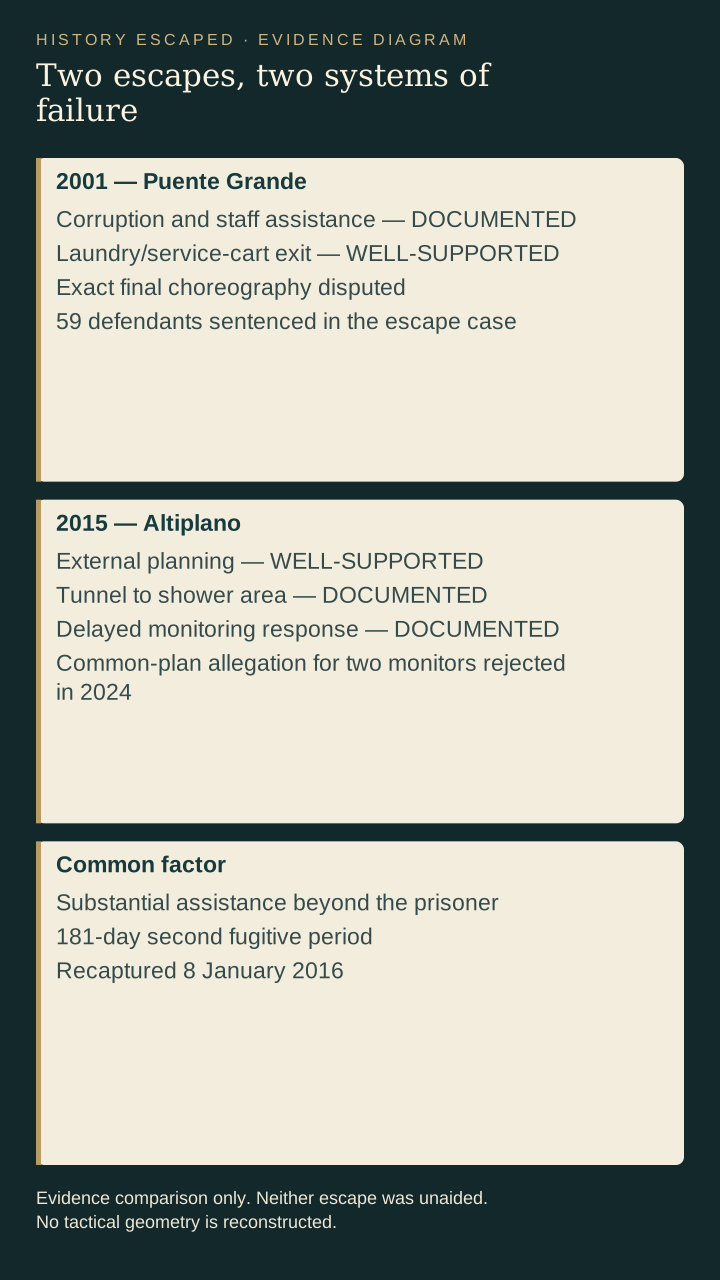
Evidence diagram
Two escapes, two systems of failure
Evidence comparison only. Neither escape was unaided. No tactical geometry is reconstructed.
- 01
Puente Grande’s controls had already been compromised
Before the 2001 escape, prison employees and oversight bodies had raised concerns about corruption, weakened discipline, and lax security. WELL-SUPPORTED. Sources: SRC-001, SRC-003.
- 02
Guzmán moved out of secure custody with staff assistance
Contemporary official reporting says he passed controlled doors and surveillance points with help from prison personnel. DOCUMENTED. Sources: SRC-001, SRC-002.
- 03
The 2001 exit mechanism remains partly disputed
A contemporary U.S. State Department report and later U.S. Justice Department summaries say Guzmán ultimately left concealed in a laundry or service vehicle. Later accounts claim he walked out more openly, sometimes in a guard uniform. The cart version is well supported but should not be presented as uniquely proven. WELL-SUPPORTED. Sources: SRC-001, SRC-015.
- 04
After recapture, a new escape network formed
Later U.S. court records describe planning meetings, financing, acquisition of nearby property, and use of a location-tracking watch to help align an underground route with Guzmán’s Altiplano cell. WELL-SUPPORTED. Sources: SRC-011.
- 05
A tunnel reached the shower area of the Altiplano cell
Mexican authorities documented an externally built tunnel terminating in the shower area, which was outside the camera’s direct view for privacy reasons. DOCUMENTED. Sources: SRC-006, SRC-008.
- 06
Guzmán disappeared from camera view
Official video review placed his final disappearance from view at approximately 20:52:15 on 11 July 2015. DOCUMENTED. Sources: SRC-006.
- 07
The alert was not immediate
Later judicial findings described a prolonged and imprudent delay in escalating the unusual loss of visual contact. The same judgment rejected the prosecution’s claim that two monitoring officers had joined a common escape plan. DOCUMENTED. Sources: SRC-012.
- 08
External accomplices moved Guzmán away from the prison
Mexican prosecutors reconstructed an organized chain of post-tunnel transport involving multiple outside collaborators. WELL-SUPPORTED. Sources: SRC-008, SRC-009.
Evidence comparison only. Neither escape was unaided. No tactical geometry is reconstructed.
Material evidence
Tools of Escape
The objects used in an escape reveal how a plan worked under constraint.
- 01Important but disputed detail
Laundry/service cart or vehicle
Central to the best-supported official reconstruction of the 2001 exit, but later accounts dispute whether concealment in the cart was the decisive final mechanism.
- 02Planning aid in the 2015 escape
Location-tracking watch
Later U.S. court records say a GPS-capable watch was provided to Guzmán to help the external team align its underground route with his cell.
Problem → response
Escape was a sequence of problems
Each response solved a practical obstacle while often creating the next one.
- 01→
Obstacle
Layered prison controls at Puente Grande
Electronic doors, cameras, motion sensors, and controlled circulation should have prevented an unaided exit.
Response
The escape depended on corruption and staff assistance rather than defeating every control independently.
- 02→
Obstacle
Continuous surveillance at Altiplano
Guzmán’s cell was monitored by video, but privacy areas were outside direct camera view.
Response
The tunnel terminated in the shower area, and later judicial findings identified a serious delay in escalating his disappearance from view.
- 03→
Obstacle
Maximum-security perimeter at Altiplano
A direct above-ground exit would have confronted multiple layers of prison security.
Response
An externally built underground route bypassed the perimeter; operational geometry beyond the historical fact is intentionally omitted.
The final accounting
Outcome
Successful prison escapes
Guzmán escaped from federal custody in both 2001 and 2015.
Durable escapes
Both periods of freedom ended in recapture.
Defendants sentenced in the 2001 escape case
The 2006 federal judgment imposed differentiated sentences according to participation.
Selected chronology
Selected chronology
Initial arrest
Guzmán was arrested in Mexico and later received a federal prison sentence.
Escape from Puente Grande
Guzmán escaped from the federal maximum-security prison in Jalisco with assistance from prison personnel.
Federal judgment in the 2001 escape case
A federal judge sentenced 59 defendants for varying roles in bribery and the escape.
Recaptured in Mazatlán
Mexican authorities recaptured Guzmán after more than thirteen years as a fugitive.
Escape from Altiplano
Guzmán escaped through a tunnel that reached the shower area of his cell.
Recaptured in Los Mochis
Mexican forces recaptured Guzmán after a six-month manhunt.
Extradited to the United States
Mexico extradited Guzmán to the United States exactly sixteen years after the Puente Grande escape.
Sentenced in U.S. federal court
Guzmán received life imprisonment plus 30 years after conviction on federal organized-crime and drug-trafficking charges.
Final judgment for two Altiplano monitoring officers
A federal judge found imprudent delay but rejected the prosecution’s claim that the two officers shared a common escape plan with Guzmán.
Evidence discipline
What the record supports
Status labels distinguish secure conclusions from uncertainty and rejected claims. Color is never the only signal.
WELL-SUPPORTED
Guzmán escaped Puente Grande hidden in a laundry cart or service vehicle.
A contemporaneous U.S. State Department report gives this mechanism, and the U.S. Justice Department later repeated it. Later accounts claim a more open walk-out, so the cart version should not be elevated to absolute certainty.
Sources: SRC-001, SRC-015DOCUMENTED
The 2001 escape was made possible by prison corruption and staff assistance.
Contemporary official reporting, warnings about Puente Grande, and the later federal convictions strongly establish extensive institutional assistance.
Sources: SRC-001, SRC-002, SRC-003WELL-SUPPORTED
The 2015 escape tunnel was externally planned and deliberately aligned with Guzmán’s cell.
Mexican prosecutorial reconstruction and later U.S. court records describe the property acquisition, planning network, construction effort, and location-tracking aid.
Sources: SRC-008, SRC-009, SRC-011DISPUTED
All prison personnel prosecuted after the 2015 escape knowingly joined a common conspiracy with Guzmán.
Prosecutors alleged intentional participation in several cases, but a 2024 final judgment concerning two monitoring officers explicitly rejected the claimed common plan while still finding criminally negligent delay.
Sources: SRC-010, SRC-012MYTH
The 2015 escape was simply the result of a camera blind spot.
The privacy blind spot mattered, but the escape also required a long-planned external construction and support network, accurate alignment with the cell, and a delayed institutional response.
Sources: SRC-006, SRC-008, SRC-011, SRC-012MYTH
The two escapes prove Guzmán personally defeated maximum-security prisons through improvisation.
Both escapes depended on substantial assistance. The 2001 case produced mass convictions for corruption and escape facilitation; the 2015 breakout involved an organized external planning network and institutional failures inside the prison.
Sources: SRC-002, SRC-008, SRC-011, SRC-012