On the evening of October 23, 2002, the second act of the musical Nord-Ost was underway at the Dubrovka Theater Center in Moscow when armed Chechen militants entered the building and took the audience, cast, crew and other people inside hostage. For nearly three days, more than nine hundred people were held under the threat of gunfire and explosives while the captors demanded that Russia end its war in Chechnya.
The crisis ended before dawn on October 26 when Russian security forces used an incapacitating chemical agent and stormed the building. The captors were killed and hundreds of people survived. The operation also produced a second catastrophe: large numbers of unconscious hostages were evacuated into a medical system that had not been adequately prepared for the agent used against them.
The official victim list associated with the crisis contains 130 names. A 2003 Moscow prosecutor’s resolution divided that total into five people killed by the captors and 125 people who died during the rescue or later in hospitals. Even that apparently simple count requires care, because the European Court of Human Rights later noted that several of the five people classified as killed by the captors had entered or tried to enter the theater after the siege began rather than being among the original audience and staff.
The chemical itself became one of the enduring controversies. Russian authorities eventually described it only as a special mixture based on fentanyl derivatives. A 2012 British laboratory study detected carfentanil and remifentanil in samples connected to three survivors, but the exact operational formula and proportions were never publicly disclosed.
Nine years after the siege, the European Court of Human Rights reached a deliberately divided conclusion. It found no violation of the right to life in the decision to resolve the crisis by force or to use the incapacitating agent. It did find violations because the rescue and medical evacuation were inadequately planned and implemented, and because the subsequent investigation into those failures was ineffective.
Dubrovka therefore cannot be reduced to a story of either a successful rescue or a failed one. Armed hostage-takers created an immediate risk of mass death, and the state ended that threat. The way it prepared for the medical consequences of its own intervention then cost many of the people it was trying to save.
At a Glance
- Crisis: October 23–26, 2002.
- Location: Dubrovka Theater Center, Moscow, during a performance of Nord-Ost.
- Best-supported official hostage count: 912, although contemporary and later sources range from roughly 800 to more than 900.
- Captors: Approximately 40 armed militants associated with the Chechen separatist movement; domestic investigators later recorded 40 killed in the assault.
- Demand: Withdrawal of Russian forces from Chechnya and negotiations over the conflict.
- Official victim list: 130 deaths connected to the crisis.
- Official 2003 breakdown: 5 killed by the captors; 125 died during the rescue or later in hospitals.
- Important denominator warning: At least some of the five people killed by the captors were not among the original theater hostages but entered or attempted to enter the building during the siege.
- Government evacuation submission to the ECHR: 778 people evacuated from the theater, including 101 dead bodies; 677 sent to hospitals.
- Chemical disclosure: Russian authorities described a mixture based on fentanyl derivatives; a later scientific study detected carfentanil and remifentanil in limited survivor samples.
- ECHR ruling: No Article 2 violation for the decision to storm or use the agent; Article 2 violations for inadequate rescue planning/implementation and an ineffective investigation.
A theater becomes a place of captivity
The Dubrovka Theater Center was hosting Nord-Ost, a popular Russian musical based on Veniamin Kaverin’s novel The Two Captains. The seizure began shortly after 9 p.m. on October 23, while the second act was in progress.
The European Court of Human Rights later described the attackers as more than forty armed members of the Chechen separatist movement. Domestic and memorial sources commonly use a rounded figure of forty. The group was led by Movsar Barayev, a young Chechen field commander whose name quickly became associated with the siege.
The captors carried firearms and explosives. The ECHR record states that eighteen suicide bombers were positioned among the hostages in the auditorium, while other militants occupied administrative areas. The building had also been prepared with explosives, creating a credible danger that any attempted assault could kill large numbers of people.
The primary political demand was an end to Russia’s military campaign in Chechnya. The captors called for Russian troops to withdraw and for political negotiations over the conflict. That demand placed the theater seizure within the Second Chechen War, but the hostages themselves were civilians, and their deliberate use as leverage cannot be reduced to an ordinary battlefield episode.
How many people were actually held?
The hostage total is one of the first places where later retellings become unstable. The ECHR judgment uses the cautious phrase “more than nine hundred,” while Human Rights Watch and contemporary press accounts used lower estimates based on information available during or immediately after the siege.
The strongest official domestic count located for this case is 912. That number appears in the Russian investigative record summarized by the ECHR and is also used by the Nord-Ost victims’ memorial organization, which says the group included roughly one hundred children.
The number should still be labeled as a best-supported official count rather than an infallible manifest total. The same victim-memory archive contains pages with different totals, and the ECHR itself avoided locking its factual introduction to an exact number.
This is not unusual in mass-hostage events. People can escape before a perimeter is secured, performers and employees may be in backstage spaces, rescuers and outsiders can later enter the building, and early lists may count ticketed attendees differently from the people physically present. The strongest specific count is 912, while “more than 900” remains an accurate general description.
Negotiation did happen
The eventual assault can make the preceding three days look as though force was the only activity under consideration. That is not what the record shows. Journalists, doctors, politicians and public figures entered the theater or communicated with the captors, and some hostages were released during these contacts, including children and foreign nationals.
Journalist Anna Politkovskaya became one of the most visible intermediaries. On October 25 she entered the building with physician Leonid Roshal and spent hours trying to negotiate. Contemporary reporting records that the captors agreed to accept food and water after the discussions.
Politkovskaya’s presence also matters for interpreting the wider conflict. She had reported extensively on abuses by Russian forces and on violence by Chechen armed groups. Her role at Dubrovka was not endorsement of the captors’ cause; it was an attempt to keep civilians alive.
The negotiations did not produce a political settlement. The captors remained committed to their demand for a Russian withdrawal from Chechnya, and the authorities were unwilling to concede it. Meanwhile, the physical danger inside the theater remained immediate.
The people killed before the rescue
The official 2003 prosecutor’s resolution identified five people as having been killed by the captors during the crisis. That figure is widely repeated as “five hostages shot by the terrorists,” but the ECHR record makes the category more complicated.
The Court summarized the domestic investigation as finding five such deaths, but noted that several of those people had not been among the original theater hostages. Olga Romanova and others identified in the file had entered or attempted to penetrate the building after the seizure. Another victim was an original hostage who was shot while resisting or attempting to escape, while a further person was wounded during the same incident and later died.
The distinction does not diminish any death; it prevents a category error. The 130-name official victim list is a list of people who died in connection with the Dubrovka crisis, not a perfectly clean statement that 130 people from the original hostage population died. That nuance is especially important because the remaining 125 deaths belong to a very different causal problem.
Why the state decided to use force
The ECHR later gave substantial weight to the danger created by the hostage-takers. The building was under armed control, explosives were present, and suicide bombers were positioned among the captives. The captors had demonstrated willingness to kill people, so the possibility of a detonation or mass execution was not merely abstract.
Russian authorities created a crisis headquarters under the Federal Security Service and prepared an armed intervention while negotiations continued. The Court ultimately concluded that the authorities had faced a real, serious and immediate threat to the hostages, treating the decision to storm as a choice made under extraordinary conditions rather than as an ordinary police operation.
That finding is central because the ECHR did not rule that using force was itself a violation of the right to life. Nor did it rule that the mere decision to use an incapacitating chemical agent was unlawful under Article 2. The legal failure came later in the sequence.
The unknown agent
Before the assault, Russian security forces introduced a chemical incapacitating agent into the theater. The intent was to disable the people controlling the explosives quickly enough for the assault teams to enter.
For years, the exact composition became the subject of speculation. The ECHR recorded a 2003 FSB response stating that the security forces had used a special mixture based on derivatives of fentanyl. The agency did not disclose more precise information about the formula or its effects, even to the domestic investigative authorities, citing national security.
That secrecy had consequences beyond historical curiosity. Doctors were treating hundreds of unconscious patients whose symptoms had been produced, at least in major part, by a substance whose precise composition had not been provided to them.
A later scientific investigation added important but limited evidence. In 2012, researchers from the United Kingdom’s Defence Science and Technology Laboratory analyzed clothing from two British survivors and urine from a third. They detected carfentanil and remifentanil, as well as a carfentanil metabolite, but could not determine the relative proportions of the two agents.
The responsible conclusion is therefore narrower than the common claim that “the gas was carfentanil.” Evidence shows that carfentanil and remifentanil were present in survivor samples, while the exact operational mixture and concentration used inside the theater remain undisclosed.
The assault
In the early hours of October 26, the chemical agent took effect and Russian special forces entered the theater. Later accounts often dwell on entry points, unit movements, explosives and the positions of the captors. The historical outcome, however, turns on the decision to use the incapacitating agent, the assault, and the medical response that followed.
The secure high-level sequence is enough. The agent incapacitated most people inside, security forces stormed the building, and domestic investigators later recorded forty hostage-takers killed. The immediate threat from the armed group ended while hundreds of hostages were unconscious or severely impaired and needed rapid medical support.
The operation’s decisive weakness lay there.
A rescue plan built for the wrong injuries
The ECHR examined the medical planning separately from the decision to storm. Before the assault, hospitals had been alerted and capacity had been expanded, while rescue workers and ambulances were positioned nearby. These preparations were real, and the Court did not pretend that the authorities had done nothing.
The problem was what the system had primarily prepared to treat. The Court found that much of the medical planning was oriented toward blast injuries, gunshot wounds and a possible structural collapse. The use of an incapacitating agent created a different mass-casualty problem involving hundreds of people whose breathing and consciousness could be impaired at once.
Medical personnel were not given timely, adequate information about what had been used. That gap was especially important because the authorities themselves controlled the choice of agent. Unlike the captors’ unpredictable actions inside the building, communication with doctors and organization of evacuation outside the theater were areas where the state had greater control.
The Court emphasized that the authorities had about two days to prepare and that a large number of injured people was entirely foreseeable.
Evacuation under pressure
The government later told the ECHR that rescue services evacuated 778 people from the theater, including 101 dead bodies. Of those evacuated alive or believed alive, 677 were sent to hospitals; twenty-one arrived in extremely grave states described as pre-agonal, agonal or clinical death.
The government said 656 were hospitalized and seven later died, while disputing a causal connection between the gas and some of those deaths. These figures do not map perfectly onto every other official casualty table, and the ECHR expressly noted that Russian agencies had used different counting methods and had not always recorded time and cause of death consistently.
The Court nevertheless identified serious operational failures. Unconscious people were moved in a chaotic environment, some were transported in ordinary city buses rather than vehicles able to provide continuous medical care, the allocation of patients among hospitals was poorly coordinated, and triage outside the theater was inadequate.
The positioning of unconscious casualties also mattered. Evidence before the Court indicated that some people were left on their backs, increasing the risk of airway obstruction or aspiration. These were part of the Court’s explanation for why an incapacitating operation intended to save lives produced so many deaths after the captors had already been neutralized.
What caused the deaths?
Russian domestic experts initially resisted attributing the mass deaths directly to the chemical agent. The official position emphasized a combination of stress, dehydration, immobility, existing illness, oxygen deprivation and other factors, treating the gas as one contributing element rather than the direct cause.
The ECHR found that broad explanation impossible to accept as a general account of the 125 rescue-related deaths. The Court did not claim that every individual died by exactly the same mechanism, and it recognized that pre-existing health, prolonged captivity and other factors could affect vulnerability.
But it concluded that the agent remained a primary cause of the deaths of a large number of victims. That wording matters: “the gas alone killed exactly 125 people” goes beyond the judgment, while “the gas had nothing important to do with the deaths” contradicts it.
The historical finding lies between those extremes. Chemical incapacitation was a major causal factor, interacting with hostages’ physical condition and with deficiencies in evacuation and treatment.
The official 130-name total
The Nord-Ost memorial organization reproduces the Moscow prosecutor’s October 2003 resolution. It states that five people were killed by the captors and that 125 people died during the rescue or at various times in hospitals afterward.
Together, those categories produce the familiar official total of 130. The total is useful for commemoration but difficult to use as a single hostage-outcome denominator because, as the ECHR pointed out, some of the five killed by the captors were people who entered or tried to enter the theater after the seizure had begun.
The count also changed in the first days and months after the operation as people died in hospitals and agencies reconciled conflicting lists. For this reason, the most accurate formulation is that 130 people on the official victim list died in connection with the crisis, rather than simply “130 of the original hostages died.”
The distinction is small numerically and important historically.
What the European Court actually ruled
The case Finogenov and Others v. Russia became final in June 2012. Its result is frequently simplified in opposite directions: one version says the Court vindicated the entire operation because the theater was dangerous, while another says the Court ruled the gas attack unlawful.
Neither is accurate. The Court made three separate findings under Article 2 of the European Convention on Human Rights.
First, it found no violation in the decision to resolve the hostage crisis by force and to use the incapacitating agent. The circumstances were exceptional, the danger to the hostages was immediate, and the Court accepted that the authorities had to act.
Second, it found a violation because the rescue operation was inadequately planned and conducted, particularly in relation to evacuation and medical assistance. Third, it found a violation because the investigation into alleged official negligence was not effective.
That final point included the continued nondisclosure of the precise chemical formula to investigators, missing or destroyed crisis-cell materials, important witnesses who were not questioned and conflicts of interest in parts of the investigative process. The Court stressed that its role was not to determine the individual criminal liability of particular officials; its judgment concerned the state’s obligations to protect life and investigate deaths effectively.
The investigation that could not answer its own central question
The nondisclosure of the agent was one of the ECHR’s sharpest concerns. The domestic investigative team asked for information about the substance, but the FSB provided only the broad fentanyl-derivative description.
The Court also noted that working papers from the crisis headquarters had been destroyed. That made it impossible to reconstruct basic questions such as when the chemical option was finally selected, how much time medical planners had to adjust, and why information reached medical services so late.
Many officials central to planning were not questioned. The result was a paradox: the state’s own investigation formally assessed whether the operation had been negligent without possessing or obtaining some of the information most necessary to make that assessment.
The ECHR therefore found the investigation neither sufficiently thorough nor independent.
The danger of hindsight
Dubrovka is particularly vulnerable to hindsight because the final casualty total is known and the captors did not survive to carry out their threats. That can create the illusion that officials in the early hours of October 26 had the same information available to historians years later.
They did not. The ECHR explicitly recognized the extreme danger inside the theater and rejected the proposition that the authorities were legally required to continue negotiations indefinitely or accept the risk of a mass detonation.
A fair reconstruction therefore cannot assume that doing nothing was a safe option. At the same time, uncertainty inside the theater did not make every failure outside it unavoidable. The state chose the incapacitating method, and once that choice was made, preparing doctors, transport, triage and hospitals for its predictable medical effects became part of the rescue itself.
This is the core distinction on which the Court’s judgment rests.
Memory after Dubrovka
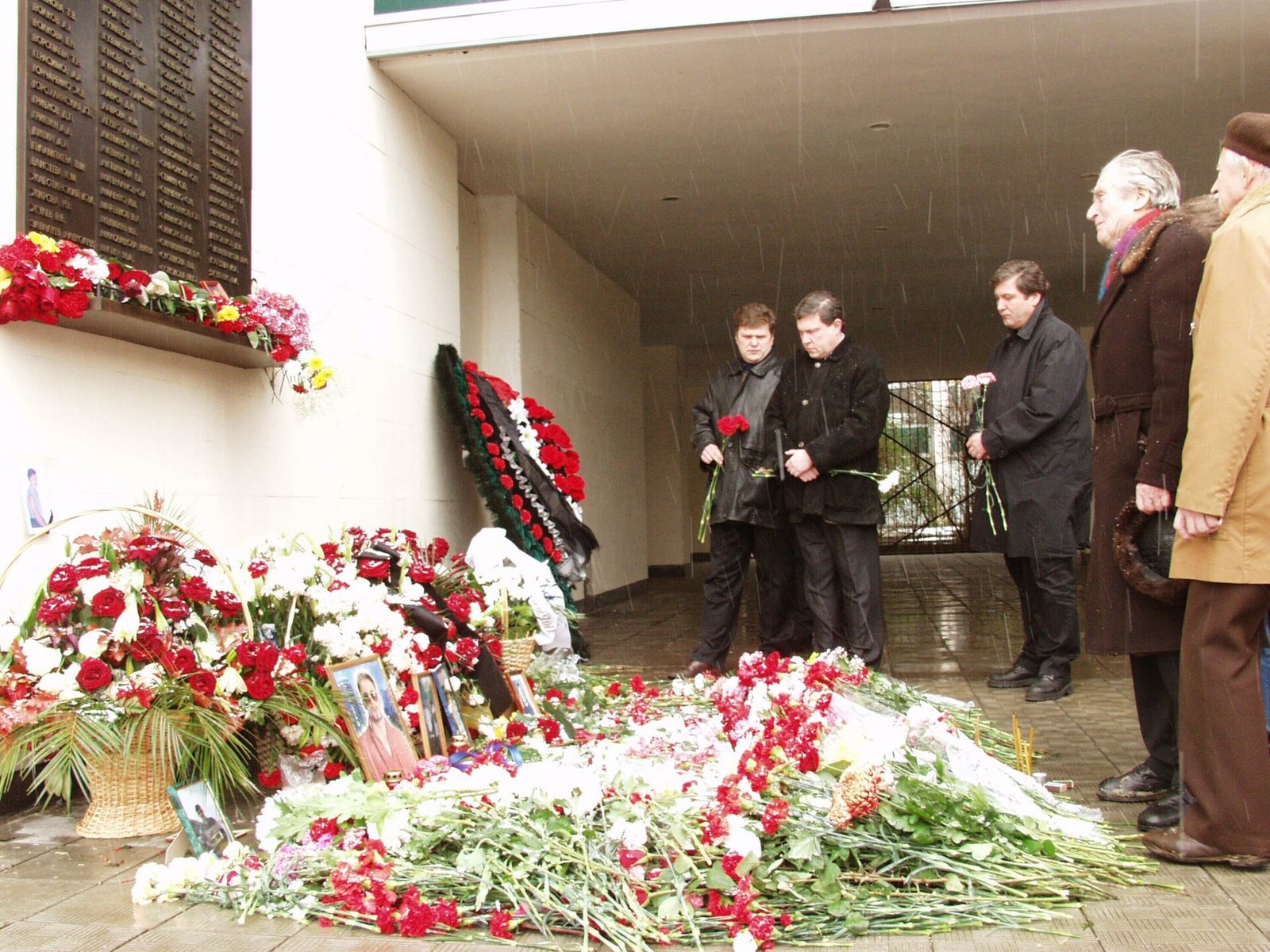
The theater remained a place of public mourning after the siege. A memorial was established outside, and anniversary ceremonies have continued to center photographs, names, flowers and candles rather than the machinery of the assault.
The victims’ organization has also continued to campaign over unanswered questions surrounding the operation and the long-term health of survivors. A year after the crisis, photographer Sergey Loktionov documented a memorial ceremony at Dubrovka, showing flowers and victim photographs rather than violence.
Such commemorations have kept public attention on the victims and on unresolved questions surrounding the operation. The scale of the loss and the continuing disputes are already visible in the names, testimony and competing counts.
What remains known and unknown
The broad sequence is secure. Armed Chechen separatist militants seized the Dubrovka Theater Center on October 23, 2002 and held more than nine hundred people while demanding the withdrawal of Russian troops from Chechnya. Negotiations continued for nearly three days, several people were killed by the captors, and some hostages were released.
Before dawn on October 26, Russian forces used an incapacitating fentanyl-based mixture and stormed the theater. Forty captors were recorded as killed, hundreds of people survived, and the official victim list ultimately reached 130.
Russian authorities never publicly disclosed the exact operational formula of the chemical agent. Later scientific testing found carfentanil and remifentanil in samples connected to three survivors. The ECHR found the agent a primary cause of many deaths while also identifying serious failures in evacuation, medical planning and subsequent investigation.
Those conclusions can coexist. The hostage-takers created the crisis and the immediate threat of mass killing. The state had a legitimate reason to intervene, and it also had a duty to organize the rescue in a way that protected the people it had just incapacitated.
Dubrovka’s tragedy lies in the space between those statements.
Evidence discipline
What the record supports
Status labels distinguish secure conclusions from uncertainty and rejected claims. Color is never the only signal.
WELL-SUPPORTED
Exactly 912 people were held hostage.
912 is the strongest domestic-investigation and victim-memorial count, but other contemporary and later sources give different totals. The ECHR uses the broader formulation more than 900.
Sources: SRC-001, SRC-004, SRC-009MYTH
Exactly 130 members of the original theater hostage population died.
The official victim list contains 130 names, but the ECHR records that several of the five people killed by captors had entered or attempted to enter the building after the seizure began.
Sources: SRC-001, SRC-003MYTH
The exact chemical formula used in the rescue is publicly known.
The FSB disclosed only that the mixture was based on fentanyl derivatives. The exact operational formula and proportions remained undisclosed.
Sources: SRC-001DOCUMENTED
Carfentanil and remifentanil were detected in samples connected to Dubrovka survivors.
A 2012 peer-reviewed laboratory study detected both agents in clothing/urine samples associated with three British survivors, while noting that their relative proportions could not be determined.
Sources: SRC-005DOCUMENTED
The chemical agent was a primary cause of many hostage deaths.
The ECHR explicitly concluded that the gas remained a primary cause of the deaths of a large number of victims, while allowing that individual vulnerability and other factors also contributed.
Sources: SRC-001MYTH
The ECHR ruled that the decision to storm the theater and use the gas violated Article 2.
The Court found no Article 2 violation in the decision to resolve the crisis by force and use the gas.
Sources: SRC-001, SRC-002MYTH
The ECHR found the rescue planning and medical evacuation adequate.
The Court found an Article 2 violation because of inadequate planning and conduct of the rescue operation, with particular concern over evacuation and medical assistance.
Sources: SRC-001, SRC-002MYTH
The post-operation investigation met Article 2 requirements.
The ECHR found a separate Article 2 violation because the investigation into alleged negligence was ineffective.
Sources: SRC-001, SRC-002MYTH
No meaningful negotiation occurred before the assault.
Journalists, doctors and public figures communicated with the captors; some hostages were released and food and water were accepted while negotiations continued.
Sources: SRC-001, SRC-006Evidence diagram
Counts, chemical evidence, and the ECHR ruling
Three evidence panels keep the hostage and victim denominators, toxicology findings, and split legal ruling distinct.
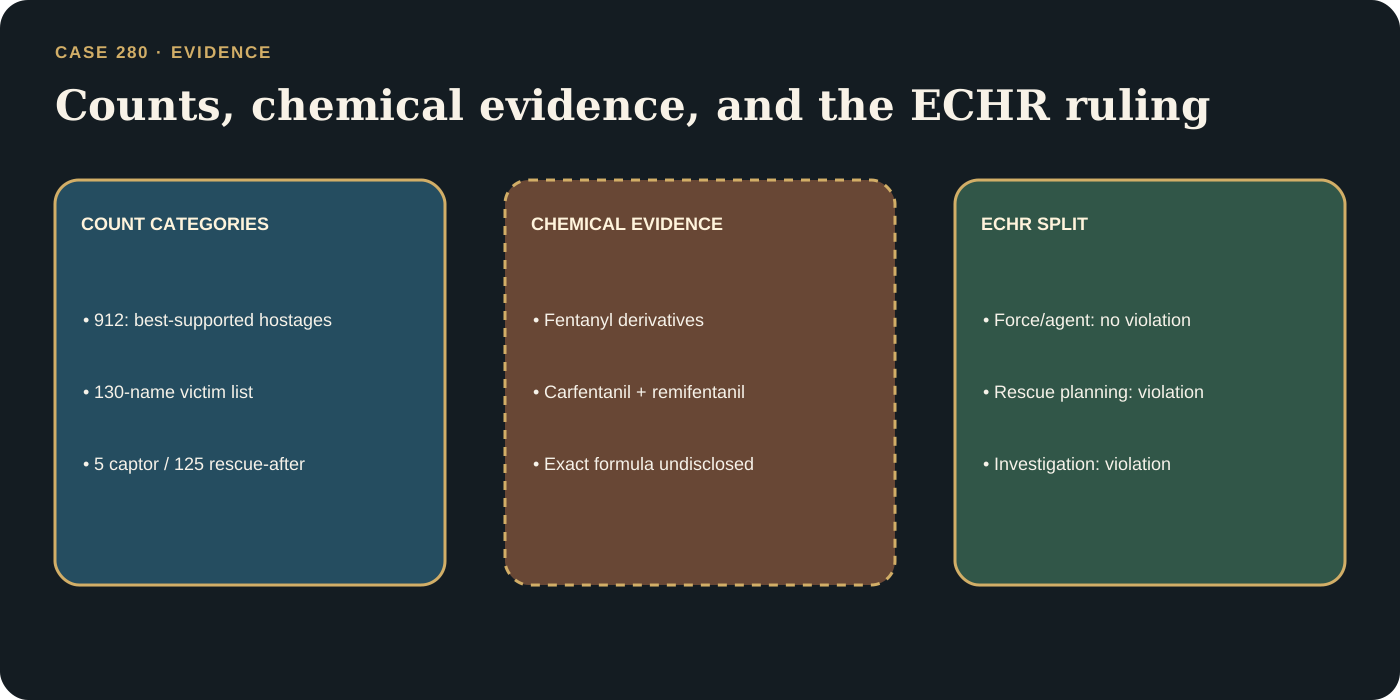
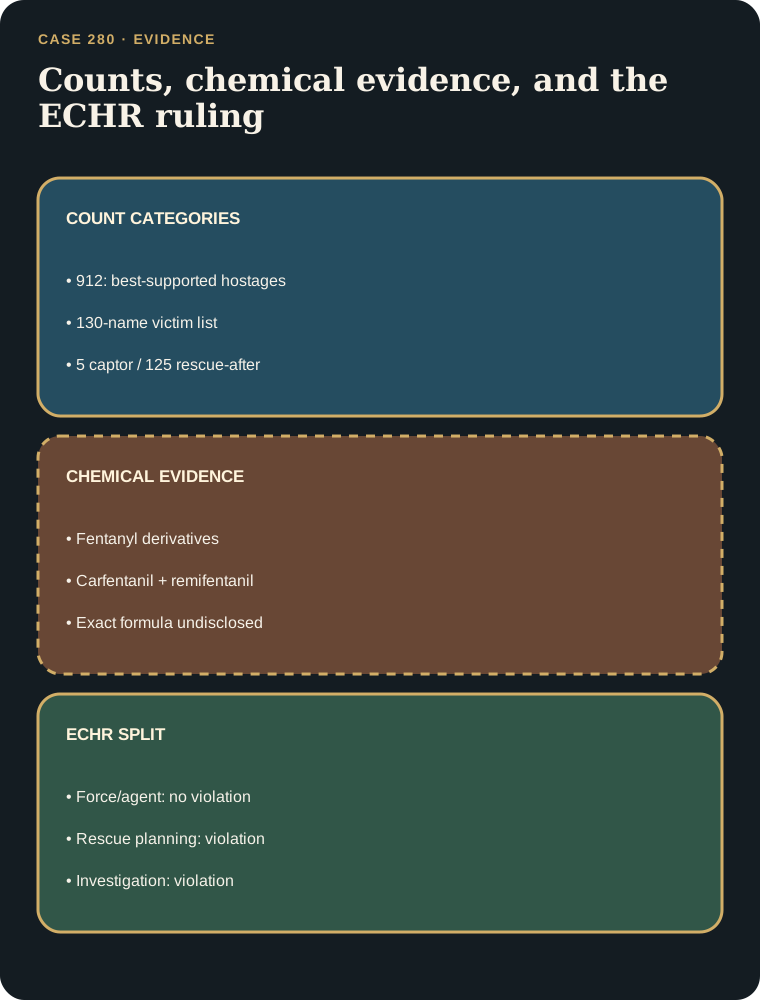
Three evidence panels keep the hostage and victim denominators, toxicology findings, and split legal ruling distinct.