
By March 1867, the authorities at Fremantle believed they had finally solved the problem of Joseph Bolitho Johns.
Johns—better known as Moondyne Joe—had already made a habit of escaping custody in Western Australia. Locks, work parties, irons, added sentences and recapture had not ended his attempts. After another escape and recapture in 1866, prison officials resorted to extraordinary measures. He was placed in a specially reinforced cell designed to make another breakout all but impossible.
Yet on the afternoon of 7 March 1867, Johns vanished again.
He did not smash through the reinforced cell. He escaped because the effort to keep him secure created a different opportunity outside it: a work site, a growing pile of broken stone, a soft limestone wall and guards who could no longer see exactly what he was doing.
Why Moondyne Joe was back in prison
Johns had been transported to Western Australia after receiving a ten-year sentence for larceny at Brecon in 1849. He arrived in Fremantle in 1853 and was granted a ticket of leave, allowing him to work under the colony’s convict system.
His later record was dominated by repeated trouble with the law and repeated attempts to get away from it. In 1861 he escaped from custody at Toodyay while facing a horse-stealing accusation. In 1865 he was sentenced to ten years’ penal servitude after being convicted of killing an ox with the intention of stealing it, a charge he continued to deny.
That sentence began another cycle of escape, recapture and additional punishment. He absconded from a work party in 1865. In 1866 he made another attempt, later escaped successfully, and was recaptured after trying with companions to make their way across the colony.
By the time he was returned to Fremantle, the authorities had reason to expect another attempt.
Material evidence
Tools of Escape
The objects used in an escape reveal how a plan worked under constraint.
- 01Wall breach
Stone-breaking tool
The heavy work implement issued for breaking stone also enabled Johns to attack the limestone perimeter wall while screened by the rock pile.
- 02Detection delay
Improvised dummy
The Perth Gazette reported that an upright hammer, wire, cap and clothing were arranged into a rough human figure left behind the stone pile.
The “escape-proof” solution
The response was a specially strengthened cell. Fremantle Prison’s history describes a cell reinforced to prevent Johns from attacking the structure around him. Contemporary reporting also emphasized how heavily secured he had become, with irons and severe restrictions on his movement.
The arrangement carried a cost. Johns’s health deteriorated, and medical advice called for more open air and exercise. Instead of allowing him to join an ordinary outside work party, officials kept him within the prison and set him to breaking stone in a yard near the perimeter wall.
That decision created the weakness he needed.
The stone he broke was supposed to be cleared away. It was not removed consistently. Day after day, broken rock accumulated around his work position. Eventually the pile became high enough to hide much of his body from the sentry on the wall and the warder supervising the yard.
Johns was still being watched—but the guards could no longer see what his hands were doing behind the stones.
Escape sequence
The breach was through the perimeter wall—not the reinforced cell
Stone-breaking work and a growing rubble pile screened the opening until it reached the adjoining property.
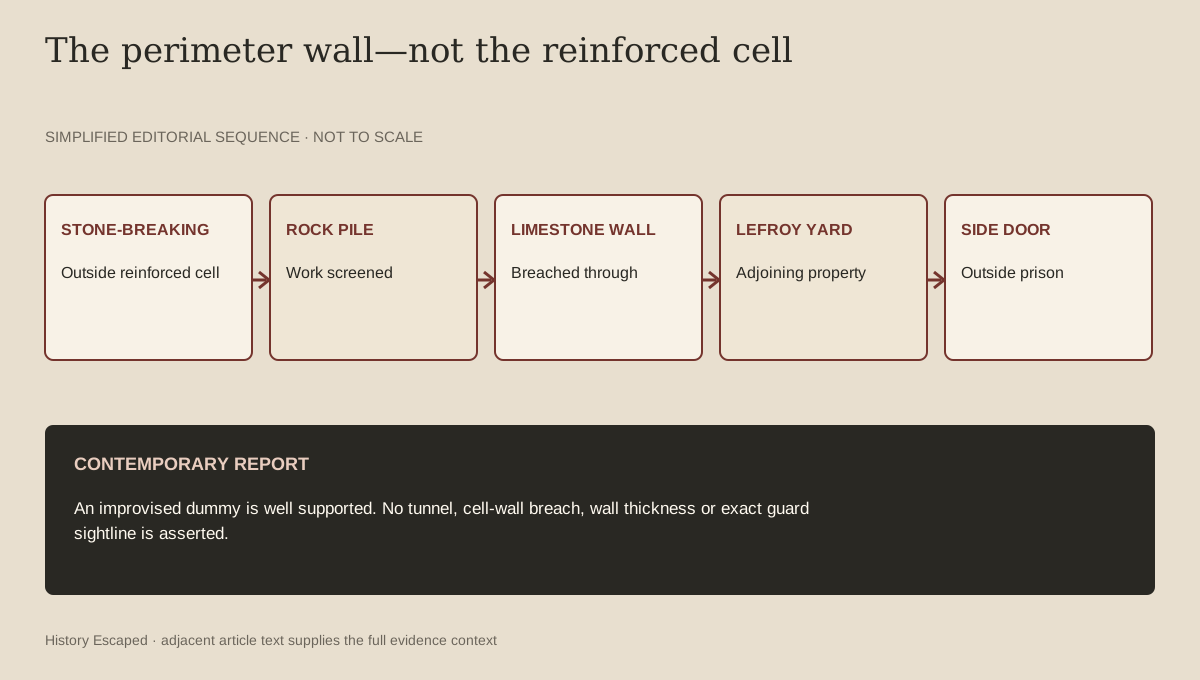
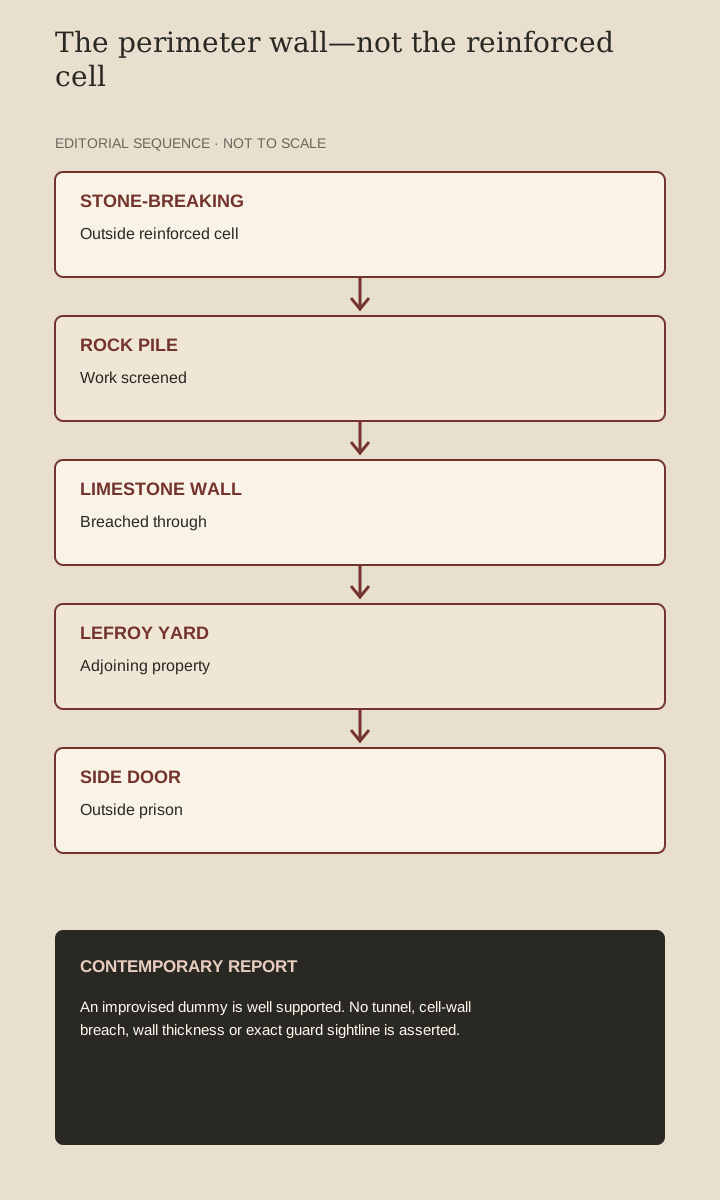
Simplified editorial sequence; not to scale. The 1867 escape breached the prison perimeter wall, not the reinforced cell.

The wall behind the rock pile
The prison perimeter was made of limestone. Fremantle Prison itself had been built largely from limestone quarried on the site, and the material could be worked with the same sort of heavy tool Johns had been given for breaking stone.
Behind the growing pile, he began attacking the wall.
A newspaper account published in The Perth Gazette and Western Australian Times on 15 March 1867—only eight days after the escape—reported that the job must have taken time. The stone pile gave Johns cover while he prepared a hole through the wall into the adjoining yard of a prison official’s residence.
The same contemporary report described another layer of deception. According to the paper, Johns stood his hammer upright, used wire to create the rough shape of shoulders and arms, and arranged his cap and clothing over the frame to resemble a man still working behind the stones.
That detail is sometimes treated as part of the legend of Moondyne Joe, but it is not a twentieth-century invention. It appeared in the press almost immediately after the breakout. The exact construction should still be described as a contemporary report rather than as an unquestionable forensic reconstruction, but the dummy belongs to the historical evidence for the escape.
7 March 1867
At about 5 p.m. on 7 March, prison staff discovered that Johns was gone.
He had opened a passage through the perimeter wall and emerged into the yard behind Superintendent Lefroy’s residence. Fremantle Prison’s historical account states that he then moved through an unlocked side door and escaped into the surrounding bush.
The reinforced cell had worked in the narrowest sense: Johns had not broken through it. The prison had failed in the larger one. The most secure prisoner in the establishment had been handed a heavy work tool beside a limestone boundary wall and gradually allowed to build the screen that concealed his escape work.
Evidence discipline
What the record supports
Status labels distinguish secure conclusions from uncertainty and rejected claims. Color is never the only signal.
DOCUMENTED
Johns escaped on 7 March 1867 by using an accumulated stone pile as concealment while breaching the prison perimeter wall.
A detailed newspaper report appeared eight days after the escape, and the core mechanism is independently preserved in Fremantle Prison’s institutional history.
Sources: SRC-001, SRC-002, SRC-003WELL-SUPPORTED
Governor Hampton promised that Johns would be forgiven if he escaped again.
The March 1867 Perth Gazette said Hampton was reported to have made the promise. Fremantle Prison’s historical account states that Henry Lefroy later confirmed Johns’s recollection during a 1871 review. The exact wording should still be treated cautiously rather than as a verbatim official transcript.
Sources: SRC-001, SRC-002WELL-SUPPORTED
Johns left a dummy behind the rock pile to delay discovery.
The dummy is described in detailed contemporary newspaper reporting from 15 March 1867, making it substantially stronger than a late legend even though every construction detail cannot be independently verified from the sources reviewed.
Sources: SRC-001MYTH
Johns broke directly out of his specially reinforced escape-proof cell in March 1867.
He was outside the reinforced cell for medically recommended exercise and stone-breaking work when he breached the prison perimeter wall. The 1867 success was an escape from the prison, not a breach of the reinforced cell itself.
Sources: SRC-001, SRC-002, SRC-005Did Governor Hampton really promise to free him?
One of the best-known parts of the story is Governor John Hampton’s supposed challenge to Johns: if he escaped again, he would be forgiven. There is real evidence behind the story, but it needs careful wording.
The Perth Gazette’s report in March 1867 said Hampton was said to have made such a promise when Johns was placed in the specially prepared cell. That is contemporary evidence, but it is still reported speech rather than an official written bargain.
Fremantle Prison’s later historical account adds that in 1871 Johns raised the promise while petitioning the authorities and that prison official Henry Lefroy was able to confirm his recollection. The promise is therefore better supported than many colorful stories attached to famous escapees. What should be avoided is presenting a polished quotation as though a verbatim official record of the conversation survives.
The other common simplification is easier to correct: Johns did not escape by breaking out of the reinforced cell. He was outside it on medically recommended exercise when he breached the prison wall.
Problem → response
Escape was a sequence of problems
Each response solved a practical obstacle while often creating the next one.
- 01→
Obstacle
Continuous guard supervision
A sentry and warder were positioned to watch Johns while he worked inside the prison grounds.
Response
He exploited the growing pile of stone, which eventually blocked the guards’ view of much of his body and concealed his work against the wall.
- 02→
Obstacle
Limestone perimeter wall
The prison boundary separated Johns from the adjoining residence yard and the outside.
Response
He used the stone-breaking work tool to create a passage through the limestone from behind the rock pile.
- 03→
Obstacle
Risk of immediate discovery
His absence could have been detected as soon as guards approached the work position closely.
Response
A contemporary newspaper reported that he left an improvised dummy dressed with his cap and clothing to resemble him from a distance.
Nearly two years free
The search that followed did not bring Johns back quickly. He remained at large for almost two years.
His freedom ended in February 1869 at Houghton’s vineyard in the Swan Valley. Johns broke into the property and hid in its cellars. By bad luck for him, police were nearby after helping recover the body of a drowned man. When the vineyard owner later brought the officers back to the cellar area, Johns tried to flee and was captured.
He was returned to custody and received additional punishment. His story, however, did not end with an ever-growing sentence. In 1871 the authorities granted him a ticket of leave, and in June 1873 he received his certificate of freedom.
Selected chronology
Selected chronology
Recaptured after an earlier escape
Johns and two companions were recaptured east of Perth after a previous 1866 escape, helping prompt the unusually severe confinement that preceded the famous breakout.
Escape from Fremantle Prison
Johns breached the limestone perimeter wall from behind an accumulated stone pile and escaped through the adjoining residence yard.
Recaptured at Houghton’s vineyard
After nearly two years at large, Johns was captured at Houghton’s vineyard in the Swan Valley when police happened to be nearby.
Sent to the Vasse district on ticket of leave
After further review of his case, Johns was granted a ticket of leave and sent toward the Vasse district.
Certificate of freedom issued
Johns’s certificate of freedom was approved and issued, bringing the long cycle of convict punishment, escape and conditional release to a close.
Why the escape lasted in memory
Moondyne Joe became famous not because he was one of Australia’s most violent bushrangers, but because he repeatedly made the penal authorities look vulnerable. The Australian Dictionary of Biography notes that later popular culture transformed him into a more romantic figure than the historical record warrants, including through John Boyle O’Reilly’s fictional treatment of “Moondyne.”
The 1867 escape needs little embellishment.
It worked because prison officials concentrated on the obvious threat—Johns breaking out of his cell—while overlooking the new conditions created by his exercise routine. A pile of rubble became a screen. A stone-breaking tool became a wall-breaking tool. The perimeter itself became the weak point.
The result was the escape that fixed Moondyne Joe in Western Australian memory: not a spectacular assault on an impregnable cell, but a patient exploitation of routine, material and human oversight.