
The Hayden escape was a family operation from the beginning. On the evening of 28 September 1844, Lewis Hayden, Harriet Bell Hayden, and Harriet’s young son Joseph left the Lexington, Kentucky, area in a hired carriage. By the following morning they had crossed the Ohio River.
The first stage can be reconstructed unusually well because two different kinds of evidence survive. Calvin Fairbank, one of the abolitionists involved, described the journey in a memoir published decades later. Delia Webster’s 1845 account of her Kentucky trial preserves testimony taken only weeks after the escape. Together they establish a carriage journey through northern Kentucky, a river crossing, and the family’s movement into Ohio. Beyond the Ripley area, the route becomes less precise.
At a Glance
- Date: Night of 28–29 September 1844
- Freedom seekers: Lewis Hayden, Harriet Bell Hayden, and Harriet’s son Joseph
- Starting point: Lexington, Kentucky
- First transport: Hired hack or carriage
- Known helpers: Calvin Fairbank and Delia Webster
- First major boundary: Ohio River into a free state
- Longer-term destination: Canada West
- Later home: Boston, where the Haydens became major abolitionist organizers
Why Family Separation Mattered
Lewis Hayden already knew what slavery could do to a family before he married Harriet. National Park Service scholarship records that his first wife, Esther Harvey, and their child were sold to Kentucky politician Henry Clay and then sold again. Lewis never saw them afterward.
He married Harriet Bell in 1842. Harriet already had a young son, Joseph, often called Jo. By 1844 the three faced the possibility that slavery could separate this family as well.
Their departure is therefore better understood as family self-emancipation than as the adventure of a single unusually daring fugitive. Every decision had to work for two adults and a child, and the risks of capture included more than individual punishment. Recapture could return all three to a system in which sale remained a constant threat.

Calvin Fairbank and Delia Webster
Calvin Fairbank was an antislavery Methodist who had been studying at Oberlin and learning routes and contacts in the Ohio River Valley. In his later memoir, he remembered meeting Lewis in Lexington and discussing his determination to be free. The dialogue Fairbank supplied was written long after the event, so it should not be treated as a stenographic record, but his involvement in arranging the escape is not in doubt.
Delia Webster, a Vermont-born teacher, was also in Lexington. Modern histories from the National Park Service and Dickinson College identify both Fairbank and Webster as people who helped the Haydens escape.
The near-contemporary evidence makes Webster’s role more complicated than that summary suggests. She unquestionably traveled in the hack, but during her December 1844 trial she denied knowingly participating in a plan to assist Lewis, Harriet, and Joseph. Fairbank’s immediate post-trial affidavit likewise claimed that she had been innocent of knowingly aiding them. Decades later, his memoir described her more directly as part of the party.
The safest historical distinction is between presence and intent. Webster’s presence on the journey is secure. Exactly what she knew before and during every stage was contested almost immediately.
The Hack Leaves Lexington
Fairbank dated the start precisely: Saturday, 28 September 1844, at eight in the evening. He described leaving Lexington “in company with Miss Webster” and the Hayden family in a hack with a hired driver.
The trial record independently supports the essential structure. Parker Craig testified that Fairbank hired a hack from him on 28 September and said it was intended for a trip toward Maysville. Other witnesses testified that Harriet disappeared that weekend and that men were sent into Ohio to look for “Lewis, Harriet and Jo.”
This evidence is important because one modern National Park Service biography of Harriet compresses the Kentucky-to-Ohio trip as travel by train. The contemporary trial record and Fairbank’s detailed narrative instead point clearly to a carriage for this first leg.
Concealment and Changing Appearances
The carriage offered more than speed. It created a social setting in which the family could be presented differently according to the people they encountered.
Fairbank later recalled that Lewis and Harriet sometimes acted as servants. At other moments, he said, they passed as a white lady and gentleman, using veils and cloaks. Joseph could be placed beneath the seat when exposure seemed especially dangerous.
The details show how flexible the deception had to be. There was no single costume that solved the journey from Lexington to Ohio. The party adjusted the family’s apparent status to the situation.
A later Boston city history adds a more famous detail: that Lewis and Harriet rubbed flour on their faces to appear white. That may preserve another strand of oral tradition, but it does not appear in Fairbank’s detailed memoir passage. Veils, cloaks, changing social roles, and Joseph beneath the seat form the stronger evidentiary core.
Millersburg and the Road North
Fairbank’s memoir places the party at Millersburg, about twenty-four miles from Lexington, where one of the horses died. He remembered a delay of roughly an hour and a half, refreshments, and a change of horses before the journey resumed.
That level of detail comes from a memoir published in 1890, forty-six years after the escape. The stop is plausible and fits the route, but its precise duration and the colorful social maneuvering Fairbank described cannot be independently checked against the trial evidence.
What the trial does confirm is movement toward Maysville. Witnesses discussed the hack’s tracks, travel on the Maysville road, and the party’s appearance to people who encountered the carriage.
Their next objective was the Ohio River.
Crossing into Ohio
Fairbank remembered crossing the river at about nine o’clock on the morning of 29 September.
That crossing changed the legal geography but did not end the danger. Ohio was a free state, yet federal law and interstate cooperation could still expose people who had escaped slavery to seizure and return. The family needed distance from Kentucky, trusted assistance, and ultimately a jurisdiction outside the United States.
Fairbank wrote that after entering Ohio the party changed teams, passed through Ripley, and then went to a place associated with a man named Hopkins. There he left the Hayden family.
That moment is an important corrective to a common simplified version of the story. Fairbank and Webster did not personally drive the family all the way to Canada. Fairbank’s own account has the white abolitionists turning back while the Haydens continued through a wider network.
Where the Route Becomes Less Certain
The first leg can be drawn with reasonable confidence: Lexington, Millersburg, the Ohio River, Ripley, and the Hopkins connection.
After that, the sources become less exact. National Park Service research states that from Ohio the Haydens escaped into Canada West, the British North American province that included present-day southern Ontario. Other modern summaries mention Detroit in different positions in the family’s later movements.
The broad outcome is secure. The family reached Canada, beyond the direct reach of American slave law. A detailed map showing a chain of precise houses, stations, and border crossings after the Ripley area would claim more than the evidence supports.
Canada was also not the end of their story. The Haydens chose to return to the United States and moved toward the center of antislavery activity.
By early 1846 they were in Boston.
The Price Paid by the Helpers
Fairbank and Webster did not return from the operation without consequences.
Kentucky authorities arrested them. Webster was tried in December 1844 on a charge of aiding enslaved people to escape and was convicted. Her own published account of the case is openly defensive, making it useful both as evidence and as an example of how immediately contested the story became.
Fairbank received a much longer sentence and spent more than four years in prison before a pardon in 1849. His later memoir credits Lewis Hayden, by then active in Boston, with helping build support for his release.
The relationship had reversed. Fairbank had helped the Hayden family reach the road to freedom; Hayden, once free, was now in a position to organize on behalf of Fairbank.
From Freedom Seekers to Boston Organizers
The Haydens settled in Boston’s Black community on Beacon Hill, where Lewis established a clothing business. Their home eventually stood at what is now 66 Phillips Street.
After passage of the Fugitive Slave Act of 1850, Boston’s Vigilance Committee organized to protect and assist people fleeing slavery. Lewis served on its executive committee, and surviving account books repeatedly record payments connected to his work: boarding freedom seekers, providing clothes, arranging carriages, and paying fares farther north.
Those records tend to put Lewis’s name on the financial transactions. National Park Service interpretation stresses that this does not mean Harriet was peripheral. Historian Stephen Kantrowitz argues that while Lewis moved around the city on committee business and ran the clothing trade, Harriet almost certainly handled much of the daily management of the household and its many boarders.
Their roles were complementary. The house worked because people were fed, sheltered, hidden, clothed, moved, and protected.
The Hayden House
The surviving house became one of Boston’s best-documented Underground Railroad sites.
In 1850, William and Ellen Craft stayed with the Haydens while agents sought to return them to slavery in Georgia. Lewis and others organized armed resistance to their seizure. The Crafts escaped Boston and eventually went to Britain.
The house also appears in the recollections of abolitionists who saw the traffic of freedom seekers firsthand. Austin Bearse remembered taking Harriet Beecher Stowe there in 1853 and finding thirteen recently escaped people gathered in one room.
Lewis’s activism extended beyond shelter. He played a leading role in the February 1851 courthouse rescue of Shadrach Minkins and joined the failed attempt to rescue Anthony Burns in 1854. During the Civil War, he helped recruit Black soldiers, including men for the 54th Massachusetts Infantry, and later served in the Massachusetts legislature.
Harriet’s work continued through abolition, community organization, and women’s rights. After her death, part of her estate supported a scholarship for Black students at Harvard Medical School.
Why the Escape Matters
The 1844 escape is remarkable on its own. A family with a young child crossed slaveholding Kentucky by carriage, survived inspection and delay, crossed the Ohio River, and continued until United States slave law no longer controlled their freedom.
Its larger importance comes from what the Haydens did with that freedom. They became part of the infrastructure that allowed other people to make similar journeys. Their Boston home was not simply a memorial to a successful escape; it was an operating place of refuge.
That later history also changes how the first journey should be remembered. Fairbank and Webster mattered, but the Haydens were not passive cargo carried to freedom by white abolitionists. They made the decision to leave, kept their family together, continued beyond the point where Fairbank turned back, and later used their own household, money, political influence, and personal risk to help others escape.
The carriage ride of September 1844 was the beginning of that work, not its conclusion.
Documentary reconstruction
Secure early movement and a generalized route north
A case-local visual focused on the historical question that the surviving evidence can answer.
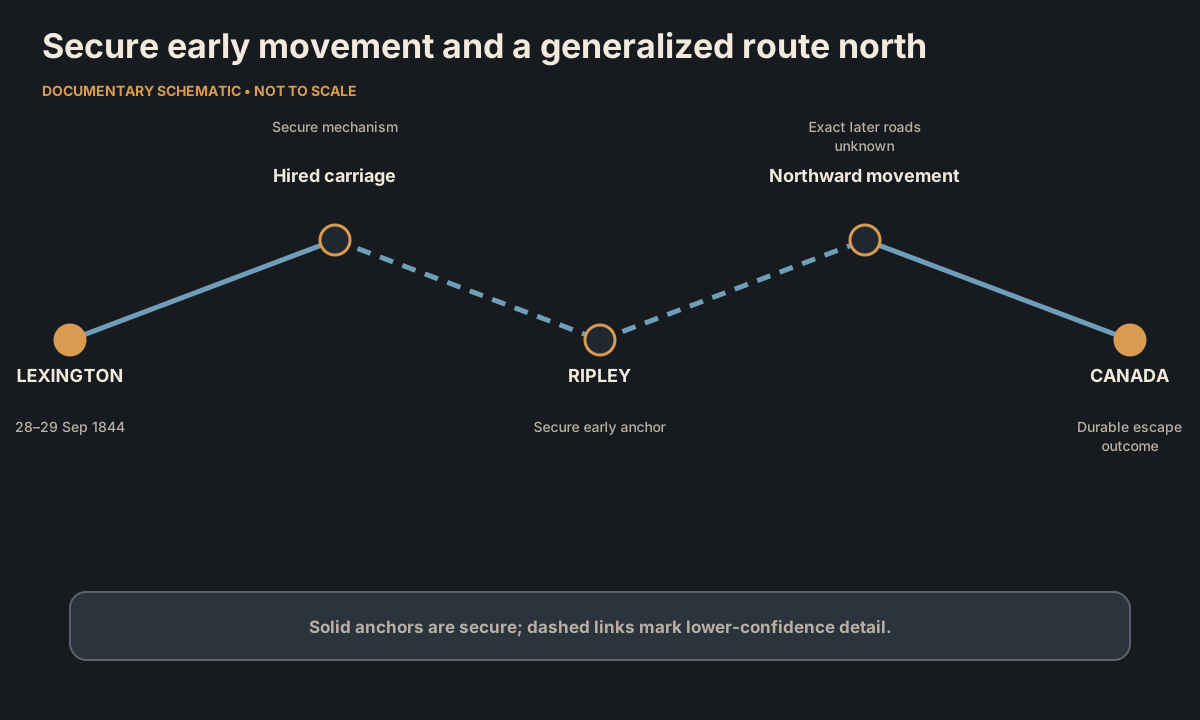
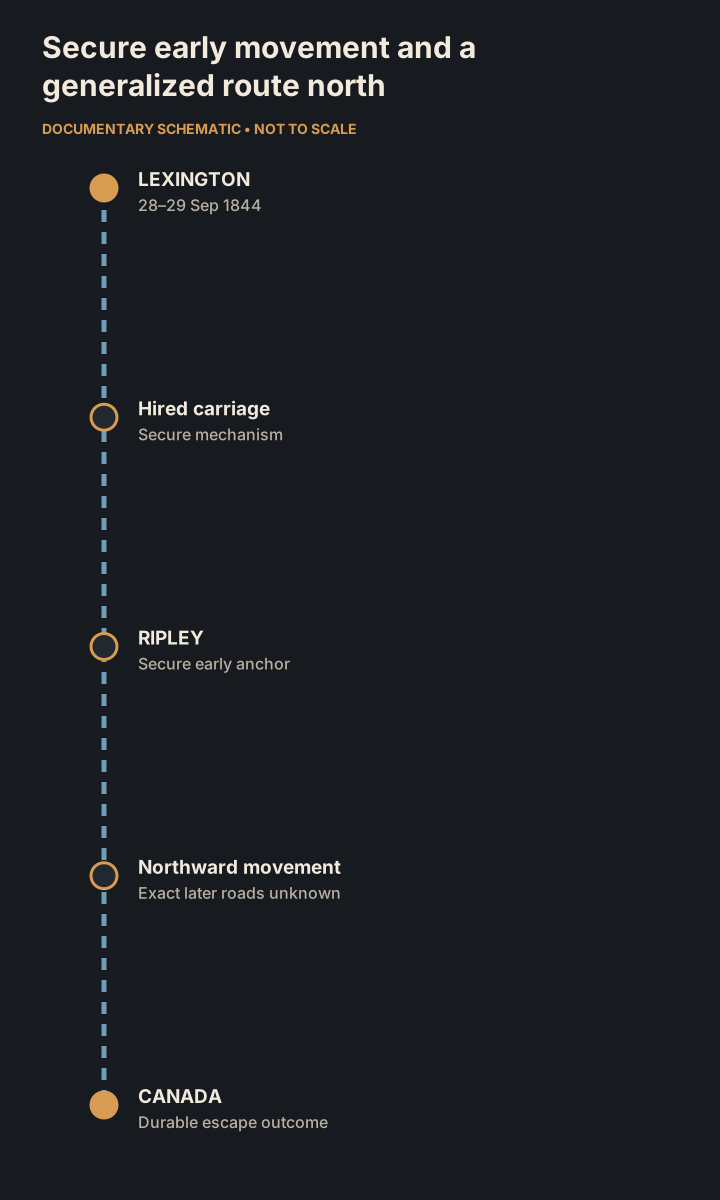
Simplified documentary reconstruction; not to scale. Evidence qualifications are written directly into the visual and explained in the adjacent text.
Evidence discipline
What the record supports
Status labels distinguish secure conclusions from uncertainty and rejected claims. Color is never the only signal.
WELL-SUPPORTED
Lewis, Harriet, and Joseph left Kentucky in a hired hack/carriage on 28 September 1844.
Fairbank’s 1890 memoir gives the date and carriage sequence. The 1844 Webster trial record independently records Fairbank hiring a hack on 28 September and witnesses searching for Lewis, Harriet, and Jo after their disappearance.
Sources: SRC-001, SRC-002MYTH
The family traveled by train from Kentucky to Ohio.
One current NPS Harriet Hayden biography uses that compressed wording, but the much stronger near-contemporary trial evidence and Fairbank’s detailed account establish a hired hack/carriage for the Kentucky-to-Ohio leg.
Sources: SRC-001, SRC-002, SRC-004WELL-SUPPORTED
Joseph was hidden beneath the carriage seat during dangerous portions of the journey.
Fairbank’s retrospective memoir states this directly, and later institutional histories repeat the detail. It is not independently recorded in the 1844 courtroom testimony used here.
Sources: SRC-001, SRC-009LATER CLAIM
Lewis and Harriet rubbed flour on their faces to pass as white.
Boston’s modern institutional history repeats a flour disguise, but Fairbank’s detailed memoir instead says the adults alternated between appearing as servants and as a veiled and cloaked white lady and gentleman. Flour should not be made part of the secure core without an earlier source.
Sources: SRC-001, SRC-009DISPUTED
Delia Webster’s knowing participation in the full escape plan is uncomplicated and directly documented.
Her physical presence in the hack is secure, and modern NPS and university histories identify her as a helper. During and immediately after her 1844 trial, however, Webster denied knowingly assisting the family and Fairbank swore an affidavit declaring her innocent of that charge. His much later memoir described her as part of the escape party.
Sources: SRC-001, SRC-002, SRC-003, SRC-007MYTH
Fairbank and Webster personally escorted the Haydens all the way to Canada.
Fairbank said he left the family at a safe location associated with Hopkins near Ripley, Ohio, then returned toward Kentucky with Webster. NPS research places the family’s onward journey from Ohio into Canada West separately.
Sources: SRC-001, SRC-003UNKNOWN
The exact station-by-station route from Ohio to Canada is securely known.
Institutional histories agree that the Haydens reached Canada West, but modern summaries differ in how they sequence Detroit and Canada, and the sources used here do not justify a precise route after Fairbank separated from the family.
Sources: SRC-003, SRC-005, SRC-007DOCUMENTED
The Haydens later became major participants in Boston’s Underground Railroad network.
National Park Service interpretation is grounded in surviving Boston Vigilance Committee account books documenting payments to Lewis Hayden for boarding, clothing, carriage transport, and fares for freedom seekers; historical analysis also identifies Harriet’s day-to-day role in the household.
Sources: SRC-005, SRC-006