
On 8 December 1944, Dutch resistance members walked into the Huis van Bewaring in Leeuwarden under a false story that was designed to look routine. They were armed, but the operation had been planned around one overriding requirement: the nearby German occupation forces must not hear a gun battle and realize that the prison was under attack.
Roughly fifty minutes later, the resistance was gone. No shot had been fired. Fifty prisoners had been removed from the prison complex, and a cooperating assistant guard had been taken with them, producing the famous total of fifty-one people extracted.
At a Glance
- Date: 8 December 1944
- Place: Huis van Bewaring, Blokhuispoort, Leeuwarden
- Country: German-occupied Netherlands
- Resistance force: Frisian Knokploegen and supporting underground personnel
- Operation leader: Piet Oberman, resistance name Piet Kramer
- Preselected prisoner list: 39
- Prisoners actually liberated: 50
- Cooperating guard extracted: 1
- Total people removed: 51
- Gunfire: None
- Immediate recaptures in the German search: None recorded by the Fries Verzetsmuseum
- Reprisals: None followed
- Core method: Deception, controlled entry, rapid release, and prearranged dispersal
Why the prison mattered
By late 1944, the resistance in Friesland faced a familiar danger of underground warfare: one arrest could lead to many more. The German occupation apparatus and its Dutch collaborators were arresting suspected resistance members, couriers, organizers, and police contacts. Once imprisoned, detainees could be subjected to severe interrogation. The danger was not only to the person in the cell. A prisoner who revealed names, addresses, or organizational connections could expose an entire network.
The Fries Verzetsmuseum identifies that threat as the central reason the Frisian Knokploegen began planning a prison raid. The KP was the armed side of the resistance, accustomed to operations such as raids for ration cards, documents, and other resources needed to sustain people in hiding. By October 1944, planning had begun for something more difficult: entering the Leeuwarden prison complex and removing selected detainees before interrogation or execution could destroy part of the underground.
A selected list
The plan was never simply "open every cell." Resistance leaders discussed which prisoners were most urgent to remove. The Fries Verzetsmuseum's modern historical presentation says they settled on a list of thirty-nine detainees.
Those choices reflected risk. Some prisoners knew a great deal about clandestine organizations, and the resistance feared that prolonged interrogation could expose many others. Others faced a serious possibility of execution.
The selection also reflected practical limits. Every additional prisoner increased the problem of moving people through occupied Leeuwarden and finding secure places for them afterward. The raid would succeed only if liberation could be followed immediately by disappearance.
Two men posed an additional complication. Jurjen Dreeuws and Klaas Leijenaar, both important to the resistance, were not being held in the same section as most of the selected prisoners. They were inside the adjacent Bijzondere Strafgevangenis and would have to be brought into the controlled part of the complex before they could be taken out.
Piet Oberman
The operation was led by Piet Oberman, a timber merchant from Dokkum who used the resistance name Piet Kramer. Oberman had risen rapidly within the Frisian armed resistance during 1944. By the time of the prison operation he was one of its key leaders.
Later memory made Oberman the public face of the raid, especially after the event was adapted for film. That reputation should not turn the operation into the work of one mastermind. Planning and execution depended on multiple KP members, resistance communications personnel, an evacuation network, and prison employees willing to cooperate or at least not obstruct the plan. The most important feature of the operation was collective coordination.
The problem with using force
The resistance possessed weapons. That did not mean it wanted to use them.
German and collaborationist forces were located close enough to the Blokhuispoort that sustained gunfire could bring an immediate response. An armed fight at the gate or inside the prison might trap both raiders and prisoners before anyone could reach hiding places.
The plan therefore treated firearms as an emergency reserve rather than as the main method of entry. A covering group remained prepared for the possibility that the operation might collapse into violence. Inside, however, the entry team would depend on disguise, paperwork, timing, and surprise. The objective was to make the prison admit its own attackers.
A routine-looking delivery
The entry story was built around an ordinary custodial event: new prisoners arriving under police escort. Resistance members posed as officers bringing three supposed black-market detainees. False imprisonment paperwork supported the story.
The deception extended beyond clothing and paper. A telephone message created the expectation that the detainees would soon arrive. When prison staff attempted to verify that information, the resistance had arranged for the confirmation to reinforce rather than expose the story.
The exact communications mechanics are historically documented, but the essential point is simpler. The prison did not open because resistance members defeated its entrance in combat. It opened because, for a few crucial minutes, the people at the gate believed they were admitting a legitimate prisoner transfer.
Inside the gate
Once the small entry group was inside, the balance changed quickly. Guards and administrative staff were overpowered. The outer door was opened to additional KP members who had been waiting nearby.
The use of coercion was real. This was an armed seizure of the facility, not a consensual handover. Staff were confined while resistance members took control of the areas necessary to reach prisoners.
But the plan continued to work as intended: no one fired. That silence mattered more than speed for its own sake. The longer the occupation authorities remained unaware that anything unusual was happening, the more time the resistance had to move prisoners out of the prison and into the city.
More than thirty-nine
The original list began to expand once the raid was underway. Some prisoners who had not been selected were released. Historical accounts describe confusion about names and personal appeals to take additional detainees.
The situation changed again when new prisoners arrived during the operation. Rather than allow them to enter the custody of an occupied prison, the raiders freed them as well.
The plan was therefore disciplined without being mechanically fixed. The thirty-nine-person list had defined the priority target, but events inside the prison changed the final total. By the end of the operation, fifty prisoners had been taken out.
Dreeuws and Leijenaar
The adjacent prison section still held Dreeuws and Leijenaar. The raiders used the authority they appeared to control inside the Huis van Bewaring to have the two men brought over under the pretext that the Sicherheitsdienst wanted them for questioning.
For the prisoners, that summons could hardly have sounded reassuring. Interrogation by the SD could mean abuse, torture, or worse.
Once they reached the controlled section, the deception reversed meaning. They had not been called out for another interrogation. They were being removed from captivity.
Their extraction demonstrates why the operation cannot be understood simply as a gate trick. Entry was only the first deception. The resistance then used temporary control of the prison's own routines to reach people who otherwise remained beyond the immediate cellblock.
The count: fifty or fifty-one?
This is where modern summaries often become confusing. The best count for prisoners liberated is fifty.
The Fries Verzetsmuseum's collection record states that fifty prisoners were taken out of the Huis van Bewaring without a shot being fired. Other historical reconstructions agree.
Why, then, do museum exhibitions, commemorations, and many histories say fifty-one? Because another person left with them.
Edjer Tiemersma
Edjer Tiemersma was an assistant guard who had helped the resistance. Leaving him visibly behind after the raid could make his cooperation obvious and could also intensify suspicion against other prison employees who had assisted the underground.
The resistance therefore took Tiemersma away with the prisoners. That made him appear, at least initially, as someone who had also been removed by the raiders rather than as an insider who had helped them.
The count becomes straightforward once the categories are kept separate: 50 prisoners + 1 cooperating guard = 51 people removed. The famous "51 freed" number is therefore not necessarily wrong. Calling all fifty-one prisoners, however, erases the specific role Tiemersma played.
Leaving the prison was only the midpoint
A prison release creates an immediate problem. Fifty people moving through an occupied city are difficult to hide.
The resistance had prepared for that before the first disguised prisoner delivery reached the gate. An Afvoerploeg, an evacuation or removal team, waited at prearranged points in Leeuwarden.
The liberated prisoners did not remain together as one large column. They left in smaller groups and were passed onward into the underground network.
From there, resistance contacts moved them toward hiding places. That logistical system turned a successful prison seizure into a successful extraction.
The raid stayed quiet
During the operation, events occurred that could easily have broken the plan. German security personnel arrived at the prison while resistance members were still inside. The covering force was armed and capable of shooting.
It did not. The new arrivals were controlled without the exchange becoming a firefight.
The distinction matters. The statement "no shots were fired" does not sanitize the coercive reality of the raid, and the presence of weapons does not turn it into an imagined battle. The resistance won the crucial part of the operation by keeping the prison quiet.
Minutes mattered, but not as spectacle
Detailed reconstructions place the deceptive entry at about 17:45 and the last raiders leaving at roughly 18:35. That makes it tempting to narrate the event as a minute-by-minute thriller.
A more useful interpretation is what the timing shows about the plan. The resistance needed enough time to gain control, locate and release the intended prisoners, bring Dreeuws and Leijenaar across, handle unexpected arrivals, and move people into the evacuation system.
At the same time, it had to finish before the prison's silence or unusual communications caused German security forces to react effectively. The operation succeeded because those two clocks did not collide.
The alarm
Shortly after the final resistance members left, German authorities realized what had happened. The search began too late to recover the situation inside the prison.
By then, liberated prisoners were no longer gathered at the Blokhuispoort. They had already begun moving through the network of rendezvous points and hiding places.
The next morning brought a much larger response. Occupation forces imposed controls, searched homes, and gathered large numbers of people in Leeuwarden as they attempted to identify or recover the escapees. They failed.
No immediate recapture
The Fries Verzetsmuseum states that the German searches produced no arrest of a freed prisoner as a result of the raid. That outcome is as important as the breach itself.
Had the prisoners simply been seized again hours later, the operation would have been a dramatic interruption rather than a successful rescue. The prearranged dispersal system prevented that.
This is also why the evacuation network belongs in the core history rather than being treated as an afterthought. The people waiting outside the prison were as essential to the final result as the men who entered it.
No reprisals
German authorities also considered how to respond politically. Blokhuispoort's historical chronology records discussion among SD personnel about reprisals. The decision was made not to carry them out.
The Fries Verzetsmuseum likewise emphasizes that, exceptionally, no reprisals followed. That does not mean retaliation had been impossible or that the resistance could have known the outcome in advance. Occupied Europe contained many examples of collective punishment after resistance actions. The absence of reprisals was a historical outcome, not a built-in guarantee of the plan.
The prisoners who remained
Postwar memory naturally centers the people who got out. Modern museum interpretation has widened the frame.
The Fries Verzetsmuseum explicitly notes that its current exhibition also considers prisoners who were not taken during the raid. That is an important corrective.
The operation began with selection. Resistance leaders had to decide whose removal was most urgent and feasible. Even after the number expanded beyond the original thirty-nine, the raid did not empty the prison. Those who remained experienced the same occupation prison after one of its most famous breaches.
Armed resistance without a gun battle
The Leeuwarden raid is sometimes described as a "nonviolent" operation because no shots were fired. That wording needs qualification.
The KP was the armed resistance. Participants carried firearms, and a covering group possessed heavier weapons for an emergency. Guards were overpowered and confined. The threat of force helped make control possible.
Yet gunfire was deliberately avoided. The historically accurate formulation is therefore more specific: an armed resistance prison rescue completed without firing a shot. That description preserves both sides of the evidence.
Why the deception worked
The operation did not rely on one magical disguise. It exploited a sequence of ordinary expectations.
Prisoners could be transferred. Officers could arrive with detention paperwork.
A telephone message could precede the delivery. Staff could assume that a controlled institutional routine was still functioning.
The resistance layered those expectations until the entry group was inside. Once the gate had been opened under a false premise, the advantage of surprise briefly belonged to the raiders. That was the opening the entire operation had been built around.
Why the operation was difficult to repeat
The Leeuwarden raid became famous partly because it looks elegant in retrospect. But its success depended on circumstances that were highly specific to occupied Friesland in December 1944: sympathetic or penetrated local institutions, a resistance network capable of coordinating communications and shelter, detailed intelligence about the prison, and German forces that did not discover the deception until after the prisoners had dispersed.
The result should not be mistaken for proof that prisons were easy targets. A plan built around silence has almost no margin once it is exposed.
Postwar fame
After the war, the raid acquired a cultural life far beyond Leeuwarden. The 1962 feature film De Overval brought the story to a national audience. The Fries Verzetsmuseum says around 1.5 million cinema-goers saw it, an enormous audience in the Netherlands of the period.
Film helped shape how later generations imagined the event: careful preparation, disguises, controlled tension, and a near-perfect outcome. That memory is itself historically important. It is also one reason a modern article should keep returning to the documentary distinctions that film compresses.
"We were no heroes"
Historian Frank van Vree has examined the raid as an anchor of Second World War memory in Friesland and the Netherlands. The title of his study—"Wy wiene gjin helden" ("We were no heroes")—points toward the tension between postwar heroic memory and the more complicated lives of actual participants.
Later biographical research on Piet Oberman and other members of the operation has similarly tried to move beyond a single triumphal scene. The raid was extraordinary. The people involved were still people living inside a violent occupation, making decisions whose consequences they could not know.
What the number 51 really tells us
The count is more than a bookkeeping correction. "Fifty-one prisoners" creates a simple story in which a single group of detainees is liberated.
"Fifty prisoners and one cooperating guard" reveals the deeper structure of the event. The prison was not divided neatly between resistance on one side and guards on the other.
Some prison staff helped the underground. Some prisoners had been selected in advance while others had not.
Some people were freed because they arrived at precisely the wrong moment for the occupiers and the right moment for the raiders. The success came from a network that crossed the prison walls before the raid ever began.
The strongest reconstruction
The core sequence does not need cinematic embellishment. The resistance selected priority prisoners because interrogations threatened wider networks.
A disguised entry team arrived under a false prisoner-transfer story. The prison opened its gate.
The resistance gained control without firing. The original thirty-nine-person list expanded as the operation unfolded.
Fifty prisoners were liberated. Tiemersma was taken as the fifty-first person.
An evacuation network dispersed them through Leeuwarden. German searches began after the opportunity for immediate recapture had passed.
No reprisals followed. That is already an exceptional wartime rescue.
A raid built around silence
The defining fact of Leeuwarden is not that the resistance had weapons. It is that the plan succeeded without having to use them.
Deception bought access. Insider knowledge reduced uncertainty.
Surprise bought time. The evacuation network converted time into distance.
And the absence of gunfire delayed the moment when the occupation authorities understood that the prison had been breached. The operation's success lay in preventing a battle, not in winning one.
Evidence discipline
What the record supports
Status labels distinguish secure conclusions from uncertainty and rejected claims. Color is never the only signal.
DISPUTED
Exactly 51 prisoners were liberated from the Blokhuispoort on 8 December 1944.
Commemorative and exhibition summaries often say 51 resistance prisoners, but the Fries Verzetsmuseum collection record gives 50 prisoners. Detailed accounts identify the fifty-first extracted person as cooperating assistant guard Edjer Tiemersma.
Sources: SRC-001, SRC-002, SRC-003, SRC-005, SRC-006WELL-SUPPORTED
Fifty prisoners were liberated and Tiemersma was also taken, producing 51 people removed.
The museum's object record gives fifty prisoners, while detailed histories identify Tiemersma as the additional extracted person.
Sources: SRC-001, SRC-005, SRC-006DOCUMENTED
The resistance originally planned to remove 39 priority detainees.
The Fries Verzetsmuseum's historical presentation explicitly describes a thirty-nine-person preselected list.
Sources: SRC-004MYTH
The Leeuwarden raid was an unarmed, non-coercive release.
The KP was an armed resistance force; guards were overpowered and a covering group had weapons available. The distinctive fact is that those weapons were not fired.
Sources: SRC-004, SRC-006DOCUMENTED
No shots were fired during the raid.
Multiple independent institutional and historical sources agree that the operation was completed without gunfire.
Sources: SRC-001, SRC-002, SRC-003, SRC-004, SRC-006DOCUMENTED
The success depended primarily on deception rather than breaching the prison by gunfire.
The entry group used false prisoner-transfer identities, paperwork and communications to be admitted before taking control.
Sources: SRC-001, SRC-006MYTH
Every person freed had been on the original prisoner list.
The final prisoner count exceeded the original thirty-nine-person selection because additional detainees were released as the raid unfolded.
Sources: SRC-001, SRC-005, SRC-006MYTH
Tiemersma was simply another prisoner.
He was a cooperating assistant guard deliberately taken away with the prisoners to manage suspicion after the raid.
Sources: SRC-005, SRC-006MYTH
The Germans immediately recaptured the liberated prisoners the next day.
The Fries Verzetsmuseum states that intensive searches produced no arrests of the liberated prisoners.
Sources: SRC-001MYTH
German reprisals followed the raid.
Historical museum sources state that reprisals were discussed but ultimately did not follow the operation.
Sources: SRC-001, SRC-006MYTH
The 1962 film De Overval can be used as an unfiltered documentary record of the prison mechanics.
The film is a major memory source and helped nationalize the story, but modern scholarship treats it as part of the postwar construction and remembrance of the raid rather than a substitute for archival reconstruction.
Sources: SRC-004, SRC-009Documentary reconstruction
Deception, release and dispersal
A case-local editorial visual separates the documented sequence from uncertainty without implying exact modern geography or operational detail.
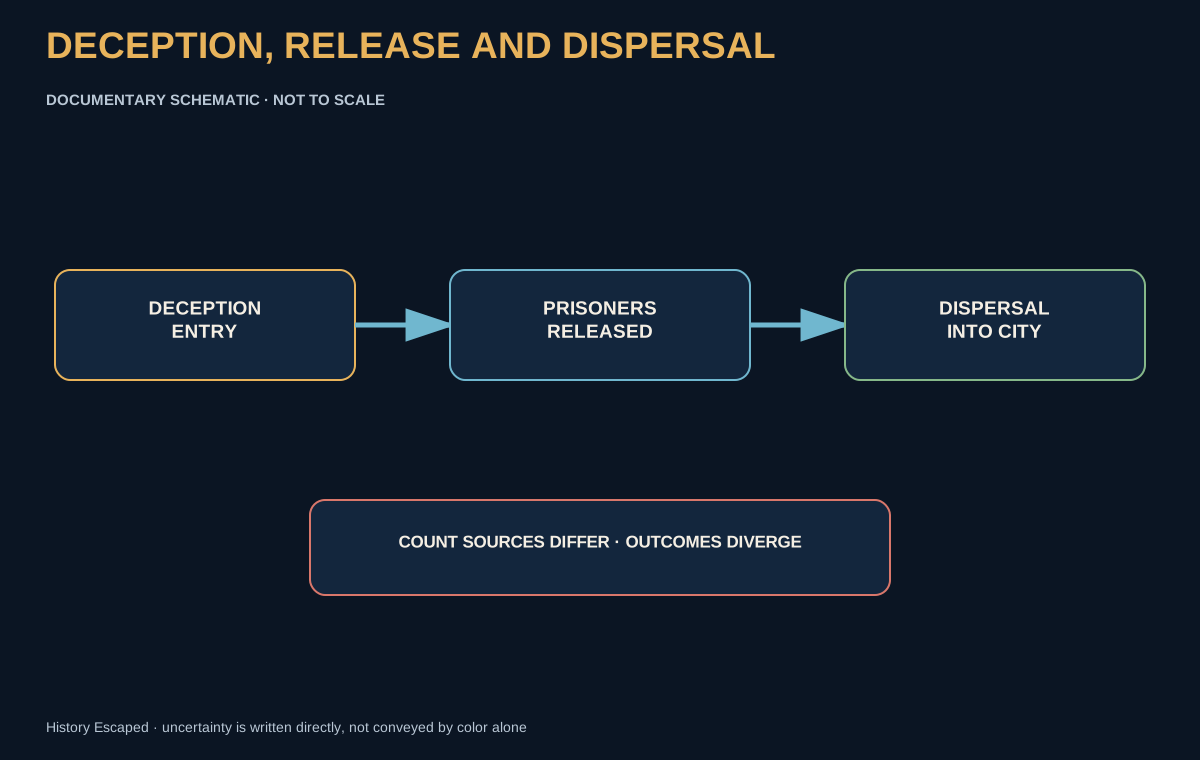
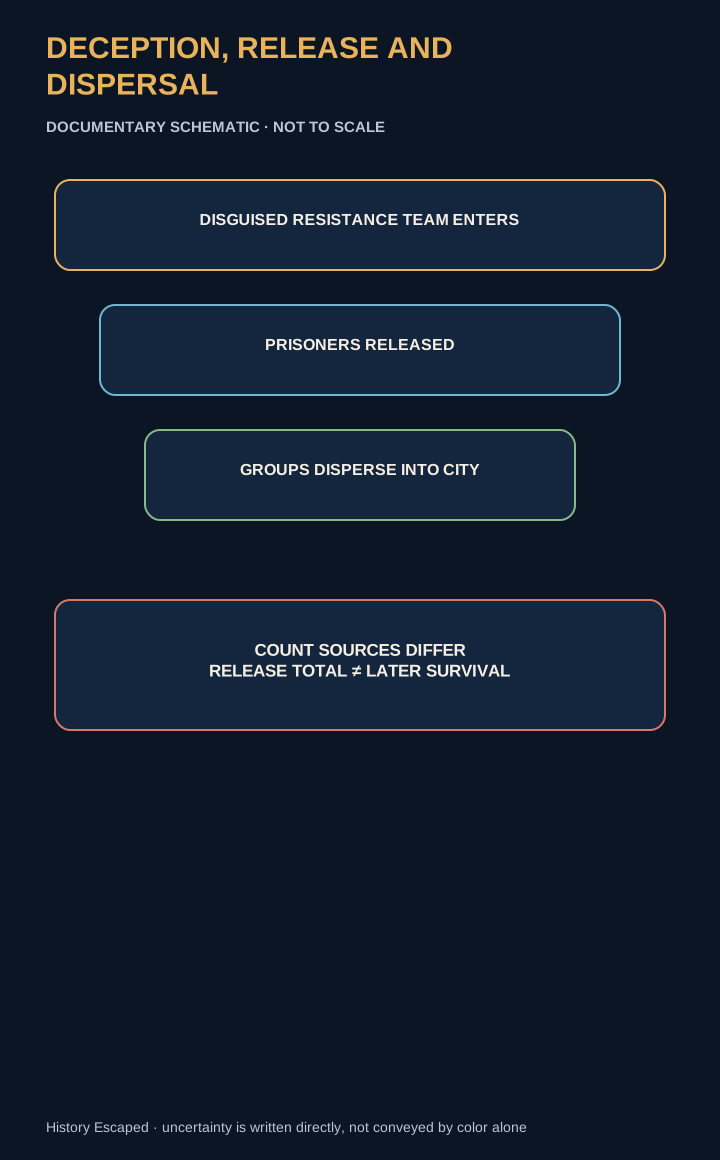
Simplified editorial reconstruction based on the cited historical record; not to scale. Uncertainty is stated directly in the visual and adjacent text.
