
When the Qarakhanids took Bukhara in 999, they did more than end a reign. They seized the Samanid ruling family and separated its princes in captivity so that they could not plan together.
One of those princes got out.
Abu Ibrahim Ismaʿil ibn Nuh—later known as al-Muntasir, “the Victorious”—escaped Qarakhanid custody around 1000. The closest narrative says that disguise was central, that he hid in the house of an unnamed old woman in Bukhara until the first search for him faded, and that he then made his way to Khwarazm. There, men loyal to the fallen dynasty gathered around him.
The escape did not restore the Samanid state. It did, however, give the dynasty five more years of war.
At a Glance
Who: Abu Ibrahim Ismaʿil ibn Nuh, son of Samanid ruler Nuh II and brother of the dynasty’s final reigning amirs.
Captured: After the Qarakhanid seizure of Bukhara in October 999.
Custody: Qarakhanid imprisonment; exact confinement site disputed.
Escape: 390 AH / 1000 CE.
Method: Disguise, concealment in Bukhara, then disguised travel to Khwarazm.
Disguise conflict: ʿUtbi’s tradition points to female clothing; later versions vary the costume.
Shelter: The house of an unnamed old woman in Bukhara.
Destination: Khwarazm.
Outcome: Samanid nobles and troops rallied to him, beginning a final restoration campaign lasting until 1005.
The Fall of Bukhara
The Samanid state had dominated Transoxiana and much of Khorasan for generations, with Bukhara as one of the great political and cultural centers of the eastern Islamic world. By the end of the tenth century, that power had fractured as military commanders increasingly controlled succession, the Ghaznavids pressed into Khorasan, and the Qarakhanids advanced from the east.
The final blow came in 389 AH, corresponding to 999. Nasr, usually called Ilig Khan in the narrative sources, entered Bukhara in October. The last ruling Samanid, ʿAbd al-Malik II, fell into his hands together with other members of the ruling family.
ʿUtbi, writing close to the events from the Ghaznavid political world, says the captured Samanid princes were deliberately separated and held apart. The reason he gives is revealing: if the brothers remained together, they might plot and find a way to escape.
That precaution worked on most of them. It did not work on Ismaʿil.
Where Was He Imprisoned?
The exact geography of the first escape is less certain than the basic event. Modern histories often state that the captured Samanid family was taken east into Turkistan, sometimes specifying Uzgend in the Ferghana Valley. Richard Frye summarizes Ismaʿil as escaping from imprisonment in Turkistan, making his way back to Bukhara, hiding there, and then going to Khwarazm.
ʿUtbi’s detailed narrative compresses the sequence differently. He moves directly from the Qarakhanid capture of Bukhara and the separation of the Samanid princes to the disguise escape, followed immediately by Ismaʿil hiding inside Bukhara.
That leaves two possibilities. Either he was first carried away and then returned secretly to Bukhara after escaping, or the relevant imprisonment took place close enough to the city for the narrative to treat the movement as one episode. The sources do not permit a confident prison address.
For that reason, this is best called an escape from Qarakhanid captivity after the fall of Bukhara, not an “Uzgend prison escape.”
The Disguise
The physical mechanism survives through one of the most memorable passages in ʿUtbi’s Kitab-i Yamini.
The English translation first calls the escaping prince “Ibrahim,” reflecting Ismaʿil’s kunya, Abu Ibrahim. It says he took clothing belonging to a woman attached to the household, covered himself with it, and escaped confinement. The same narrative then calls him Muntasir.
He reached Bukhara and took refuge with an old woman. He remained there while the immediate excitement surrounding the escape cooled and the men searching for him began to give up hope of finding him. Then he moved again.
ʿUtbi says he went to Khwarazm “in this disguise.” Later historical tradition changes the clothing details, with versions using a shepherd’s mantle and ordinary-soldier dress.
Those differences matter because they show how a good escape story accumulated sharper visual details as it was retold. The strongest reconstruction is not that we know one exact outfit. It is that disguise was central to the tradition, that he hid in Bukhara while the search was hottest, and that he maintained an inconspicuous identity long enough to reach Khwarazm.
The Unnamed Woman in Bukhara
The person who sheltered Ismaʿil is barely visible in the record. ʿUtbi calls her simply an old woman of Bukhara. There is no secure name, family connection, political affiliation, or explanation for why she helped him.
Her role was nevertheless crucial. A disguise might get a prisoner past immediate guards, but an escaped prince was one of the most recognizable political fugitives in Transoxiana. Searchers would have expected him to run quickly for allies.
Instead, he disappeared inside the city whose dynasty had just collapsed. By waiting while the first pursuit lost momentum, he turned a momentary breach of custody into a viable escape.
Only then did he make for Khwarazm.
Why Khwarazm?
Khwarazm lay beyond the immediate political center the Qarakhanids had just seized. It also contained men with ties to the old Samanid order.
Encyclopaedia Iranica places Ismaʿil’s arrival there probably in 390 AH / 1000. Supporters of the house of Saman gathered around him, and the refugee prince began raising an army.
This was the point at which escape became rebellion. Ismaʿil became known by the title al-Muntasir, conventionally translated “the Victorious.” He no longer acted simply as a surviving member of a displaced family. He presented himself as the man who could reverse the conquest of Transoxiana.
The first results were encouraging. His supporters moved back toward Bukhara and temporarily drove out Qarakhanid forces. Samarkand also became part of the renewed struggle. For a short time, a dynasty that had appeared finished in 999 had a claimant in the field again.
A Restoration That Would Not Hold
Ismaʿil’s problem was larger than escaping prison. The political map had changed.
The Qarakhanids controlled Transoxiana. Mahmud of Ghazna controlled Khorasan. The two powers had effectively divided much of the old Samanid sphere between them.
Ismaʿil could win battles, seize cities, and attract men who still respected the dynasty. He could not consistently hold territory against both successor powers. During the next several years he moved repeatedly between Transoxiana and Khorasan, fought Qarakhanid armies, challenged Ghaznavid commanders, sought help from local rulers, and recruited Oghuz Turks.
At times the campaign looked surprisingly viable. At other moments his troops scattered and he survived only by flight. Encyclopaedia Iranica describes the five years from 1000 to 1005 as a sustained attempt to avenge the fall of the dynasty and restore the Samanid house.
The original prison escape was the condition that made all of it possible.
The Other Escapes
Al-Muntasir’s later career produced several escape stories of its own. ʿUtbi describes him abandoning Oghuz allies at night with selected cavalry after fearing that they might reconcile with his enemies. Reaching the Jayhun, his party found the river frozen and crossed it.
A still later defeat produced another extraordinary flight. With no boat available, ʿUtbi says Ismaʿil joined trees together and crossed the river while escaping Qarakhanid forces.
These episodes explain why later illustrated histories pictured al-Muntasir as a mounted fugitive repeatedly crossing the river frontier. They should not be confused with the escape that began his restoration attempt.
In 1000, the key mechanism was not a battlefield river crossing. It was concealment: separated captivity, disguise, an anonymous safe house in Bukhara, and a quiet departure toward Khwarazm.
The End of the Samanid Restoration
The campaign finally failed. Ismaʿil’s alliances repeatedly broke down, and the larger political order favored the Qarakhanids and Ghaznavids.
In 395 AH / 1005 he was killed, traditionally through the betrayal of an Arab nomad chief in the region near Merv and the Qara Qum. With his death, the last serious Samanid restoration effort ended.
The dynasty itself remained culturally important long after it lost power. Bukhara’s Samanid legacy endured in architecture, Persian literary memory, and later political writing. But no Samanid claimant again came as close as al-Muntasir to turning the collapse of 999 back into a living war for restoration.
What the Sources Actually Establish
The escape is unusually well shaped even though several details remain uncertain.
The Qarakhanids captured the Samanid family after taking Bukhara. The princes were separated specifically to prevent coordinated plotting and escape. Ismaʿil nevertheless got out around 1000.
ʿUtbi supplies the strongest mechanism: disguise, hiding in the house of an old woman in Bukhara, waiting until the search weakened, and then reaching Khwarazm under concealment.
The exact disguise is less secure than the broader method. The near-contemporary tradition points toward female clothing; later retellings introduce a shepherd’s mantle and common-soldier dress. The exact prison location is also uncertain.
Neither ambiguity damages the historical core. A captured prince of a dynasty that had just been extinguished escaped deliberate separation, vanished inside the conquered capital, crossed into a safer political zone, and returned almost immediately as a restoration claimant.
The Qarakhanids had captured the Samanid state. They failed to keep its last fugitive prince.
Evidence diagram
From captive prince to restoration claimant
The frozen-river episode in later manuscripts belongs to later campaigns, not the original prison escape.
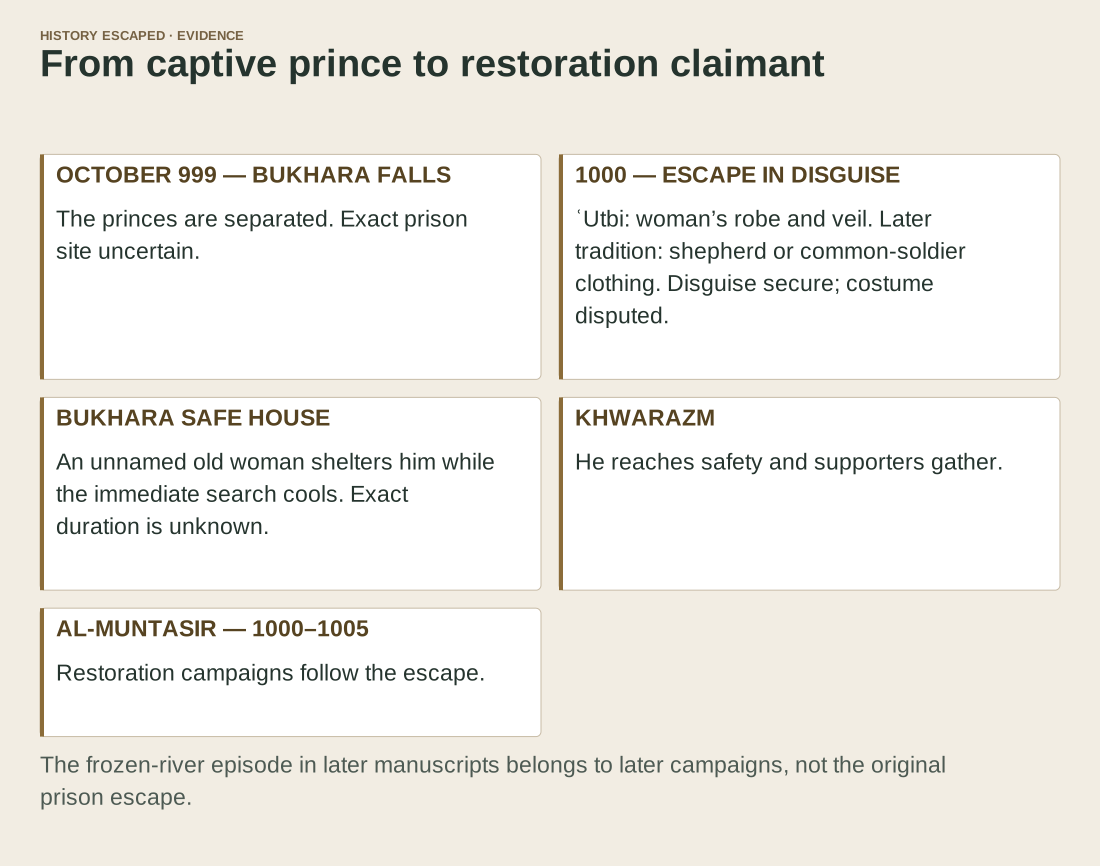
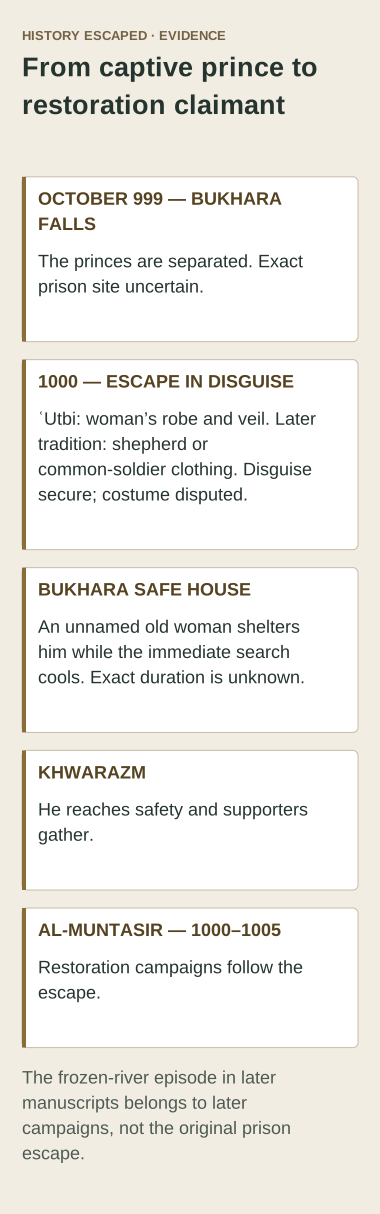
The frozen-river episode in later manuscripts belongs to later campaigns, not the original prison escape.
Material evidence
Tools of Escape
The objects used in an escape reveal how a plan worked under constraint.
- 01Central to the recorded escape mechanism but not secure enough to reconstruct visually as one exact outfit.
Disguise clothing
Clothing used to conceal Ismaʿil’s dynastic identity during escape and flight. The precise costume differs across traditions.
Problem → response
Escape was a sequence of problems
Each response solved a practical obstacle while often creating the next one.
- 01→
Obstacle
Deliberate separation of captured princes
The Qarakhanids kept Samanid brothers apart to prevent coordinated plotting and escape.
Response
Ismaʿil escaped independently using disguise.
- 02→
Obstacle
Active search in and around Bukhara
Qarakhanid pursuers sought the escaped prince after he left custody.
Response
He remained hidden in a private house until the immediate search weakened.
- 03→
Obstacle
Need to reach a politically safer region
Remaining in conquered Bukhara left Ismaʿil vulnerable to recapture.
Response
He traveled in disguise to Khwarazm, where he could assemble supporters.
The final accounting
Outcome
Immediate outcome
Ismaʿil escaped Qarakhanid control and reached Khwarazm.
Political outcome
Samanid supporters rallied around him and he began a final restoration campaign lasting until 1005.
Long-term outcome
The restoration ultimately failed; al-Muntasir’s death in 1005 marked the definitive end of Samanid attempts to recover rule.
Selected chronology
Selected chronology
Qarakhanids capture Bukhara
Nasr/Ilig Khan took the Samanid capital and seized ʿAbd al-Malik II and other members of the dynasty.
Samanid princes separated in captivity
ʿUtbi says the brothers were kept apart so they could not plot together or seek a way to escape.
Ismaʿil escapes
The prince escaped Qarakhanid custody using disguise; the exact prison location and exact costume are uncertain.
Concealment in Bukhara
He hid in an unnamed old woman’s house until the immediate search lost intensity.
Flight to Khwarazm
Ismaʿil reached Khwarazm, where former Samanid nobles and troops gathered around him.
Restoration attempt begins
Known as al-Muntasir, Ismaʿil began campaigns against the Qarakhanids and later Ghaznavids.
Al-Muntasir killed
After repeated defeats and renewed attempts to enter Transoxiana, Ismaʿil was killed, ending the last major Samanid restoration effort.
Evidence discipline
What the record supports
Status labels distinguish secure conclusions from uncertainty and rejected claims. Color is never the only signal.
DOCUMENTED
Ismaʿil al-Muntasir escaped Qarakhanid captivity after the fall of Bukhara.
ʿUtbi gives a detailed near-contemporary escape narrative, and modern scholarship independently summarizes his successful escape from Qarakhanid captivity.
Sources: SRC-001, SRC-002, SRC-004DISPUTED
The exact prison was at Uzgend.
Modern reconstructions often place the captured family in Turkistan/Uzgend, while ʿUtbi’s narrative moves directly from the Bukhara capture to escape and concealment in Bukhara. The precise point of confinement from which Ismaʿil escaped is not secure.
Sources: SRC-001, SRC-004WELL-SUPPORTED
Ismaʿil escaped specifically in female clothing.
The near-contemporary ʿUtbi tradition describes a woman’s robe/veil, but later traditions vary the exact costume. Female disguise is strong evidence, though not the only surviving version.
Sources: SRC-001UNKNOWN
The old woman who hid Ismaʿil can be identified by name.
The source identifies only an unnamed old woman of Bukhara.
Sources: SRC-001LATER CLAIM
Ismaʿil hid in Bukhara for exactly three days.
ʿUtbi says he waited until the first pursuit subsided but does not supply a three-day count in the translated passage; the exact duration appears in later retellings.
Sources: SRC-001MYTH
The frozen Jayhun crossing depicted in later art was the 1000 prison escape.
The frozen-river episode belongs to a later phase of al-Muntasir’s restoration wars, not the original escape from Qarakhanid captivity.
Sources: SRC-001, SRC-006