
Fray Servando Teresa de Mier is a rare case in which the repeated escapes are the story. Between his expulsion from New Spain in 1795 and the fall of Agustín de Iturbide’s empire in 1823, Mier passed through convent confinement, royal prisons, wartime captivity, Inquisition cells, colonial fortresses, and political detention. He escaped repeatedly, was repeatedly recaptured, and repeatedly returned to political and literary life.
Reducing that history to a single “great escape” would distort it. His importance for an escape archive lies in the serial pattern: confinement by different authorities, changing legal justifications, improvised breakouts, failed attempts followed by later successes, and a final escape that lasted barely a day before recapture.
The strongest reconstruction supports seven principal escape episodes between roughly 1796 and January 1823. That count is useful, but it is not a sacred number. Some biographers count differently depending on whether they include his escape from French wartime captivity in 1809, distinguish two separate escapes from Los Toribios in Seville, or count only escapes that led to sustained freedom.
The Sermon That Started the Cycle
Mier’s long chain of confinements began with a sermon delivered in Mexico City on 12 December 1794. He challenged the conventional history of the Virgin of Guadalupe by arguing that Christianity had reached Mexico before the Spanish conquest through Saint Thomas, whom he associated with Quetzalcoatl. Archbishop Alonso Núñez de Haro treated the sermon as a grave ecclesiastical and political offense.
Mier was confined, stripped of his doctoral privileges, barred from preaching and teaching, and sentenced to ten years of exile in Spain with reclusion in the Dominican convent of Nuestra Señora de las Caldas. His later memoirs portray the punishment as persecution by powerful church and colonial officials. That self-defense is central to the source record, but it is also why his memoirs require caution: Mier was writing not simply to remember events but to justify his conduct. What is beyond dispute is that by 1795 he had entered a cycle in which ecclesiastical discipline and state custody repeatedly overlapped.
Las Caldas: The First Escape
Mier reached the convent of Las Caldas in Cantabria around Christmas 1795. His own Memorias provide unusually concrete details of his first breakout. He says the bars of his window were set in lead and that he possessed a hammer and chisel. He cut away the lead, removed one bar, and climbed out before dawn carrying his clothes.
He left behind a verse letter explaining why he believed the confinement unjust. The escape itself worked. The flight did not.
Mier hid during the day in brush on the mountain and paid a local man to guide him onward. The guide, alarmed that Mier admitted he was at Las Caldas by royal order, revealed his direction. Because Mier was still visibly wearing his religious habit, the search found him quickly.
He was returned to custody. The failure immediately changed the regime around him. Authorities transferred him to the Dominican convent of San Pablo in Burgos, where Mier says he was initially received as a prisoner before the prior relaxed his treatment. The first escape established the pattern that would follow for decades: close confinement, an improvised opening, temporary freedom, betrayal or detection, and a new place of custody.
Burgos, Salamanca, and the Road to France
The years after Las Caldas were administratively complicated. Mier petitioned repeatedly to have his case heard before the Council of the Indies. He moved between religious houses and civil jurisdictions, at times enjoying considerable freedom inside a convent and at other times being formally detained.
An order eventually sent him toward a convent in Salamanca. He did not follow the route expected of him and was arrested again. He was then confined with Franciscans in Burgos.
From that confinement he made the escape that changed his life. In 1801, Mier succeeded in leaving Spanish custody, crossing the frontier, and reaching Bayonne in France. Alfonso Reyes’ early critical introduction to the Memorias places his arrival there on the Friday before Holy Week.
Unlike the Las Caldas breakout, this escape produced sustained freedom. From Bayonne he went to Bordeaux and Paris, met Simón Rodríguez, and participated in intellectual and educational life. He later traveled to Rome and obtained secularization from the Dominican order. The escape did not make him cautious.
Back to Spain and Los Toribios
Mier returned to Spain in 1803. He was arrested again in Madrid, this time amid renewed political suspicion and controversy over his writings, and was transferred in early 1804 to the institution known as Los Toribios in Seville.
The surviving chronology gives 24 June 1804 for his escape. He reached Cádiz but was captured again and sent back. Later accounts describe heavier restraints after his recapture.
The distinction between this escape and the next one matters. Mier did not simply “escape from Seville once and live free.” The 1804 breakout failed as a durable flight.
A later escape from the same cycle of custody did succeed. By 1805 he had reached Portugal, where he remained for several years and eventually worked for the Spanish consular establishment in Lisbon. This two-stage sequence is one reason simplified biographies disagree over how many escapes Mier made.
A Fifth Escape in Wartime
The Napoleonic occupation of the Iberian Peninsula changed Mier’s political position again. He supported Spanish resistance to France, served as a military chaplain, and became attached to the Volunteers of Valencia. During the fighting he was captured by French forces after the battle of Belchite.
He escaped again. The University of Texas archival biography and other later summaries preserve the episode, though it is far less fully documented than the Las Caldas escape. The fine mechanics are not secure enough for reconstruction.
For the serial case, its importance is structural: an individual previously imprisoned by Spanish authorities for disobedience and political suspicion was now escaping French wartime captivity while serving the Spanish cause. Mier’s relationship to imprisonment cannot be reduced to a simple story of “Spain versus rebel priest.” The identity of the jailer changed repeatedly.
From Revolutionary Exile to Royalist Captivity
By 1811 Mier was in London supporting the independence of Spanish America. He later joined the expedition of Francisco Xavier Mina, which reached New Spain in 1817. When royalist troops overwhelmed the position at Soto la Marina, Mier was captured once again.
This detention lasted years rather than days. He was moved through royalist custody, including San Carlos de Perote and the Inquisition prison in Mexico City. During this period he wrote major autobiographical and political texts, including portions of the works through which the earlier escapes are known.
The end of the Inquisition did not produce his freedom. Authorities decided to send him to Spain.
He was transported back toward Veracruz and San Juan de Ulúa and then shipped through Havana in 1821. That transit created the setting for his sixth major escape.
Havana, 1821
The Havana escape is less richly documented by Mier himself than his Spanish episodes, but the broad sequence is strong across archival and biographical sources. Mier arrived in Cuba while being transported toward Spain. He was held in Spanish custody, associated in later accounts with Morro Castle and then a medical transfer.
He escaped in Havana. By late spring he was able to leave Cuba for the United States, and by June 1821 he was in Philadelphia, where he resumed political writing and argued against monarchical solutions for newly independent Mexico.
The escape was strategically more important than any of his earlier European breakouts. It removed him from Spanish custody at the moment Mexican independence was becoming irreversible.
Later authors sometimes describe Havana as his “sixth escape.” That number works only if one counts the earlier sequence in a particular way, but it aligns with a seven-escape reconstruction.
San Juan de Ulúa Was Not an Escape
In 1822 Mier returned to Mexico. His arrival did not bring immediate freedom. Spanish royalists still controlled San Juan de Ulúa, and he was imprisoned there again after reaching Veracruz.
This episode belongs in the custody timeline but not in the escape count. Mier did not break out of San Juan de Ulúa. His election as a deputy and intervention by the new Mexican political authorities secured his release. That distinction matters because serial biographies sometimes compress every departure from confinement into another “escape.”
Iturbide’s Empire and the Last Breakout
Mier quickly became an opponent of Agustín de Iturbide’s empire. In August 1822 he was arrested with other deputies suspected of republican conspiracy. Because he was a cleric, he was held under custody at the Dominican convent of Santo Domingo in Mexico City.
On 1 January 1823, he escaped. Alfredo Ávila’s study of Mexican republicanism identifies clerical assistance in the breakout and says Mier left the convent disguised. The freedom was brief.
A woman betrayed his presence the following morning while he was injured and seeking help. Authorities captured him again and transferred him first to the Court jail and then to the former Inquisition prison.
The seventh escape had succeeded physically but failed strategically. Mier remained a prisoner until the republican military movement against Iturbide transformed the political situation. On 11 February 1823, troops aligned against the emperor freed him. That release was political, not another escape.
Why the Number “Seven” Needs a Footnote
The phrase “Fray Servando escaped seven times” is memorable because it is approximately right. It is not a simple contemporary count. A defensible seven-event sequence is:
- Las Caldas, c. 1796 — breakout through the window bars; recaptured.
- Burgos to France, 1801 — successful cross-border escape.
- Los Toribios, 24 June 1804 — escape; recaptured at Cádiz.
- Los Toribios/Spanish custody, c. 1805 — escape leading to Portugal.
- French wartime captivity, c. 1809 — escape after capture during the Peninsular War.
- Havana, 1821 — escape from Spanish custody during deportation.
- Santo Domingo, 1 January 1823 — escape from imperial Mexican custody; recaptured shortly afterward.
The count deliberately excludes transfers, releases secured by legal or political intervention, and movements in which Mier was not actually free. It also treats the serial identity as more important than pretending that every episode is documented to the same standard.
Mier as His Own Witness
No account of these escapes can ignore Mier’s Memorias. They are among the most vivid autobiographical works of the independence era. They are also argumentative, satirical, self-defensive, and theatrical.
Mier presents himself as the persistent victim of corrupt officials, incompetent clerics, arbitrary prisons, and absurd bureaucracies. He often remembers conversations in polished form and turns humiliating experiences into comic or moral scenes.
Modern literary scholars have emphasized that this voice is part of the work’s historical significance. The memoir is not merely a container of facts. It is one of the ways Mier transformed persecution into political argument. That means the early escapes can often be reconstructed in exceptional detail, especially Las Caldas, while the narrator’s judgments about motives and villains require independent restraint.
A Life Defined by Repeated Custody
Mier’s serial escapes are historically unusual because they cross so many political regimes.
He escaped ecclesiastical confinement imposed under the Spanish monarchy. He escaped Spanish detention on the Peninsula. He escaped French military captivity while fighting for Spain. He escaped renewed Spanish royalist custody after becoming an independence activist. Finally, he escaped confinement imposed by the new Mexican empire.
No single jailbreak captures that trajectory. The repeated pattern also explains why Mier became so useful to later political memory. He could be remembered as priest, exile, fugitive, insurgent, prisoner of the Inquisition, republican, and constitutional politician without any one label exhausting the career.
His final escape did not end with permanent freedom. He was recaptured within days.
His real release came only when the political order that held him began to collapse. The central historical point is that Fray Servando Teresa de Mier did not escape one prison. He spent almost three decades proving that every new form of confinement might still be temporary.
Evidence diagram
Seven principal escapes, 1796–1823
“Seven” is an editorial reconstruction of the principal escapes, not a universally standardized contemporary enumeration.
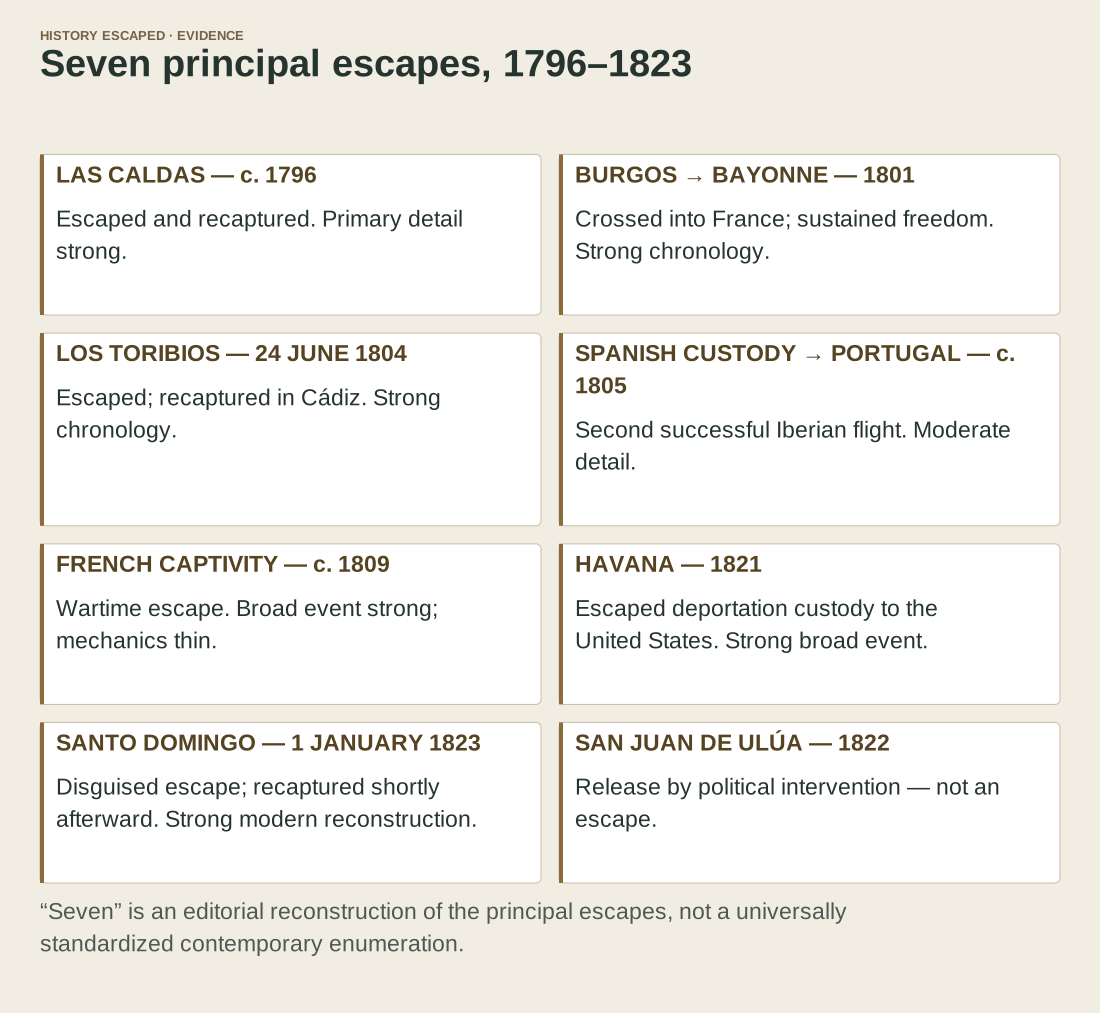
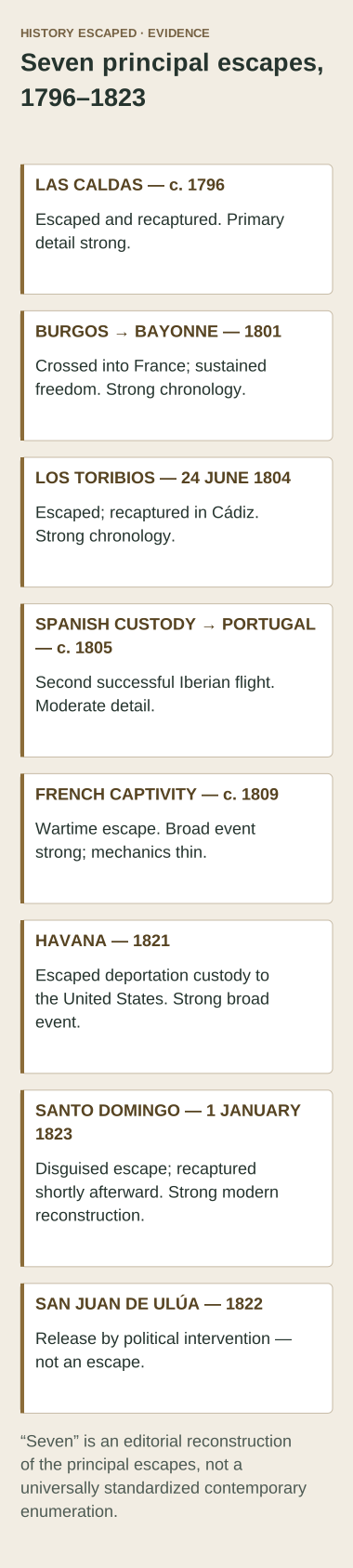
“Seven” is an editorial reconstruction of the principal escapes, not a universally standardized contemporary enumeration.
Material evidence
Tools of Escape
The objects used in an escape reveal how a plan worked under constraint.
- 01One of the few serial episodes whose physical breakout tools are described directly by Mier.
Hammer and chisel
Mier says he used these at Las Caldas to cut away the lead securing a window bar.
- 02Helped Mier pass out of political confinement; exact wardrobe detail should not be overproduced.
Disguise / borrowed clothing
Modern scholarship on the 1823 Santo Domingo escape describes clerical assistance and clothing used to leave disguised.
Problem → response
Escape was a sequence of problems
Each response solved a practical obstacle while often creating the next one.
- 01→
Obstacle
Repeated reclassification of custody
Mier moved between convent reclusion, royal prisons, military captivity, Inquisition detention, and political confinement.
Response
His escape methods changed with the institution: physical breakout, evasion, cross-border flight, or exploitation of transit conditions.
- 02→
Obstacle
Rapid recapture
Several breakouts produced only hours or days of freedom.
Response
The serial pattern includes failed breakouts rather than counting only durable escapes.
- 03→
Obstacle
Political dependence after escape
Even successful physical flight did not eliminate the wider legal or political threat.
Response
Mier repeatedly moved jurisdictions—Spain to France, Spain to Portugal, Cuba to the United States—or waited for regime change.
- 04→
Obstacle
Memoir self-fashioning
The most vivid early evidence comes from Mier’s own satirical and apologetic memoir.
Response
Mechanics are retained where specific; judgments about persecutors and motives are separated from observable sequence.
The final accounting
Outcome
Canonical principal escapes
Seven episodes are used for site structure, with an explicit count caveat.
Immediate recaptures in canonical sequence
Las Caldas, the 1804 Los Toribios escape, and the 1823 Santo Domingo escape ended in relatively rapid recapture.
San Juan de Ulúa 1822 escape
This confinement ended through intervention/release and is intentionally excluded from the count.
Selected chronology
Selected chronology
Guadalupe sermon
Mier delivers the sermon that triggers ecclesiastical prosecution and later exile.
Exiled to Spain
Mier is sent from New Spain to ten years of exile and reclusion in Spain.
Las Caldas escape and recapture
Mier removes a window bar and flees the convent but is found and returned to custody.
Escape to France
Mier escapes renewed confinement in Burgos and reaches Bayonne.
Los Toribios escape
Mier escapes from confinement in Seville but is recaptured at Cádiz.
Escape to Portugal
A renewed escape from Spanish custody leads to several years in Portugal.
French captivity and escape
Mier escapes after capture by French forces during the Peninsular War.
Royalist capture after Mina expedition
The collapse at Soto la Marina returns Mier to prolonged Spanish royalist custody.
Havana escape
During deportation toward Spain, Mier escapes custody in Havana and reaches the United States.
San Juan de Ulúa release
Spanish royalists imprison Mier after his return to Mexico, but political intervention secures his release; this is not counted as an escape.
Final escape from Santo Domingo
Mier escapes imperial political detention but is recaptured shortly afterward.
Political release
The anti-Iturbide republican military movement frees Mier from his last imprisonment.
Evidence discipline
What the record supports
Status labels distinguish secure conclusions from uncertainty and rejected claims. Color is never the only signal.
MYTH
Fray Servando made exactly seven escapes according to a single contemporary official record.
Seven is a defensible editorial count assembled from memoir, archival chronology, and later scholarship. Contemporary authorities did not maintain one canonical lifetime escape total.
Sources: SRC-002, SRC-003DOCUMENTED
The Las Caldas breakout involved removing a barred window.
Mier explicitly says the bars sat in lead and that he used a hammer and chisel to remove one before leaving before dawn.
Sources: SRC-001MYTH
Every escape produced lasting freedom.
Several ended in rapid recapture, including Las Caldas, the 1804 Seville escape, and the final 1823 breakout.
Sources: SRC-001, SRC-002, SRC-003, SRC-006MYTH
Mier escaped from San Juan de Ulúa in 1822.
He was imprisoned there after returning to Mexico, but the new Mexican political authorities secured his release. It was not a jailbreak.
Sources: SRC-003, SRC-007MYTH
The Havana escape’s exact physical mechanics are as well documented as Las Caldas.
The broad escape from Spanish custody in Havana is strong, but the exact route and mechanics depend more heavily on later biographical reconstruction.
Sources: SRC-003, SRC-007MYTH
Mier’s memoir can be read as a neutral prison log.
The memoir is satirical, apologetic, and politically argumentative; it is invaluable primary testimony but not neutral administrative documentation.
Sources: SRC-001, SRC-005MYTH
The 1 January 1823 escape permanently freed Mier.
He was recaptured shortly afterward and remained a prisoner until the republican revolt against Iturbide changed the political situation.
Sources: SRC-003, SRC-006