
From a Burgundian fortress, Joan tried to turn captivity back into action — and survived a leap that failed to free her.
A prisoner who kept trying to get out
Joan of Arc did not accept captivity as something she was obliged to endure quietly.
Her own words at the 1431 trial make that unusually clear. When interrogators asked about an earlier escape attempt from the castle of Beaulieu, she answered that whenever she was imprisoned she would gladly escape. At Beaulieu, she said, she had hoped to shut her guards inside a tower, but a porter saw her and stopped the attempt.
Beaurevoir was therefore not a sudden, isolated act of desperation. It was at least her second known attempt to recover her freedom after capture.
What happened there was more extreme.
Held in a fortress by John of Luxembourg’s household during the autumn of 1430, Joan learned that the English wanted possession of her. She also feared for Compiègne, the town outside whose walls she had been captured months earlier and which remained threatened by Burgundian forces.
She wanted out badly enough to jump from a tower.
The surviving trial record does not preserve a secure exact date for the leap. Nor does it give a reliable measurement of the tower’s height. Later retellings often supply dramatic numbers and precise physical details, but the primary record is less tidy.
It tells us what matters most: Joan jumped, she was injured, she did not get away, and months later her judges tried to turn the act into evidence against her.
From Compiègne to captivity
Joan had been captured on 23 May 1430 during fighting outside Compiègne.
By then she was one of the most famous people in France. In 1429 she had helped transform the military and political situation around Orléans, accompanied the royal campaign toward Reims, and stood near Charles VII at his coronation. To English and Burgundian interests she was not merely another soldier taken in war. She was a figure with enormous symbolic value.
Her legal and financial status as a captive was also important. Modern scholarship has emphasized that contemporaries could treat her as a prisonnière de guerre — a prisoner of war — in a medieval system centered heavily on the captor’s rights over the prisoner and the possibility of ransom or transfer.
After her capture by Burgundian-aligned forces, she came into the possession of Jean de Luxembourg, lord of Beaurevoir and a vassal of Philip the Good, duke of Burgundy. The English wanted her transferred.
Pierre Cauchon, bishop of Beauvais, pressed for her surrender so that she could be tried for religious offenses. Documents incorporated into the later trial record show the English side offering a payment of 10,000 livres for her delivery.
Before that transfer was completed, Joan remained in a chain of Burgundian custody. And she looked for ways out.

The first attempt: Beaulieu
The 1431 interrogators asked Joan directly about an escape attempt at Beaulieu.
Her answer is one of the clearest statements of her attitude toward imprisonment. She said she was never a prisoner anywhere without wanting to escape.
At Beaulieu, according to her testimony, she tried to exploit an opening around two pieces of timber and intended to shut her keepers in the tower. A porter encountered her before she could complete the escape.
The attempt failed.
She was subsequently held at Beaurevoir, a stronger castle associated with Jean de Luxembourg. France’s official heritage inventory dates the castle’s principal medieval construction to around 1310 and records Joan’s imprisonment there for roughly four months in 1430. Much of the fortress was later demolished; the surviving above-ground remnant known as the Tour Jeanne d’Arc should not be treated as a complete guide to the castle as Joan knew it.
That distinction matters.
It is tempting to look at the surviving tower and reconstruct an exact route, window, platform, landing point, or distance. The evidence does not support that level of precision.

What Joan said happened at Beaurevoir
The most important account comes from Joan herself — but it comes through the hostile legal setting of her 1431 trial at Rouen. Her judges repeatedly returned to the Beaurevoir leap.
On 3 March, she was asked how long she had been at Beaurevoir. She answered that she had been there about four months. She said she became angry when she learned that the English were coming to take her. Although the voices she identified as saints had repeatedly told her not to jump, she eventually did.
She commended herself to God and Our Lady. She was wounded in the fall.
On 14 March the questioning became even more specific. Joan gave two reasons for the act.
First, she said she had heard that the people of Compiègne were in danger of terrible destruction. She wanted to go to their aid.
Second, she said she knew she was being sold to the English and would rather die than fall into their hands. Those words have sometimes encouraged later writers to label the leap a suicide attempt. That is too simple.
When the judges asked whether she had expected to kill herself, Joan said no. She said she had hoped to escape and avoid delivery to the English. Elsewhere in the same proceedings she explicitly rejected the prosecution’s description of the act as despair, saying she had jumped in the hope of saving herself and helping people in need.
Her language contains tension: she also said she would rather die than be delivered to the English. But preferring death to capture is not the same as stating that death was the intended result of the jump.
The safest historical formulation is therefore that the leap was a dangerous escape attempt undertaken despite a clear possibility of death. Its precise psychological balance cannot be reconstructed beyond Joan’s own testimony.
Why Compiègne mattered
The leap cannot be separated from Compiègne.
Joan had been captured while defending the town. During her captivity she remained intensely concerned about what would happen there. In the trial transcript, she said she had heard reports that its inhabitants faced massacre.
Whether every detail of that rumor was accurate is a different question. What matters for the escape is that Joan told her judges she believed the threat and that it affected her decision.
Her testimony also shows a conflict between that desire to act and the religious counsel she said she received.
She told the court that St. Catherine had repeatedly instructed her not to jump and assured her that God would aid the people of Compiègne. Joan nevertheless wanted to go there herself.
For a defendant whose judges were building a case around the authority and truth of her revelations, that disobedience was legally useful to the prosecution. An escape attempt became evidence.
The fall
The primary record gives no safe height. It gives no exact shape of the descent.
It does not tell us that Joan bounced from a roof, struck a tree, landed in a moat, fell onto soft ground, or survived because of some specific architectural feature. Those details appear in various later retellings, but without a firm source they should not be inserted into a reconstruction.
The trial testimony says she leaped from the tower and was injured.
For two or three days afterward, Joan said, she did not eat. In one version of her answer she explained that she had been so hurt that she could not eat or drink. She later recovered.
She also said that after the fall she confessed and asked God to forgive her for making the leap.
That part of the story is historically important because it shows that Joan herself did not later defend every aspect of the act. She maintained that she had not jumped from despair, but she also said she came to believe the decision was wrong and sought forgiveness.
The failed escape had both physical and spiritual consequences in the story she told at Rouen.
Why the escape failed
Unlike a tunnel, disguise, bribery, forged document, or coordinated rescue, the Beaurevoir attempt appears to have had almost no recoverable second stage. The surviving evidence does not tell us of a horse waiting outside, a friendly guide, a route to French-held territory, or a group positioned to receive her. That does not prove no plan existed.
It means the evidence does not preserve one.
The decisive step was simply getting out of the tower. Joan appears to have gambled that surviving the descent would create an opportunity to flee.
It did not.
The fall injured her badly enough to leave her unable or unwilling to eat for days. The leap removed her from the tower but did not carry her beyond her captors’ control.
The distinction is essential: she breached a vertical barrier, but she did not achieve freedom.
The English transfer closes in
While Joan remained a prisoner, the political and financial machinery around her continued moving.
The English government and its allies wanted custody. Pierre Cauchon pursued the transfer. The University of Paris also pressed for an ecclesiastical prosecution.
Joan’s own language at the trial shows that she understood the danger of being delivered to the English before the transfer happened. Eventually the negotiations succeeded.
After Beaurevoir she was moved through other places of confinement, including Arras, and ultimately transferred to English control. By late December 1430 she had been taken to Rouen.
There she was held for the trial that opened in early 1431. The Beaurevoir escape followed her into the courtroom.
How the prosecution used the jump
The trial record is not a neutral transcript produced for modern historians. It is the record of a prosecution.
That does not make Joan’s answers useless. In fact, the survival of detailed questions and answers is the reason the escape can be reconstructed at all. But the wording of the accusations must be separated from the wording of Joan’s defense.
The formal articles accused her of having thrown herself from the tower under diabolical influence and out of despair. Her interrogators linked the jump to questions about mortal sin and to her claim that heavenly voices guided her.
Joan pushed back.
She said she had not jumped from despair. She said she wanted to escape. She said she hoped to aid Compiègne. She acknowledged disobeying the voices as she understood them and said she later sought forgiveness.
The episode therefore survives in two layers:
- the prosecution’s attempt to classify the act as spiritually and morally incriminating;
- Joan’s own explanation of it as an escape attempt made under fear, urgency, and concern for others.
Those layers should never be silently merged.
Did Joan try to kill herself?
The question has survived because the act itself was so dangerous and because the trial explicitly raised despair. The strongest evidence does not permit a simple yes.
Joan said she would rather die than be delivered to the English. That is documented.
Joan also said she did not expect to kill herself when she jumped and that she hoped to escape. That is documented too.
The prosecution characterized the leap as a desperate and sinful act. That framing is also documented — as an accusation.
What cannot be documented is the exact inner state of a nineteen-year-old prisoner standing above a dangerous drop six centuries ago. Calling the leap an ordinary escape understates its danger. Calling it a proven suicide attempt contradicts Joan’s direct answer. The event sits in between: an extraordinarily hazardous attempt to regain freedom by someone who knew death was preferable to the captivity she feared.
After Beaurevoir
The escape failed, but one of Joan’s concerns soon changed. The Burgundian siege of Compiègne was lifted in late October 1430. Joan, however, remained captive.
By December she was in Rouen. Her trial opened in January 1431. The Beaurevoir leap became one incident among many used to challenge her conduct, her revelations, and her obedience.
She was convicted and executed at Rouen on 30 May 1431.
Twenty-five years later, a new judicial inquiry annulled the earlier verdict. The nullification proceedings also preserve testimony about the circumstances of her captivity and the conduct of the first trial.
None of that transformed the Beaurevoir leap into a successful escape. Its significance is different.
Why Beaurevoir matters
Joan of Arc is usually remembered in motion: riding toward Orléans, standing at Reims, carrying a banner, pressing commanders to attack. Beaurevoir shows what happened when movement was taken away. Her response was not passive.
She tried at Beaulieu. She tried again at Beaurevoir. Even during the later Rouen trial, when asked what she would do if she saw an open door, she said she would go.
The Beaurevoir leap is therefore not a picturesque side story attached to a famous life. It is one of the clearest pieces of evidence for how Joan understood captivity.
A prisoner could try to leave. She did not believe she owed her captors a promise to remain. At Beaurevoir, that conviction carried her over the edge of a tower. She survived the fall.
The escape did not.
Escape reconstruction
How the escape unfolded
An evidence-aware sequence of the principal stages.
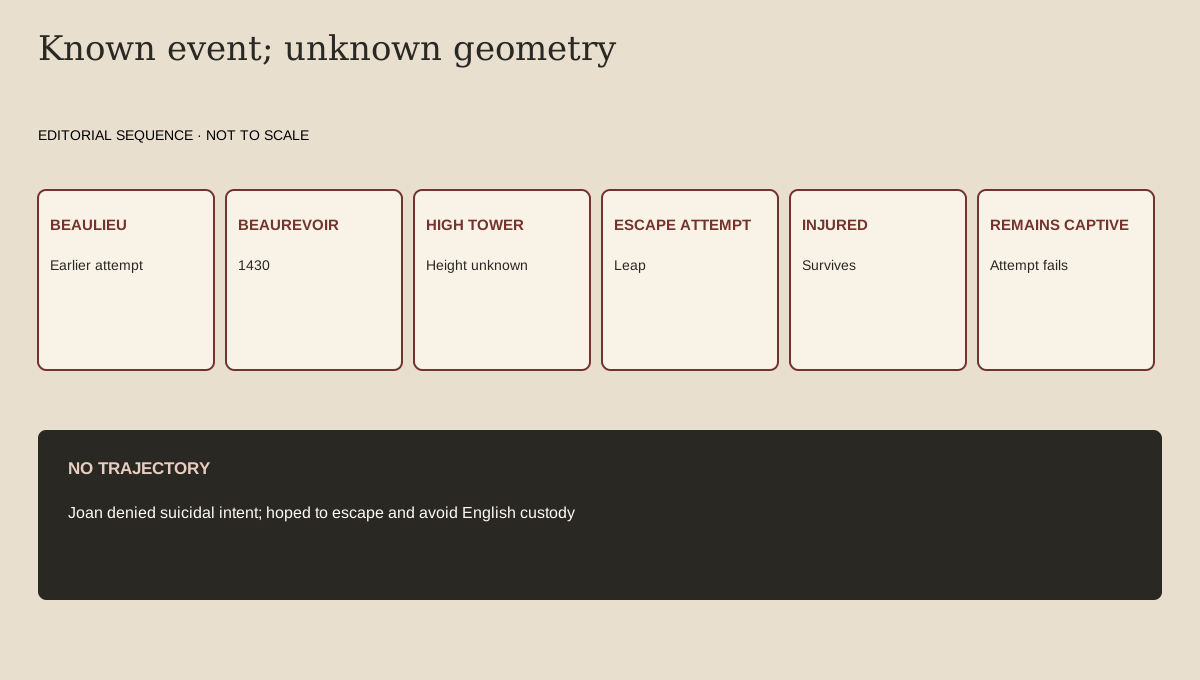
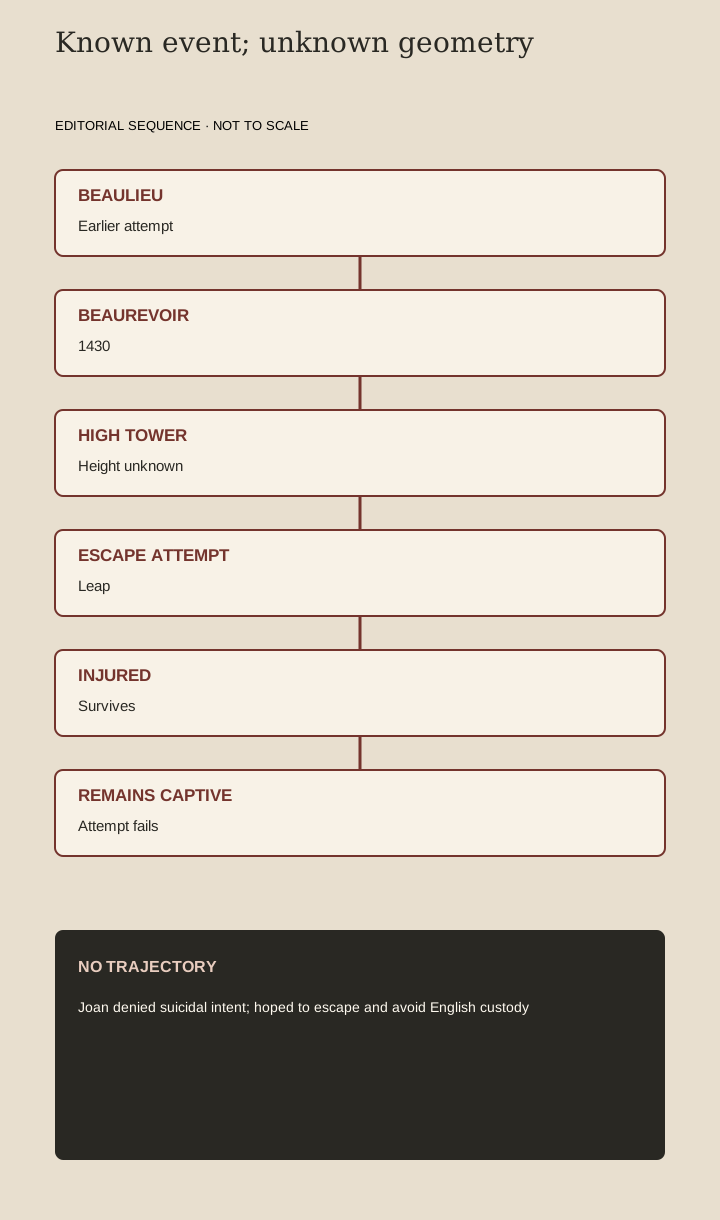
Simplified editorial reconstruction; not to scale. See adjacent text for evidence qualifications and unresolved details.
Problem → response
Escape was a sequence of problems
Each response solved a practical obstacle while often creating the next one.
- 01→
Obstacle
Fortified confinement
Joan was held inside a medieval castle whose surviving remnant does not preserve enough information to reconstruct the exact 1430 escape geometry.
Response
Rather than use a documented door, rope or hidden passage, she attempted to overcome the vertical barrier directly by jumping.
- 02→
Obstacle
Approaching English custody
Joan believed she was about to be transferred to the English, whom she regarded as her enemies.
Response
She chose a highly dangerous escape attempt before the transfer could remove her from Burgundian custody.
- 03→
Obstacle
Severe injury from the fall
The leap left Joan badly hurt and unable to eat or drink normally for a period.
Response
She survived and recovered physically, but the injury prevented the leap from becoming durable freedom.
The final accounting
Outcome
Escape fails
Joan survives the descent but remains in captivity; no secure evidence shows that she passed beyond the control of her keepers.
Joan recovers from the fall
She later tells her judges that she began eating again and recovered after several days.
The leap becomes trial evidence
The prosecution later uses the Beaurevoir incident in charges concerning despair, sin and Joan’s claimed obedience to her voices.
Transfer to English custody proceeds
The failed escape does not stop the negotiated transfer. Joan is eventually taken to Rouen, tried and executed in 1431.
Evidence discipline
What the record supports
Status labels distinguish secure conclusions from uncertainty and rejected claims. Color is never the only signal.
DOCUMENTED
Joan made a deliberate escape attempt at Beaurevoir by jumping from a tower.
The 1431 trial record repeatedly questions Joan about the leap, and she openly acknowledges making it.
Sources: SRC-001MYTH
The Beaurevoir leap was Joan’s first attempt to escape captivity.
At the same trial Joan described an earlier failed escape attempt at Beaulieu in which she hoped to shut her keepers in the tower before a porter stopped her.
Sources: SRC-002DISPUTED
Joan jumped because she wanted to kill herself.
The prosecution framed the act as despair, and Joan said she would rather die than be delivered to the English. But when asked directly whether she expected to kill herself, she said no and stated that she hoped to escape. A proven suicide intent therefore goes beyond the evidence.
Sources: SRC-001DOCUMENTED
Joan’s motives included fear for Compiègne and fear of English custody.
Those are the two reasons Joan herself gave under questioning on 14 March 1431. Whether every rumor she had heard about Compiègne was accurate is a separate question.
Sources: SRC-001UNKNOWN
The exact height of Joan’s jump is known.
The trial record calls the structure a high tower but gives no dependable measurement. The present heritage remains are not sufficient to reverse-engineer the 1430 drop.
Sources: SRC-001, SRC-003MYTH
Joan escaped successfully from Beaurevoir after the leap.
She survived but remained a prisoner and was later transferred toward English custody.
Sources: SRC-001, SRC-005DOCUMENTED
Joan regarded escape from captivity as permissible.
When questioned about her attempts, she stated that she would willingly escape from any prison and elsewhere argued that she had given no promise not to do so.
Sources: SRC-002Selected chronology
Selected chronology
Joan captured at Compiègne
Burgundian-aligned forces capture Joan during fighting outside Compiègne, beginning the captivity that eventually takes her through Beaulieu and Beaurevoir.
Escape attempt at Beaulieu
Joan later says she tried to escape at Beaulieu and intended to trap her keepers, but a porter encountered her.
Transferred to Beaurevoir
Joan is held at the fortified Château de Beaurevoir; she later says the stay lasted about four months.
Tower escape attempt
Fearing transfer to the English and concerned for Compiègne, Joan leaps from the tower. She survives but does not escape captivity.
Siege of Compiègne lifted
The Burgundian siege that had weighed heavily on Joan during captivity is lifted, but Joan remains a prisoner.
Joan taken to Rouen
Joan arrives at Rouen under English escort, where the prosecution that will question her about Beaurevoir is prepared.
Joan questioned about Beaurevoir
During her trial Joan says she had been at Beaurevoir about four months, feared the English and was wounded in the leap.
Joan explains her motives
She tells the court that fear for Compiègne and fear of English custody drove the leap, and denies that she expected to kill herself.
Joan executed at Rouen
After conviction in the ecclesiastical trial, Joan is handed to secular authority and burned at Rouen.
Original verdict annulled
The later nullification process overturns the 1431 verdict.