
On 1 August 1323, Roger Mortimer of Wigmore was still one of King Edward II’s most dangerous prisoners. By the next morning, he was gone.
Mortimer had not broken out by overpowering a guard or tunnelling through the Tower of London. His escape depended on something more difficult to defend against: cooperation from inside the fortress and a chain of helpers beyond it. The Tower’s constable and other members of the garrison were incapacitated during the feast of St Peter in Chains. Gerard d’Alspaye, a Tower official with access to Mortimer, helped release him. Mortimer then crossed the fortress, descended toward the Thames, reached a waiting boat, and escaped into a wider network that carried him toward the coast and ultimately to France.
The escape was extraordinary in its own right. Its consequences were larger still. Three years later Mortimer returned to England with Queen Isabella, helped overthrow Edward II, and became the dominant political figure of the new regime. The man whom Edward’s government had failed to keep inside the Tower in 1323 became one of the people who brought that government down.
From Marcher Lord to Royal Prisoner
Roger Mortimer was not an obscure captive. He was a major landholder, an experienced soldier, and one of the most powerful lords of the Welsh Marches. He had served the English crown in Ireland, but during Edward II’s reign he joined the opposition to Hugh Despenser the Younger and the king’s increasingly aggressive treatment of the Marcher lords.
The struggle became open rebellion in 1321–22. Mortimer and his uncle, Roger Mortimer of Chirk, submitted to Edward II at Shrewsbury in January 1322. Both were sent to the Tower of London. The younger Mortimer was condemned to death, but the sentence was commuted to perpetual imprisonment.
That reprieve did not make his position secure. Other opponents of Edward II and the Despensers had been executed after the collapse of the rebellion. Mortimer therefore had good reason to regard indefinite confinement as dangerous even if no surviving royal order proves that the king had secretly decided to kill him in the summer of 1323.
That distinction matters. Some later narratives describe a planned execution as the immediate trigger for the escape. The evidence is not strong enough to state that as fact. What is certain is that Mortimer remained a politically important prisoner in a regime that had already dealt ruthlessly with many of his allies.
Material evidence
Tools of Escape
The objects used in an escape reveal how a plan worked under constraint.
- 01Created the security gap
Drugged or otherwise adulterated drink
Used to incapacitate members of the Tower garrison during the feast; the precise substance is unknown.
- 02Physical exit method
Rope ladder
Allowed Mortimer and his helper or helpers to descend from the Tower defenses toward the Thames.
- 03Immediate extraction
Waiting boat
Carried Mortimer away from the Tower across the Thames to the next stage of the escape network.
- 04Converted breach into lasting escape
Horses and Channel transport
Prearranged transport carried Mortimer away from London and ultimately across the Channel.
The Tower Was Secure — but Not Sealed
The medieval Tower of London was a royal fortress, palace, armory, treasury, and prison. It was not a purpose-built modern penitentiary. High-status prisoners might be confined within a functioning royal complex in which officials, servants, guards, kitchens, chapels, gates, and river access all overlapped.
That created opportunities unavailable in a cell block designed solely for incarceration. Security depended not only on walls but also on people.
Mortimer’s escape exploited that weakness.
Gerard d’Alspaye, described in modern scholarship as the deputy constable or sub-lieutenant associated with Mortimer’s custody, was central to the operation. The royal administrative record confirms that the Tower’s constable, Stephen de Segrave, and others were incapacitated through deliberate “artifice.” Chronicle traditions and later reconstructions describe drugged drink served while the garrison was dining during the feast of St Peter ad Vincula — St Peter in Chains — whose chapel stood within the Tower precinct.
The exact substance is unknown. “Drugged wine” is a reasonable description of the traditional mechanism, but no source allows us to identify a specific sedative.
Escape sequence
Inside help opened a route whose details remain incomplete
The broad chain is well supported; individual rooms and the coastal departure point are not.
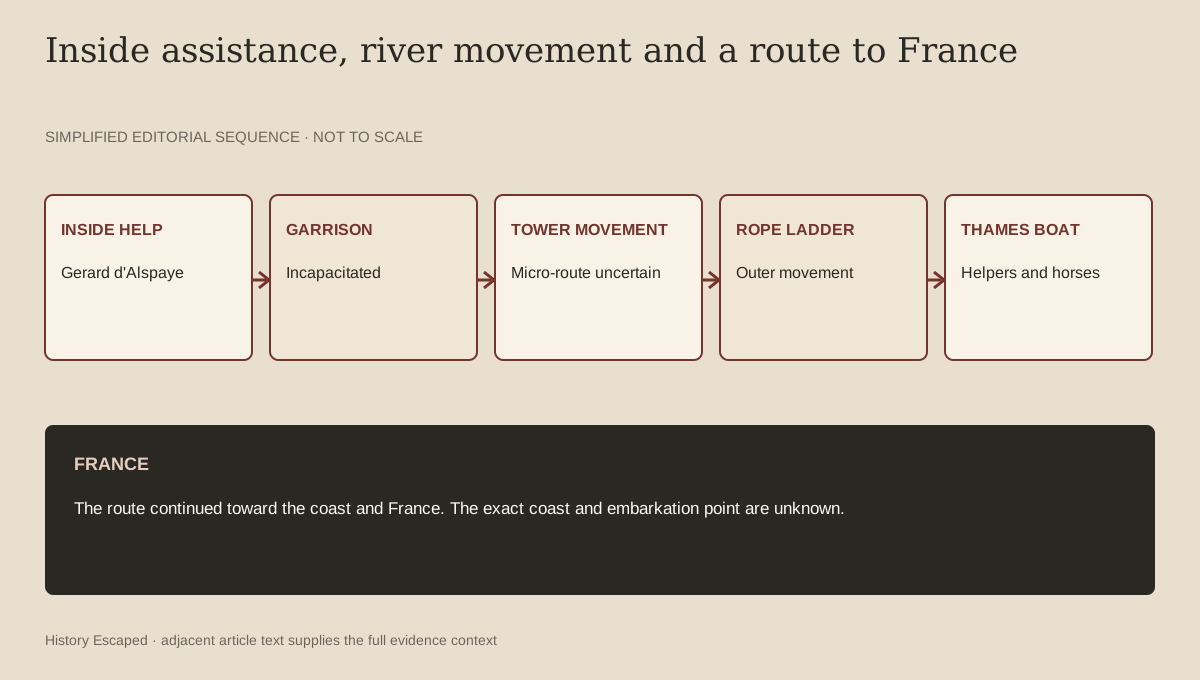
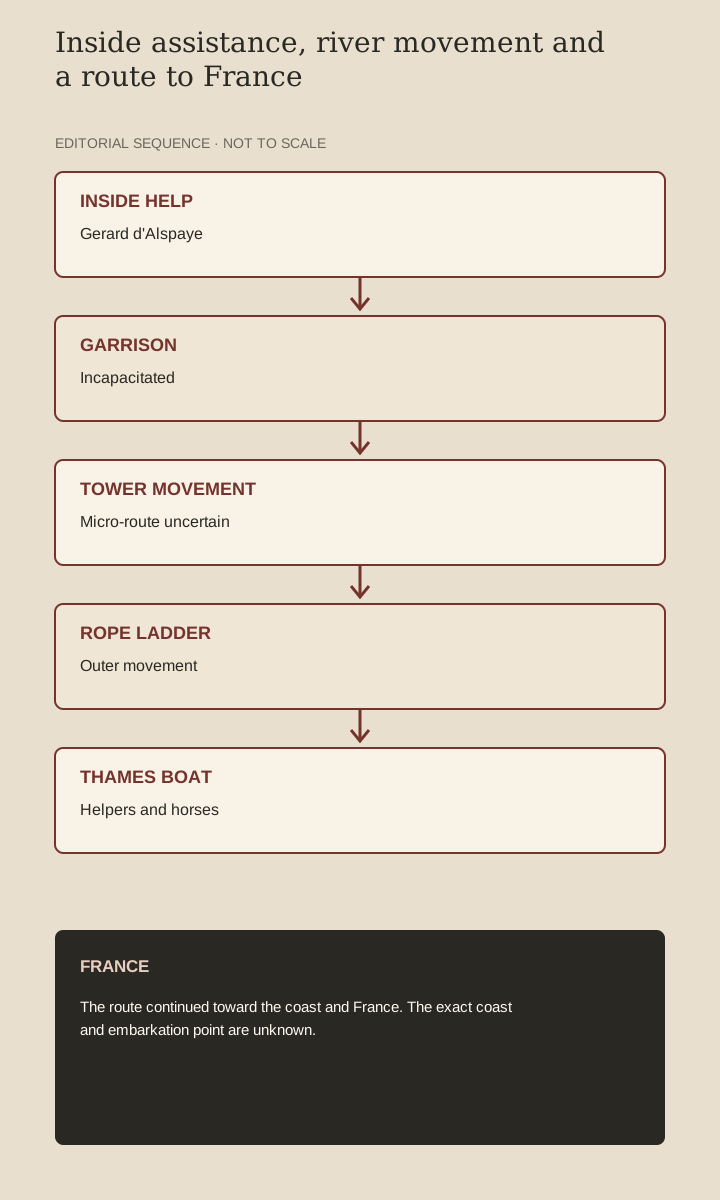
Simplified editorial sequence based on historical accounts; not to scale. Exact Tower micro-route and coastal embarkation point remain uncertain.

The Night of 1 August 1323
The reconstruction begins with what the different kinds of evidence agree on.
The guards were neutralized. D’Alspaye assisted Mortimer. Mortimer moved out of confinement and through the Tower complex. A rope ladder or ladders were used to descend from the defenses toward the river. Helpers waited outside. A boat carried the fugitives across the Thames. Horses and further assistance allowed Mortimer to continue toward the coast. He then crossed the Channel and reached France.
Later narrative sources provide a more cinematic route. They describe stones removed from a wall, movement through the royal kitchens, ascent through or over parts of the palace complex, and descent near the river. Ian Mortimer’s modern biography follows a highly detailed version of this path and names additional helpers. Seymour Phillips, in his major biography of Edward II, preserves the core sequence without requiring every architectural detail to be accepted as equally certain.
That is the better way to read the escape. The operation was clearly planned and involved multiple people. The exact internal path through the Tower is less secure than the fact that Mortimer escaped with official assistance and reached a prepared chain of transport.
Even the coastal route requires caution. Some older accounts send Mortimer toward Dover. Other research connects the escape network with Portsmouth or Portchester and a ship arranged from Normandy. The government’s rapid response establishes that Mortimer had crossed to France, but the surviving evidence does not justify presenting every mile of the journey as settled.

A Manhunt Across Edward II’s Realm
Edward II’s government reacted quickly.
Within days, royal commissions were being issued to arrest Mortimer. Orders went to officials in Wales and elsewhere. By September, instructions in the Gascon Rolls told royal officers in the king’s continental dominions to place spies where necessary and seize Mortimer if he appeared. The order explicitly identified him as a rebel who had recently escaped from the Tower and gone overseas.
The administrative record is especially valuable because it anchors the escape to 1323.
This corrects a long-lived chronological error. One detailed medieval account, followed by older scholarship including the nineteenth-century Dictionary of National Biography, placed the escape in 1324. E. L. G. Stones demonstrated in a 1951 note in The English Historical Review that the correct date was 1 August 1323. Royal orders generated immediately after the escape make the year impossible to mistake.
The 1324 date therefore belongs to the history of the story, not to the event itself.
Evidence discipline
What the record supports
Status labels distinguish secure conclusions from uncertainty and rejected claims. Color is never the only signal.
DOCUMENTED
Roger Mortimer escaped from the Tower on 1 August 1323.
Royal administrative records generated immediately after the escape establish 1323; E. L. G. Stones corrected the older 1324 chronology.
Sources: SRC-001, SRC-002, SRC-004DOCUMENTED
The Tower garrison was deliberately incapacitated during the escape.
The Close Rolls record that Stephen de Segrave and others were poisoned or incapacitated by artifice; narrative sources describe drugged drink.
Sources: SRC-001, SRC-005, SRC-006WELL-SUPPORTED
Gerard d’Alspaye assisted Mortimer from inside the Tower.
The main chronicle tradition and modern scholarly reconstructions consistently identify the Tower official as the key insider.
Sources: SRC-005, SRC-006, SRC-010DISPUTED
Adam of Orleton masterminded the escape.
Older accounts credit the bishop with organizing the operation, but Seymour Phillips states that no evidence proves Orleton took part in the August 1323 escape.
Sources: SRC-005, SRC-009MYTH
Mortimer escaped in 1324.
The year 1324 derives from a chronicle error repeated in older scholarship. Royal records and Stones’s correction establish 1323.
Sources: SRC-004, SRC-010UNKNOWN
Every room and architectural feature in the popular escape route can be reconstructed with certainty.
The broad sequence is strong, but some detailed features such as the exact cell breach, rooftop path, and internal geometry depend on later narrative reconstruction.
Sources: SRC-005, SRC-006, SRC-010DISPUTED
Mortimer embarked for France from a single securely identified port.
Older accounts and later reconstructions differ over the coastal route and embarkation point. The secure conclusion is that he reached the south coast and crossed to France.
Sources: SRC-005, SRC-006, SRC-010Was Bishop Adam of Orleton the Mastermind?
A second tradition needs similar care.
Older accounts often credit Adam of Orleton, bishop of Hereford and a political associate of the Mortimer faction, with organizing the escape from outside. Some biographical references repeat that claim directly.
Modern scholarship is more cautious. Seymour Phillips notes that Edward II suspected Orleton of sympathy and collusion with the Mortimers, but that there is no evidence proving he participated in the August 1323 escape.
That does not prove Orleton was uninvolved. It means the evidence does not justify calling him the mastermind as though that were documented fact.
D’Alspaye’s role, by contrast, sits much closer to the secure core of the event. The operation required someone with access inside the Tower, and the surviving narrative tradition consistently places him in that position.
Selected chronology
Selected chronology
Mortimer submits to Edward II
Roger Mortimer of Wigmore and Roger Mortimer of Chirk submitted at Shrewsbury after the collapse of the Marcher opposition.
Death sentence commuted
The younger Mortimer’s death sentence was commuted to perpetual imprisonment.
Escape from the Tower of London
With Gerard d’Alspaye’s assistance and the garrison incapacitated, Mortimer escaped the Tower, crossed the Thames, and entered a prepared flight network.
Royal pursuit expands
Edward II’s government issued commissions to raise forces and arrest Mortimer after his escape.
Gascony ordered to watch for Mortimer
Royal officers in Gascony were ordered to use spies and seize Mortimer if he appeared in the duchy.
Mortimer returns with Queen Isabella
Mortimer returned to England with Isabella’s invasion force, beginning the rapid collapse of Edward II’s government.
Mortimer executed at Tyburn
After Edward III seized personal control, Mortimer was condemned for treason and executed.
Freedom in France
Mortimer’s success was not merely that he crossed the Tower wall. It was that he escaped the king’s jurisdiction long enough to remain free.
By August 1323 Edward’s government knew he was abroad. The crown worried that he might move through Gascony, return toward Ireland, or coordinate with enemies and exiles. Attempts to isolate him continued.
Mortimer instead became part of the political opposition gathering outside England. In France he later joined Queen Isabella, Edward II’s estranged wife. Their political alliance — and, according to the dominant historical interpretation, their personal relationship — transformed Mortimer from fugitive into regime-threatening exile.
In September 1326 Isabella and Mortimer landed in England with a small invasion force. Edward II’s support collapsed with remarkable speed. The Despensers were captured and executed. Edward was deposed in favor of his son, Edward III.
Mortimer had gone from prisoner in the Tower to one of the central brokers of power in England in little more than three years.
The Escape Did Not End His Story at the Tower
The reversal was not permanent.
Mortimer accumulated land, wealth, offices, and influence during the minority of Edward III and was created Earl of March in 1328. His dominance created new enemies. In October 1330, the young Edward III seized power for himself and had Mortimer arrested at Nottingham Castle.
Mortimer was taken to London, condemned for treason, and executed at Tyburn on 29 November 1330. So the Tower remained part of his story in a larger sense: it was the place from which he escaped Edward II’s authority, but not the end of his confrontation with the English crown.
Problem → response
Escape was a sequence of problems
Each response solved a practical obstacle while often creating the next one.
- 01→
Obstacle
Controlled royal custody
Mortimer was confined in the Tower under officers responsible to Edward II.
Response
The escape depended on Gerard d’Alspaye’s cooperation from inside the institution.
- 02→
Obstacle
Tower walls and river-facing defenses
Leaving a secure royal fortress required more than gaining access to a corridor or gate.
Response
The fugitives used a rope ladder to descend toward the Thames.
- 03→
Obstacle
Immediate risk of royal pursuit
Once the escape was discovered, Edward II could mobilize officials, armed men, ports, and continental agents.
Response
A prepared chain of boat, horses, coastal movement, and Channel passage moved Mortimer beyond the king’s immediate reach.
Why the Escape Worked
Mortimer’s escape succeeded because it attacked the human system around the prison rather than the masonry alone.
First, he had an insider. D’Alspaye could move within the Tower and help create access that an isolated prisoner could not create by force.
Second, the timing mattered. A feast brought guards together and created an opportunity for food or drink to become the means of incapacitation.
Third, the plan extended beyond the walls. A boat, helpers, horses, and a Channel crossing had to exist in sequence. Getting outside the Tower but remaining trapped in London would have been only a temporary success.
Finally, Mortimer’s political importance worked both for and against him. It made the crown pursue him intensely, but it also meant he had supporters with enough resources and motivation to build an escape network.
The result was not a spontaneous dash. It was a coordinated extraction.
What the Popular Story Gets Wrong
The escape is often retold with a level of certainty the evidence does not support. It happened in 1323, not 1324. The guards were deliberately incapacitated, but the exact drug is unknown. The core route — out of custody, through the Tower, over or down the defenses, to a boat on the Thames — is strongly supported, but the precise room-by-room path comes from narrative sources and later reconstruction.
Adam of Orleton may have sympathized with Mortimer and may even have assisted indirectly, but calling him the proven organizer goes beyond the surviving evidence.
And Mortimer’s destination after leaving London should be described conservatively. He reached France. The exact road and embarkation point are less certain than many polished retellings suggest.
Those qualifications do not make the escape less impressive. They make it more historical.
Mortimer escaped one of the most formidable royal strongholds in England because a network reached from inside his prison to the river, the road, the coast, and another kingdom. The walls mattered. The people around them mattered more.