
On the morning of 4 April 1943, twelve prisoners walked out of the Davao Penal Colony compound as part of ordinary work details.
Ten were American prisoners of war. Two were Filipino prisoners who had agreed to guide them.
They were not climbing a wall, cutting wire or overpowering guards. Their escape depended on something more ordinary: being allowed outside the main enclosure to work. Once they were beyond the gate, they turned that routine into a breakout.
At a Glance
- Date: 4 April 1943
- Place: Davao Penal Colony, Mindanao, Philippines
- Escapees: 10 American POWs + 2 Filipino prisoners/guides
- American leader: Lt. Cmdr. Melvyn H. McCoy, U.S. Navy
- Filipino guides: Benigno de la Cruz and Victorio Jumarong
- Method: Work-detail deception, cached supplies, movement through swamp and jungle, then guerrilla assistance
- First guerrilla contact: 7 April 1943
- Allied connection: Mindanao guerrilla network with radio links to Australia
- Evacuation: Seven Americans left Mindanao later in three separate submarine extractions
- Americans who stayed: Paul Marshall, Robert Spielman and Leo Boelens
- Major outcome: The escapees supplied U.S. authorities with firsthand evidence of the Bataan Death March and POW-camp conditions
From Bataan and Corregidor to Davao
The men who escaped Davao had already survived some of the worst phases of the Japanese conquest of the Philippines.
Some had surrendered on Bataan. Others were captured when Corregidor fell in May 1942. Between them, they had experienced the Death March, Camp O’Donnell, Cabanatuan, Bilibid Prison and the broader system of Japanese captivity that followed the collapse of organized American-Filipino resistance.
In late October 1942, about a thousand American prisoners were selected for transfer from Cabanatuan. After passing through Bilibid, they were packed aboard a transport bound for Mindanao.
They arrived near Davao in early November and then marched inland to the penal colony. Davao seemed, at first, like an improvement.
A Prison Farm With Food the POWs Could Not Control
Before the war, the Davao Penal Colony had been a large Philippine prison plantation. It produced rice, fruit and other food and included extensive agricultural land. The Japanese converted the site into a POW camp.
Official Marine Corps history notes that the food at Davao was initially better than at Cabanatuan. Prisoners sometimes received fish or meat, and there was more agricultural produce around them than in the camps on Luzon. But abundance on the farm did not mean control over food.
The prisoners remained on inadequate rations and under forced labor. They cut timber, hauled gravel, farmed, built defensive works and performed other jobs for the Japanese occupation system. Disease and beatings remained part of camp life.
The 1944 U.S. Military Intelligence report on POW camps makes the distinction clear: Davao had at first been better than Cabanatuan, but conditions deteriorated. Malaria was widespread, sick men could still be forced to work, and later escape attempts brought additional restrictions.
For the men planning to leave in early 1943, the relevant question was not whether Davao was the worst place they had been. It was whether staying there offered a tolerable future.
Two Escape Plans Become One
The escape did not begin as one unified project.
Marine officers Austin Shofner, Jack Hawkins and Michiel Dobervich were considering a breakout. William Dyess, Samuel Grashio and Leo Boelens were also thinking along similar lines.
A second group centered on Melvyn McCoy, Stephen Mellnik, Paul Marshall and Robert Spielman. The groups eventually learned about one another and merged.
McCoy, as the senior officer and an experienced navigator, became the leader. Mellnik took a major planning role.
Their original objective was extraordinarily ambitious: get away from Davao, reach a coast, obtain a boat and somehow sail toward Allied territory. Australia was more than a thousand miles away.
The Two Filipinos
The plan became far more realistic when Benigno de la Cruz and Victorio Jumarong joined it.
Both were Filipino prisoners in the penal colony. Wartime American accounts described them as men serving sentences for homicide or murder. Those descriptions should not obscure what they became in the escape plan: partners whose local knowledge was essential. They knew the terrain and the surrounding Filipino population.
Other Filipino prisoners also supplied information. Later histories describe a map being drawn of possible paths around the swamp.
The Americans could organize the work details, collect supplies and navigate at sea. They could not cross unfamiliar Mindanao country alone with the same confidence.
Selected chronology
Selected chronology
American POWs reach the Davao area
About a thousand prisoners transferred from Cabanatuan arrive on Mindanao and are marched to the Davao Penal Colony.
Escape rehearsal
The official Marine Corps history records a successful dummy run using the work-detail arrangement.
Davao breakout
Ten American POWs and two Filipino prisoners leave the penal colony through the work-detail system and enter the swamp/jungle.
First guerrilla contact
After several days in the swamp, the party reaches local Filipinos who conduct them to the Longaog guerrilla outpost.
Northward trek begins
With local guerrilla escorts and guides, the party leaves for the larger American-led guerrilla network in northern Mindanao.
Contact with the Tenth Military District
The escapees enter the larger guerrilla command and obtain access to radio communication with Allied authorities.
McCoy, Mellnik and Dyess evacuated
The first three American escapees leave Mindanao aboard USS Trout; McCoy’s report and guerrilla-submarine chronology place the rendezvous on 9 July.
Briefing MacArthur in Brisbane
Dyess, McCoy and Mellnik are photographed with General Douglas MacArthur after reporting their experiences to Allied command.
Grashio evacuated on USS Bowfin
USS Bowfin takes Samuel Grashio and other evacuees from Mindanao to Allied territory.
Three Marines evacuated on USS Narwhal
Shofner, Hawkins and Dobervich leave Nasipit after months of service with the Mindanao guerrillas.
William Dyess dies
Dyess is killed in a P-38 crash in California before the full public release of his POW narrative.
Leo Boelens killed in action
Boelens is killed while still serving with guerrilla forces on Mindanao.
The escapees’ POW testimony reaches the public
After earlier restrictions, accounts by McCoy, Mellnik and Dyess are released widely through magazines, newspapers and books.
Building a Breakout Inside Daily Routine
For roughly two months, the group accumulated supplies.
Food, medical material and equipment were moved outside the compound in small quantities and hidden near the fields. The use of normal prison labor was central to the plan.
Shofner controlled or participated in a plowing detail. McCoy arranged another work group operating nearby.
The objective was to place all ten Americans outside the main prison enclosure at the same time without making their movement look extraordinary. The official Marine Corps history records a successful rehearsal on 14 March 1943.
A planned attempt later in March was postponed after camp circumstances changed. The next opportunity came on Sunday, 4 April.
April 4
At about eight in the morning, the work parties left the prison compound. The men passed the gate as prisoners who were supposed to be going to their jobs.
Once clear of the immediate guard system, the two groups doubled back toward their rendezvous and uncovered supplies hidden outside the camp. They then waited.
De la Cruz and Jumarong had been delayed by the guards and did not reach the meeting point immediately. The American party remained dangerously close to the Japanese barracks for roughly two hours.
At about 10:30, the Filipino guides arrived. The twelve men entered the jungle. The escape had begun.
The Route Immediately Goes Wrong
Their first major problem was navigation.
The official Marine history says the group missed the trail it had intended to follow. The heavy rain that began that day helped obscure tracks, but it also contributed to brutal travel conditions. The party became trapped in swamp and dense vegetation.
Men hacked through growth with bolos. The weakened former POWs struggled with exhaustion, insects and lack of sleep. Later retellings emphasize crocodiles and other dangers; the official history records that the escapees learned after reaching the guerrillas that the swamp they had crossed contained crocodiles.
What matters more than the wildlife is that the route did not unfold according to plan. For roughly three days, the twelve were moving through hostile terrain while Japanese search parties looked for them.
Gunfire in the Distance
On the third day, the escapees heard firing and saw signs of combat in the distance. They initially moved away from it.
The following day, 7 April, they investigated the area and found evidence that fighting had taken place. They continued north and eventually reached an occupied house.
The people there did not betray them. Instead, they brought the fugitives to a guerrilla outpost at Longaog. This was the real turning point.
They had escaped the penal colony on 4 April. On 7 April, they entered an organized Filipino resistance network.
Local Assistance Changes the Plan
At Longaog, the men received food, shelter and rest. They also received information that made their original plan look unnecessary and dangerous.
The escapees had expected to make for the coast and try to reach Australia themselves. Local guerrillas told them that a much larger resistance organization existed farther north on Mindanao and that it had radio communication with Allied forces.
Captain Claro Laureta of the Philippine Constabulary became one of the important intermediaries. His network could provide guides, escorts and intelligence.
The escapees abandoned the idea of an independent sea voyage. Their new goal was to reach the American-led guerrilla command.
The Long Trek North
The party left the local guerrilla area on 21 April.
The official Marine Corps history describes a long and difficult journey to Medina on the northwestern side of Mindanao, where they entered the orbit of Lt. Col. Ernest McLish’s 110th Division and the wider Tenth Military District under Wendell Fertig.
The exact path between those points is less secure than the dates and major destinations. There is a reason. When McCoy and Mellnik prepared their wartime account, they explicitly said they were not publishing an approximate route across Mindanao and were withholding guerrilla-unit information because it still had military value.
Later memoirs and histories provide more geographical detail. The earliest account was deliberately incomplete. A responsible reconstruction should remain incomplete too.
Allied Contact
Once inside the northern Mindanao guerrilla network, the escapees were no longer isolated fugitives.
Fertig’s forces had radio contact with General Douglas MacArthur’s command in Australia. U.S. Navy officer Charles “Chick” Parsons was also operating the submarine supply and intelligence connection to the Philippine guerrillas.
Information from the escapees could now move beyond Mindanao. That mattered almost as much as their physical escape. They had firsthand knowledge of the fall of the Philippines, the Bataan Death March, the POW camps and Japanese treatment of prisoners.
The group had wanted to reach Allied territory to tell that story. Now the story could begin moving before all of them did.
Documentary reconstruction
Breakout, guerrilla contact and divergent outcomes
A case-local editorial visual separates the documented sequence from uncertainty without implying exact modern geography or operational detail.
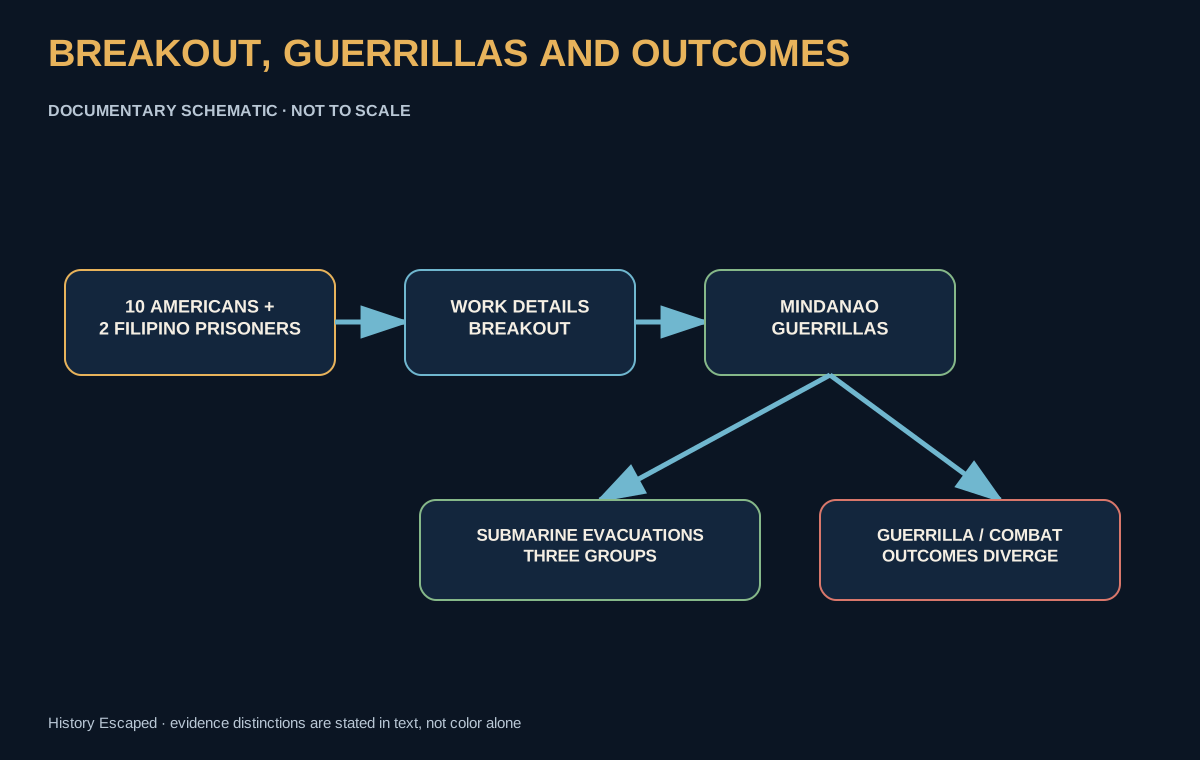
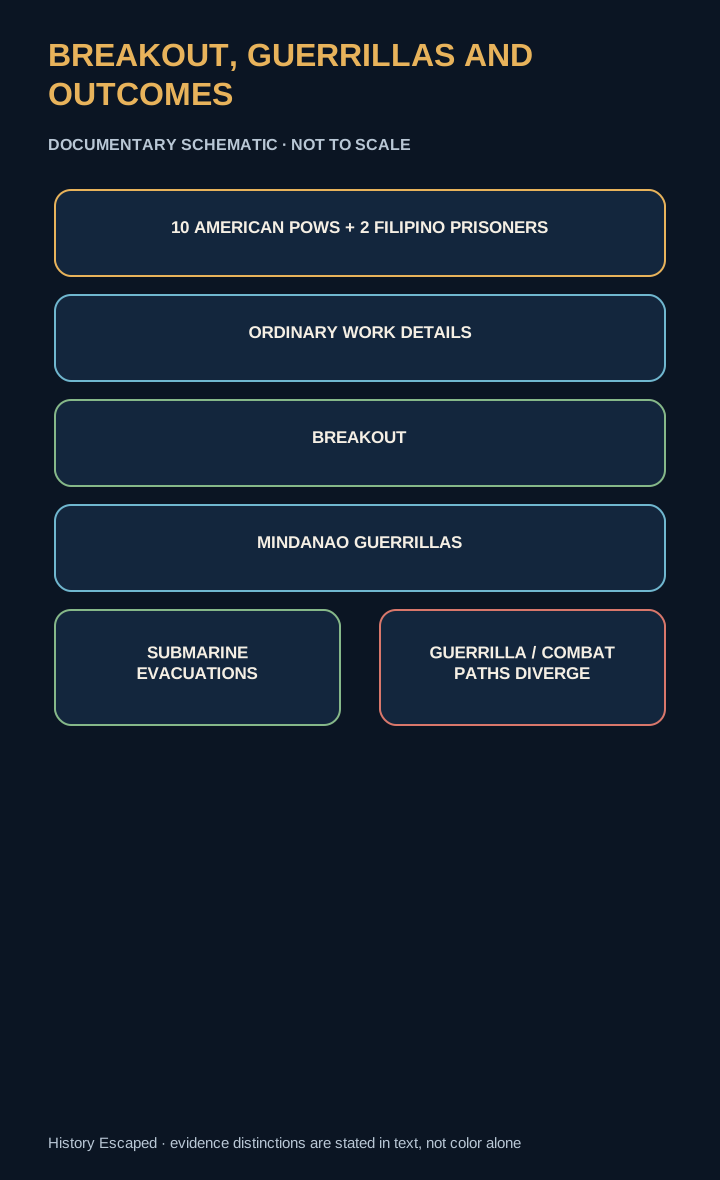
Simplified editorial reconstruction based on the cited historical record; not to scale. Uncertainty is stated directly in the visual and adjacent text.
The Group Splits
The Davao escape is often narrated as if all ten Americans simply reached a submarine and sailed away. They did not. The months after guerrilla contact produced several different paths.
McCoy, Mellnik and Dyess were the first of the ten to leave Mindanao. McCoy’s wartime report places their submarine rendezvous on 9 July 1943. They were evacuated aboard USS Trout and reached Australia.
By 30 July, the three were photographed with General MacArthur in Brisbane. Their presence at Allied headquarters transformed them from escaped POWs into official eyewitnesses.
Grashio Leaves on Bowfin
Samuel Grashio remained in Mindanao longer. The Pacific Fleet Submarine Museum’s patrol history records that USS Bowfin picked him up on 29 September 1943 during a clandestine Philippine mission.
He was not alone on the submarine. The boat also evacuated other guerrilla personnel and civilians. Grashio’s extraction was therefore part of the wider submarine supply and intelligence system supporting resistance in the occupied Philippines.
The Three Marines Stay for Months
Austin Shofner, Jack Hawkins and Michiel Dobervich did not immediately leave. They joined the 110th Division and took staff roles in the guerrilla command.
Official Marine history says Shofner became deputy chief of staff and assistant operations officer, Hawkins the division intelligence officer, and Dobervich the supply officer. They also participated in operations against Japanese positions.
They remained for roughly six more months. On 15 November 1943, the three Marines boarded USS Narwhal at Nasipit in Butuan Bay and were evacuated to Australia. Their escape from Davao had become a return to active war.
Three Americans Remain
That left Paul Marshall, Robert Spielman and Leo Boelens in Mindanao. Marshall and Spielman remained with the guerrillas and survived the war. Boelens also continued serving in the resistance.
He did not survive. Guerrilla records and later military sources place his death in action on 22 January 1944 while serving in Mindanao. This is an important correction to the idea that “the Davao ten” all made it home.
Nine of the ten Americans survived the war. Boelens did not.
What Happened to de la Cruz and Jumarong?
The wartime American publication gave de la Cruz and Jumarong credit but did not preserve their later lives with anything like the detail devoted to the U.S. servicemen. That imbalance continues in much of the historical record.
Local Davao historical research states that Jumarong served with the Mindanao guerrillas until the war ended and that both Filipino escapees survived. The post-escape record for de la Cruz is less complete in accessible primary sources.
Their importance does not depend on reconstructing a postwar biography. They were part of the breakout itself. Without them, the Americans would have been entering unfamiliar terrain with far less local knowledge and no guaranteed bridge into Filipino communities.
Evidence discipline
What the record supports
Status labels distinguish secure conclusions from uncertainty and rejected claims. Color is never the only signal.
MYTH
Only ten people escaped Davao Penal Colony on 4 April 1943.
Ten American POWs and two Filipino prisoners escaped together. Early American accounts often counted only the ten U.S. servicemen.
Sources: SRC-001, SRC-003, SRC-005MYTH
Benigno de la Cruz and Victorio Jumarong were guides encountered only after the Americans escaped.
They were prisoners inside Davao Penal Colony and joined the escape plan before 4 April.
Sources: SRC-003, SRC-010MYTH
The group climbed over the camp perimeter at night.
The Americans passed through the gate as members of authorized daytime work details and broke away outside the main compound.
Sources: SRC-001, SRC-003MYTH
The escape party followed its planned trail cleanly through the swamp.
The official Marine history says the party missed the intended trail and spent several difficult days lost or disoriented in swamp and jungle.
Sources: SRC-001MYTH
The complete route across Mindanao is documented in the original wartime account.
McCoy and Mellnik explicitly stated that route and guerrilla information was intentionally withheld because it still had military value.
Sources: SRC-003MYTH
All ten American escapees were evacuated together.
Seven left Mindanao in three later submarine evacuations; Marshall, Spielman and Boelens remained with the guerrillas.
Sources: SRC-005, SRC-006, SRC-007MYTH
All ten American escapees survived the war.
Leo Boelens was killed in action on 22 January 1944. William Dyess survived captivity and escape but died in an aircraft accident in December 1943.
Sources: SRC-009, SRC-012MYTH
The escapees’ testimony was published immediately after they reached Allied territory.
U.S. authorities initially restricted publication. Public dissemination of the major POW accounts came in early 1944.
Sources: SRC-005, SRC-011MYTH
Davao was uniformly worse than Cabanatuan from the moment the POWs arrived.
Official U.S. sources say Davao initially had somewhat better food and medical conditions than Cabanatuan, although forced labor, disease, beatings, inadequate rations and later deterioration remained serious.
Sources: SRC-001, SRC-002The Story Reaches MacArthur
McCoy, Mellnik and Dyess were extensively debriefed after reaching Australia.
They told U.S. commanders what had happened to prisoners after the collapse of Bataan and Corregidor.
The Bataan Death March had not been completely unknown before their arrival. Other reports had reached Allied channels.
What the Davao escapees provided was a powerful body of firsthand military testimony from officers who had survived captivity and physically reached Allied command. Their evidence helped turn fragments and rumors into an authoritative record.
Then Washington Delayed Publication
The public did not immediately hear everything the escapees had said. Military authorities initially restricted publication of their accounts.
Part of the concern was operational security: the Mindanao guerrilla network and submarine supply routes were active. McCoy and Mellnik themselves withheld route and unit details from their wartime narrative.
There was also broader government caution over information about POW treatment. Dyess’s story became the subject of a prolonged dispute over release. By early 1944, the restrictions loosened.
“Ten Escape from Tojo” and The Dyess Story
McCoy and Mellnik’s account appeared publicly under the title Ten Escape from Tojo, first in magazine form and then as a book. Dyess’s testimony appeared in syndicated newspaper articles and in The Dyess Story. The accounts described the Death March, starvation, disease, beatings, killings and prison conditions in language that was shocking to American readers.
Dyess did not live to see the full public impact. He died in a P-38 crash in California on 22 December 1943, after surviving Bataan, imprisonment and the Davao escape. When his narrative appeared in 1944, it was already the testimony of a dead witness.
What the Escape Actually Accomplished
The twelve did more than get out of a prison camp. They crossed the gap between occupied territory and Allied command.
The ten Americans did not all follow the same route afterward, and the two Filipino guides did not vanish from the story once the swamp ended. Local civilians, guerrillas, porters, guides, radio operators and submarine crews turned the initial breakout into a functioning line back to the Allied war.
That is why the escape mattered beyond its audacity. Davao was not the end of the journey.
It was the point where prisoners became witnesses again. ---
