
On 14 December 1944, 150 American prisoners of war remained at Camp 10-A near Puerto Princesa on the Philippine island of Palawan. By the end of the Japanese killing operation that afternoon and evening, most were dead. Eleven men survived—not because the massacre failed to begin, but because they escaped from shelters, cliffs, rocks, refuse, jungle, and shoreline while Japanese troops continued to search for men who had broken out.
Their survival was only the first stage. Some crossed Puerto Princesa Bay toward the Iwahig area; others hid for days before moving. Filipino civilians, prisoners at Iwahig, fishermen, and members of the Palawan Special Battalion then fed, clothed, treated, concealed, moved, and eventually connected the Americans with Allied forces. The result was not one clean escape route but a collection of separate escapes that gradually became an organized recovery.
At a Glance
- Date of massacre: 14 December 1944
- Place: Camp 10-A, Puerto Princesa, Palawan, Philippines
- American POWs present: 150
- Best-supported death toll: 139
- Survivors: 11
- First documented air evacuation: six survivors from Brooke’s Point to Morotai on 6 January 1945
- Later documented evacuation: Douglas Bogue, Fern Barta, and Glenn McDole were picked up on 21 January and taken to Leyte
- Critical assistance: Filipino civilians, Iwahig prisoners, and the Palawan Special Battalion
Camp 10-A and the shrinking margin for survival
The Japanese had established Camp 10-A for American POWs sent to Palawan to build and maintain an airfield at Puerto Princesa. Hundreds had passed through the camp since 1942, but by December 1944 only 150 remained. Conditions had long included hunger, illness, beatings, forced labor, and executions following escape attempts.
The strategic situation had changed sharply by late 1944. American forces had returned to the Philippines, U.S. aircraft were striking Palawan, and Japanese commanders had reason to fear that Allied forces might reach the island. Later investigations and military histories connected the massacre to orders or policies intended to prevent prisoners from being liberated, though the surviving documentary trail is more secure about the deliberate killing at Camp 10-A than about every step in the higher command chain.
The POWs had previously used covered air-raid trenches during attacks. On 14 December, however, guards forced the prisoners into the shelters under circumstances that survivors remembered as different from earlier alerts. The killing began when Japanese troops poured fuel into or around the shelters and ignited it, then fired on prisoners attempting to get out.
The massacre cannot be separated from the escape. The men who became “survivors” did so while the killing was still underway, and many other prisoners who initially broke from the shelters were killed on the camp grounds, on the cliff, along the shore, or while hiding nearby.
Breaking out did not mean reaching safety
Survivor accounts agree on the broad mechanism without producing a single identical sequence for every man. Prisoners in the shelters nearer the camp perimeter forced openings toward the cliff and shoreline. More than a handful got beyond the shelters, but Japanese troops pursued men who had escaped the immediate fires.
Rufus W. Smith and Glenn W. McDole were among those who came out from the shelter area near the cliff. Smith later described hiding in vegetation while Japanese troops searched nearby. McDole concealed himself in the camp’s refuse area and remained in danger even after the main killing had ended. Douglas W. Bogue reached the rocky area below the camp and hid while searchers moved through the shore zone.
Other survivors followed different paths. Eugene P. Nielsen escaped wounded and eventually entered the water. Alberto D. Pacheco and Edwin A. Petry hid together in a coastal cavity until the tide forced them out. Fern Joseph Barta survived separately and spent days in hiding before reaching Filipino assistance.
The available accounts make one point especially important: there was no moment on 14 December when all eleven surviving POWs gathered and began a common march to freedom. They were dispersed, some unaware that anyone else had lived. Their separate movements make later summaries that describe “the eleven” swimming or traveling together misleading.
Across the bay and into Filipino hands
Several survivors attempted the long crossing of Puerto Princesa Bay toward the Iwahig side. The National WWII Museum’s reconstruction, based heavily on survivor testimony and wartime records, describes a crossing of roughly five miles for some men, with currents increasing the distance actually traveled. The exact path of any individual swimmer should not be treated as survey-quality geography.
Nielsen reached the opposite side wounded and exhausted, then encountered a Filipino who led him to friendly contacts. There he learned that Pacheco and Petry had also survived. Smith likewise reached the Iwahig side and received food, clothing, and treatment from Filipinos. McDole, after remaining hidden for days, eventually entered the bay and was helped after reaching a fish trap.
Bogue’s wartime statement describes five days and nights in the jungle before prisoners connected with the Iwahig Penal Colony found and assisted him. Barta’s path took longer; later records describe him spending about ten days in the jungle before reaching safety. These differences are why a single “escape duration” would be false precision.
The Filipino role went far beyond a chance encounter. Local people provided immediate aid, while the Palawan Special Battalion supplied an organized network capable of sheltering men, moving them south, relaying intelligence, and communicating with Allied headquarters. The battalion had developed from resistance organizations on Palawan and became part of a broader guerrilla and intelligence structure linked to the Sixth Military District.
Some of the former POWs were moved from the Iwahig area toward Aborlan and then to Brooke’s Point in southern Palawan. A wartime photograph of a local outrigger canoe later used in museum interpretation illustrates the kind of coastal transport available, but surviving records do not justify assigning one identical conveyance or route to every survivor.
From concealment to Allied control
Filipino guerrillas reported the massacre and the existence of survivors through their intelligence channels. The first report reaching higher headquarters was imperfect. It gave the wrong date, described only the survivors then known to the guerrillas, and itself warned that parts of the account were unverified. Those defects help explain why Allied intelligence initially treated the news cautiously.
By early January, the picture was stronger. On 6 January 1945, a U.S. Navy PBY Catalina reached Brooke’s Point and evacuated six Palawan survivors to Morotai in the Dutch East Indies. Eugene Nielsen was debriefed there the next day. Those interviews helped transform a guerrilla report into an Allied intelligence account supported by men who had been inside Camp 10-A.
Not every survivor was on that aircraft. Bogue’s contemporary statement records that he, Barta, and McDole reached Brooke’s Point later and were picked up by a PBY on 21 January, arriving at Leyte that evening. Other records indicate that the remaining survivors were recovered separately; the surviving sources used for this reconstruction are not equally precise about every final transfer.
This staggered recovery matters. “Eleven survived” is an outcome count, not the passenger list of one rescue flight. The first six reached Morotai on 6 January, at least three more were documented in the 21 January pickup, and the complete eleven-person survivor roster emerged through later reconciliation of statements and records.
Eleven survivors, not a shifting memorial total
The strongest modern reconciliation begins with 150 Americans at Camp 10-A and ends with 139 killed and 11 survivors. The best-supported survivor roster is William J. Balchus, Fern Joseph Barta, Douglas W. Bogue, Thomas T. “Tommie” Daniels, Elmo V. Deal, Ernest J. Koblos, Glenn W. McDole, Eugene P. Nielsen, Alberto D. Pacheco, Edwin A. Petry, and Rufus W. Smith.
That arithmetic has not always appeared cleanly in public memory. Early reports were produced while survivors were still scattered and information was incomplete. A Japanese count overheard by Smith suggested 149 dead, which reflected what the perpetrators believed or reported that night rather than the final verified total. Contemporary press and later memorials also produced figures such as 141 or 143.
A particularly revealing memorial error concerns Don T. Schloat. Schloat had been a POW on Palawan and later became deeply involved in memorializing the massacre, but he had been transferred away before 14 December. One Plaza Cuartel survivor inscription nevertheless lists him and omits Douglas Bogue. The U.S. War Memorials Overseas database now explicitly flags the substitution as incorrect.
The recovery of remains creates another denominator that should not be confused with the death toll. U.S. personnel later recovered the remains of 123 victims from the site. That number represents recovered remains, not a revised claim that only 123 men died. The difference between 123 recovered victims and 139 men killed is part of the postwar accounting problem.
What the survivors changed
The men who escaped Palawan carried evidence of a massacre that Allied planners feared could be repeated elsewhere in the Philippines. Their testimony did not single-handedly create every subsequent POW rescue plan, and later claims sometimes compress a complicated operational story into one dramatic cause-and-effect line. Yet official and specialist histories agree that Palawan became an important warning as U.S. forces approached other camps.
Within weeks, American and Filipino forces were carrying out major liberations at Cabanatuan, Santo Tomas, Bilibid, and Los Baños. The Palawan survivors’ accounts strengthened the urgency behind efforts to reach prisoners before retreating Japanese forces could kill them.
The escape therefore belongs to more than the history of individual endurance. Eleven men survived the destruction of Camp 10-A, but their path to Allied control depended on a Filipino network that turned isolated fugitives into protected survivors, moved intelligence out of occupied territory, and brought recovery aircraft to Brooke’s Point.
The massacre remains the defining fact of 14 December 1944: 139 American POWs were killed. The escape story does not soften that fact. It explains how eleven men survived it, why their movements cannot be reduced to one route, and how Filipino assistance carried the survivors from immediate evasion toward freedom and testimony.
Evidence discipline
What the record supports
Status labels distinguish secure conclusions from uncertainty and rejected claims. Color is never the only signal.
WELL-SUPPORTED
The massacre left 139 dead and 11 survivors from 150 POWs present.
This is the strongest modern reconciliation across U.S. military history, museum scholarship, survivor records, and roster research. Early reports and some memorials used different figures.
Sources: SRC-001, SRC-002, SRC-003, SRC-011MYTH
All eleven survivors escaped and traveled together by the same route.
Survivor testimony shows separate hiding places, different bay crossings, different durations in concealment, and staged recoveries.
Sources: SRC-002, SRC-006, SRC-009MYTH
Don T. Schloat was one of the eleven massacre survivors.
A Plaza Cuartel survivor memorial incorrectly lists Schloat. He had been a Palawan POW but was transferred away before 14 December; Douglas W. Bogue belongs in the survivor roster.
Sources: SRC-010, SRC-011DISPUTED
The guerrillas’ first report immediately established the exact date, mechanism, and survivor count.
The initial report was valuable but contained a wrong date, an incomplete survivor count, and explicit uncertainty. Later survivor debriefings and investigations corrected the record.
Sources: SRC-002, SRC-004MYTH
123 recovered remains means only 123 POWs were killed.
123 is the later remains-recovery figure. It is a different denominator from the best-supported death toll of 139.
Sources: SRC-004Documentary reconstruction
Survivor pathways and recovery stages
A case-local editorial visual separates the documented sequence from uncertainty without implying exact modern geography or operational detail.
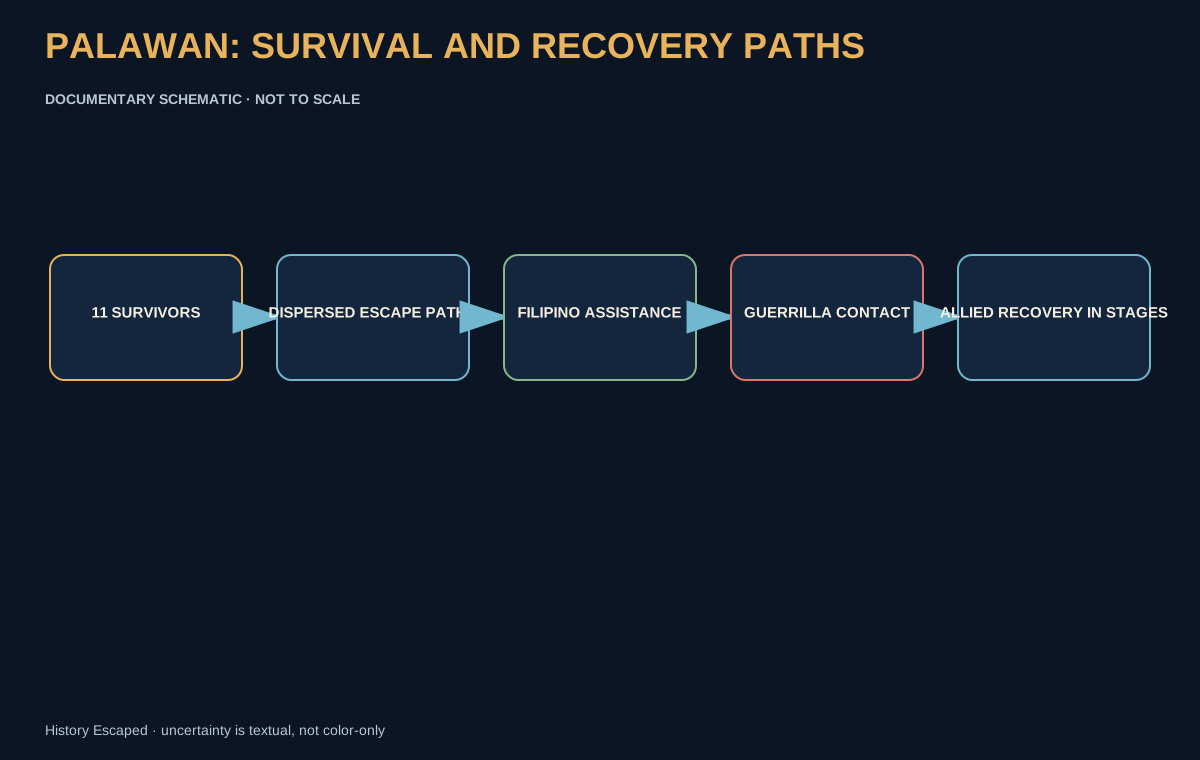
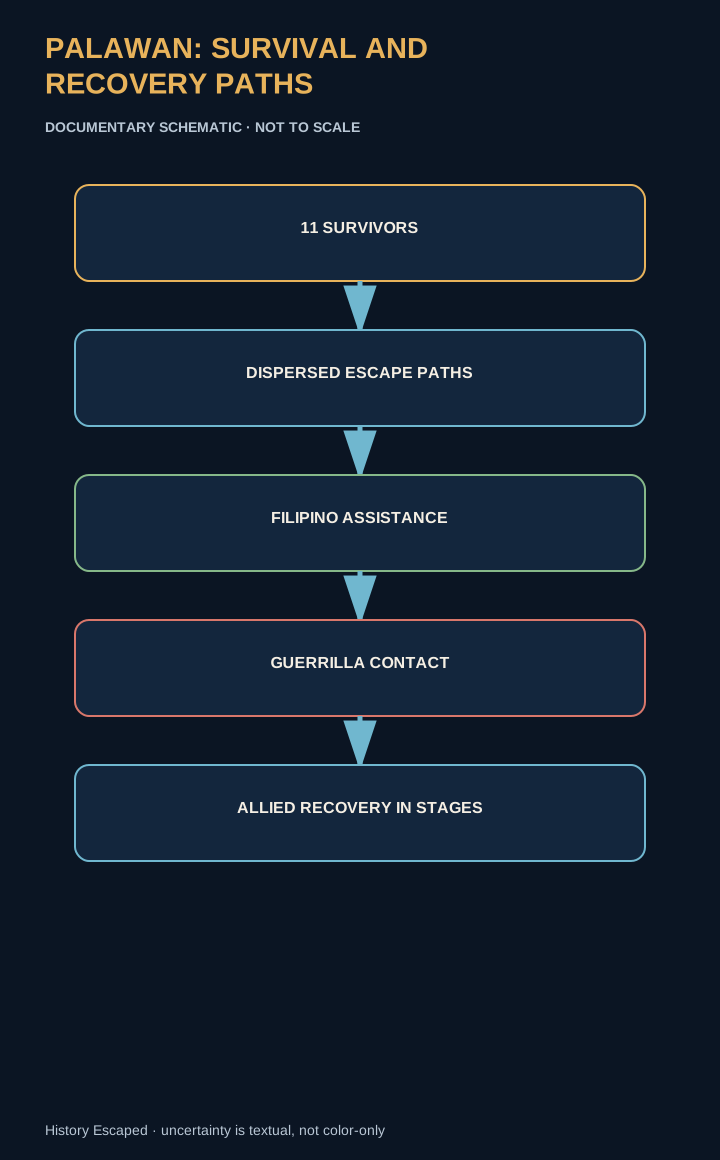
Simplified editorial reconstruction based on the cited historical record; not to scale. Uncertainty is stated directly in the visual and adjacent text.