
On the evening of 20 December 1815, a woman left the Conciergerie prison in Paris after visiting a condemned prisoner. Her face was partly hidden. Her daughter accompanied her. The prison staff had seen the same family ritual before, and a sedan chair waited outside.
The woman was not Émilie de Lavalette. She was still inside.
The person passing through the prison gates was Émilie's husband, Antoine-Marie Chamans, comte de Lavalette, a former senior official of Napoleon's government who was scheduled to be executed the next day. The escape depended on disguise, but clothing alone was not enough. It worked because the Lavalettes exploited something more powerful: routine. Émilie's repeated prison visits had taught the guards what to expect. On the final evening, Lavalette stepped into that expectation and walked out.
His freedom was not secure when the prison door closed behind him. The escape unfolded in two stages. First came the substitution at the Conciergerie and a hurried movement into concealment in Paris. Only later did another network—most famously including three British helpers—get him beyond France.
A death sentence after the Hundred Days
Lavalette's importance in 1815 came from his close association with Napoleon. He had served Bonaparte as an aide-de-camp and became director general of the French postal administration under the Empire. When Napoleon returned from Elba in 1815, Lavalette resumed control of the postal service during the Hundred Days.
After Waterloo and the restoration of Louis XVIII, that conduct placed him in danger. The restored monarchy prosecuted a number of prominent figures connected with Napoleon's return. Lavalette was brought before the Seine assize court, convicted in November 1815, and sentenced to death. His case included accusations connected with the return of Napoleon and with his assumption of public authority during the Hundred Days.
Lavalette contested the case against him. His later declarations insisted that he had not been involved in a prearranged conspiracy to bring Napoleon back from Elba. Whatever the broader political argument, the legal danger was real. The Court of Cassation rejected his appeal in mid-December.
Émilie de Lavalette then tried to obtain clemency. She appealed to the monarchy, but no pardon arrived in time. Execution was fixed for 21 December.
By 20 December, the problem was no longer theoretical. If Lavalette remained in the Conciergerie overnight, the state could carry out the sentence the following morning.
Material evidence
Tools of Escape
The objects used in an escape reveal how a plan worked under constraint.
- 01Decisive disguise
Émilie's clothing
The principal disguise that allowed Lavalette to reproduce the appearance of his wife's departure from the prison.
- 02Recognition control
Face covering / veil
Helped obscure Lavalette's face while making visible distress plausible during the exit.
- 03Extraction handoff
Sedan chair
A familiar part of Émilie's visiting routine that moved Lavalette away from the immediate prison entrance.
- 04International flight
British officer disguise
A later disguise used during the separate operation to move Lavalette out of France.
The opportunity hidden inside a routine
The Conciergerie was a working prison attached to the Palais de Justice. It had held political prisoners through the revolutionary and post-revolutionary eras, and Lavalette was not being held in a place from which a simple dash for an exterior wall would have been realistic.
The useful weakness was procedural rather than architectural.
Émilie had been allowed to visit her husband. Her presence therefore did not need to be invented on the day of the escape. Nor did the sedan chair associated with her visits. The guards already had a mental model for what an ordinary departure looked like: the comtesse arrived, visited the prisoner, and left again with the people and conveyance connected to her.
That made substitution possible.
On 20 December, Émilie came to the prison with the couple's daughter Joséphine. Published accounts disagree over Joséphine's exact age, but they agree on her presence and on her participation in the departure. The group entered under the cover of an ordinary final visit to a condemned man.
The plan required Lavalette to become, at least for the few minutes that mattered, the person the guards expected to see leaving.
Escape sequence
A prison substitution followed by a separate international escape
The visual keeps Émilie’s Conciergerie operation distinct from the later British-assisted flight out of France.
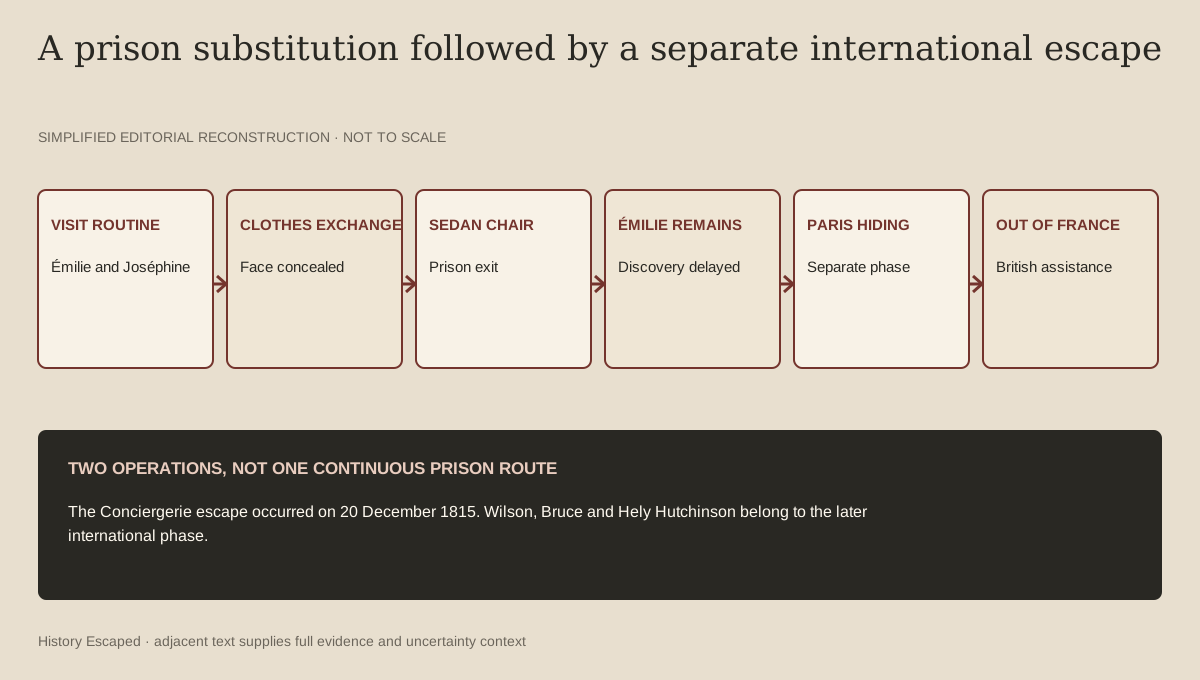
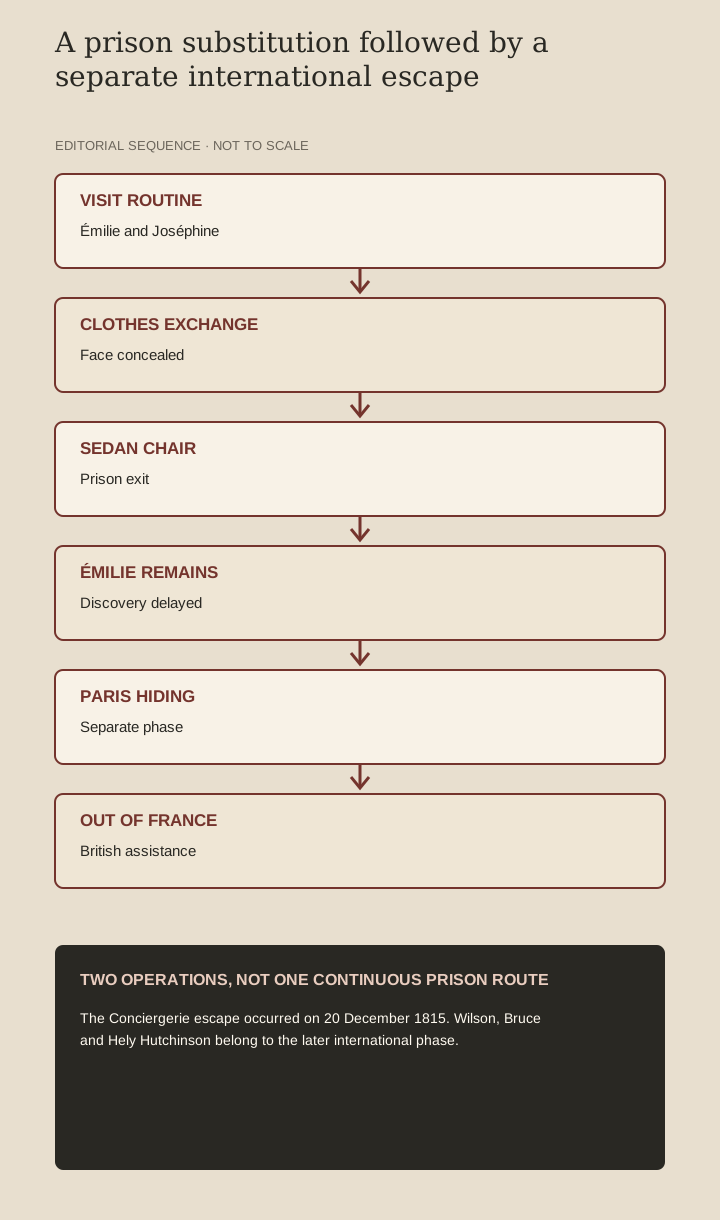
Simplified editorial sequence; not to scale. The later British helpers belong to the international phase, not the prison clothing exchange.

The exchange
Inside the prisoner's room, husband and wife exchanged clothing.
Later accounts describe a woman's outer costume substantial enough to alter Lavalette's outline and headwear or a veil that helped obscure his face. The exact inventory varies by retelling, and there is no reason to turn every accessory into a fixed technical specification. The mechanism is clear without that embellishment: Lavalette put on Émilie's clothes, concealed his face as much as the situation allowed, and prepared to leave as though he were the departing comtesse.
Émilie stayed behind.
This was the decisive risk of the plan. She was not merely lending him a disguise. The substitution required her to remain in the prisoner's room long enough for Lavalette to pass through the controlled spaces between the cell and the exterior.
He did not walk out alone. Joséphine accompanied him. That detail mattered because a departing mother with her daughter more closely reproduced the familiar visiting pattern than a solitary disguised man would have.
The deception still had to survive close contact with guards.
Problem → response
Escape was a sequence of problems
Each response solved a practical obstacle while often creating the next one.
- 01→
Obstacle
Recognition by prison staff
Lavalette had to pass guards familiar with the condemned prisoner and with Émilie's visits.
Response
The escape reproduced Émilie's ordinary departure pattern, using her clothing, a concealed face, Joséphine's presence, and the established sedan-chair routine.
- 02→
Obstacle
Controlled prison exits
Leaving the prison required multiple officials to accept the disguised visitor as Émilie.
Response
Lavalette did not force the exits; he relied on the guards reading the scene as the normal departure of a grieving wife.
- 03→
Obstacle
Rapid police pursuit
Once the substitution was discovered, authorities closed exits and searched for Lavalette.
Response
Friends moved him into concealed accommodation in Paris rather than attempting an immediate dash across the frontier.
- 04→
Obstacle
Leaving French territory
Remaining in Paris could not provide durable safety.
Response
A separate British-assisted plan supplied another disguise and an escorted route toward Mons.

Through the prison gates
Nineteenth-century accounts preserve a tense sequence in which Lavalette passed prison personnel who had every reason to know that he was a condemned man scheduled to die the next day. A face hidden in grief was not, by itself, extraordinary. Émilie had spent weeks trying to save her husband. A distraught wife leaving a final visit was plausible.
That plausibility protected him.
The guards allowed the supposed comtesse to continue. Lavalette reached the prison court and the sedan chair associated with Émilie's visits. Even here the plan nearly became unstable: later narratives describe a delay involving the chairmen. Whether every dramatic second of those accounts can be independently verified is less important than the larger documented fact that the sedan chair served as the bridge between the prison routine and the escape network outside.
The chair moved away from the Conciergerie.
A short distance later, Lavalette transferred to other transport and then changed his appearance again. Friends outside the prison had prepared the next stage. He was taken across Paris and eventually brought to a hiding place associated with Bresson, an official connected with the Ministry of Foreign Affairs.
Only then could the first escape be considered complete.
He had escaped the prison. He had not escaped the manhunt.
The final accounting
Outcome
Prison escape
Lavalette successfully left the Conciergerie on 20 December 1815.
British helpers convicted
Wilson, Bruce, and Hely Hutchinson were convicted for assisting the later flight from France and sentenced to three months' imprisonment.
Long-term result
Lavalette reached exile, lived principally in Bavaria, and returned to France in 1822.
Émilie remains behind
The deception could not last.
When prison staff discovered Émilie in the room where Lavalette should have been, the response was immediate. Authorities alerted the police, Paris exits were watched, and searches began. Émilie was detained.
Her role later became the most celebrated part of the story, and rightly so, but romantic retellings can flatten the cost. Remaining behind was not symbolic. She knowingly placed herself in the hands of the authorities after enabling a condemned prisoner to escape.
Her subsequent health became the subject of extensive nineteenth-century commentary. It is safer to say that she suffered severely after the escape and detention than to assign a single cause to her later mental illness. The episode occurred amid intense strain and family tragedy, and later accounts do not justify a simple one-cause diagnosis.
The second escape: getting out of France
Lavalette spent the next part of the story hidden in Paris.
This is where another common simplification enters the story. Sir Robert Thomas Wilson, Michael Bruce, and Captain John Hely Hutchinson are often named as Lavalette's rescuers. They were crucial—but their documented role belongs to the later effort to move him out of France, not to Émilie's substitution inside the Conciergerie.
The distinction became explicit when the three men were prosecuted in 1816 for assisting Lavalette.
During those proceedings, Émilie stated that the Englishmen had not helped carry out the prison escape. Her claim matched the basic chronology: she and the immediate French circle had organized the clothing exchange and reception from the Conciergerie; the British network became essential afterward.
Lavalette's own later narrative describes preparations for an English military disguise and the difficulty of passing as a British officer when he did not speak English. In January 1816 he left his Paris concealment, joined the escape route prepared for him, and traveled with Wilson toward Mons.
The disguise changed again. The condemned French official who had left prison as his wife now traveled as an English officer.
At Mons, beyond the immediate reach of the French authorities, Wilson separated from him. Lavalette continued into the German states and reached Bavaria, where the Beauharnais family connection provided support.
The prison escape had taken minutes. Achieving durable safety took weeks.
The helpers go on trial
The state did not simply absorb the humiliation.
In April 1816 Wilson, Bruce, and Hely Hutchinson were tried in Paris along with others accused in connection with Lavalette's escape. The proceedings are valuable because they help separate participants and phases of the operation.
The jury convicted the three British men. The applicable law allowed a range of imprisonment, and the court imposed the minimum term: three months. A prison official, Eberle, was also convicted of negligence and received a heavier sentence.
The case therefore produced an unusual reversal. The men who helped move Lavalette beyond France ended up serving time in the same wider prison system from which he had escaped.
What made the escape work
Lavalette's escape is sometimes presented as a near-magical triumph of disguise. That misses the more interesting mechanism.
The clothing mattered, but the disguise worked because it was embedded in an established social script.
The guards expected Émilie to visit. They expected her to leave upset. They expected her daughter to be nearby. They expected the sedan chair. Every familiar element reduced the number of new things the escape had to explain.
The plan also divided risk. Émilie handled the substitution inside. Friends handled reception and concealment outside. A later group handled the international flight. No single disguise had to carry Lavalette from a condemned cell all the way to Bavaria.
And the plan exploited hesitation. A guard confronting an unfamiliar figure may inspect aggressively. A guard seeing a grieving noblewoman who has appeared repeatedly may be slower to challenge what appears to be normal.
That does not mean the guards deliberately allowed the escape. Claims of official connivance appeared in later discussions, but suspicion is not proof. The surviving evidence does not require a conspiracy among jailers or ministers to explain the result.
A simpler explanation works: routine created confidence, disguise preserved the routine for a few crucial minutes, and outside accomplices were ready to move Lavalette before the deception was discovered.
Evidence discipline
What the record supports
Status labels distinguish secure conclusions from uncertainty and rejected claims. Color is never the only signal.
DOCUMENTED
Lavalette escaped the Conciergerie by exchanging clothes with his wife Émilie.
The substitution is supported by institutional biographies, contemporary reporting, later historical accounts, and Lavalette's own memoir tradition.
Sources: SRC-001, SRC-002, SRC-004, SRC-007WELL-SUPPORTED
Émilie's established visiting routine and sedan chair were integral to the escape.
Contemporary reporting and later detailed histories agree that the familiar visit-and-departure pattern reduced suspicion and that the sedan chair carried the disguised Lavalette away from the prison.
Sources: SRC-004, SRC-007MYTH
The three British helpers carried out the clothing substitution inside the Conciergerie.
Their documented role belongs to the later flight from France. At their 1816 trial, Émilie stated that they had not participated in the prison escape itself.
Sources: SRC-005, SRC-006DISPUTED
Joséphine de Lavalette's exact age during the escape is securely established by the standard narratives.
Sources give conflicting ages. Her presence and participation are secure, but no single age is certain without stronger civil-record reconciliation.
Sources: SRC-002, SRC-004, SRC-007UNKNOWN
French officials deliberately permitted Lavalette to escape.
Later writers speculated about connivance, but the available evidence does not establish that guards or ministers intentionally allowed the escape.
Sources: SRC-005MYTH
Lavalette was immediately safe once he left the prison.
He remained concealed in Paris while police searched for him and required a second operation in January 1816 to leave France.
Sources: SRC-002, SRC-005UNKNOWN
Émilie's prison substitution alone can be identified as the sole cause of her later mental illness.
Severe post-escape illness is well attested, but the historical record includes detention, prolonged fear, family loss, and other stresses; a single-cause medical claim would exceed the evidence.
Sources: SRC-005What later retellings blur
Three points are worth keeping straight.
First, Émilie was not merely an accessory to someone else's plan. The prison substitution depended on her access, her clothing, her willingness to remain behind, and the credible pattern created by her repeated visits.
Second, the British helpers did not perform the cell substitution. Their important role came later, when Lavalette needed to get out of France.
Third, escaping the Conciergerie did not instantly make Lavalette safe. He spent an extended period concealed in Paris while police searched for him. The movement to Mons was a second operational problem requiring a new disguise and a new set of helpers.
Those distinctions make the episode more impressive, not less. It was not a single trick. It was a sequence of handoffs in which each stage solved a different problem.
Selected chronology
Selected chronology
Arrest after the Second Restoration
Following the Bourbon return, Lavalette was arrested and prosecuted for his conduct connected with Napoleon's Hundred Days.
Death sentence
The Seine assize court sentenced Lavalette to death.
Cassation appeal rejected
The Court of Cassation rejected Lavalette's challenge to the competence of the assize court.
Escape from the Conciergerie
Lavalette exchanged clothes with Émilie and passed out of the prison in the guise of his wife while she remained behind.
Concealment in Paris
Friends transferred Lavalette away from the prison and into a hiding place while authorities began a manhunt.
Departure from Paris
After weeks in concealment, Lavalette moved into the British-assisted phase of the escape and departed Paris under a new disguise.
Reach Mons and continue toward Bavaria
Wilson accompanied Lavalette toward Mons; Lavalette then continued into the German states and reached Bavaria.
Trial of the British helpers
Wilson, Bruce, and Hely Hutchinson were tried in Paris for assisting Lavalette and received three months' imprisonment.
Return to France
Lavalette's exile ended and he returned to France.
Aftermath
Lavalette remained abroad for several years, principally in Bavaria, and was eventually permitted to return to France in 1822. He lived until 1830 and left memoirs that became an important source for his career and escape.
Émilie's reputation became inseparable from the events of December 1815. Contemporary and later writers treated her act as an extraordinary example of marital devotion, though modern readers should also see the practical intelligence behind it. She recognized that the prison routine surrounding her visits could be turned against the prison itself.
That is the enduring reason the escape belongs in the history of prison breaks.
No tunnel was dug. No wall was scaled. No guard was physically overpowered.
For a few minutes, the prison saw exactly what it expected to see—and opened the door.