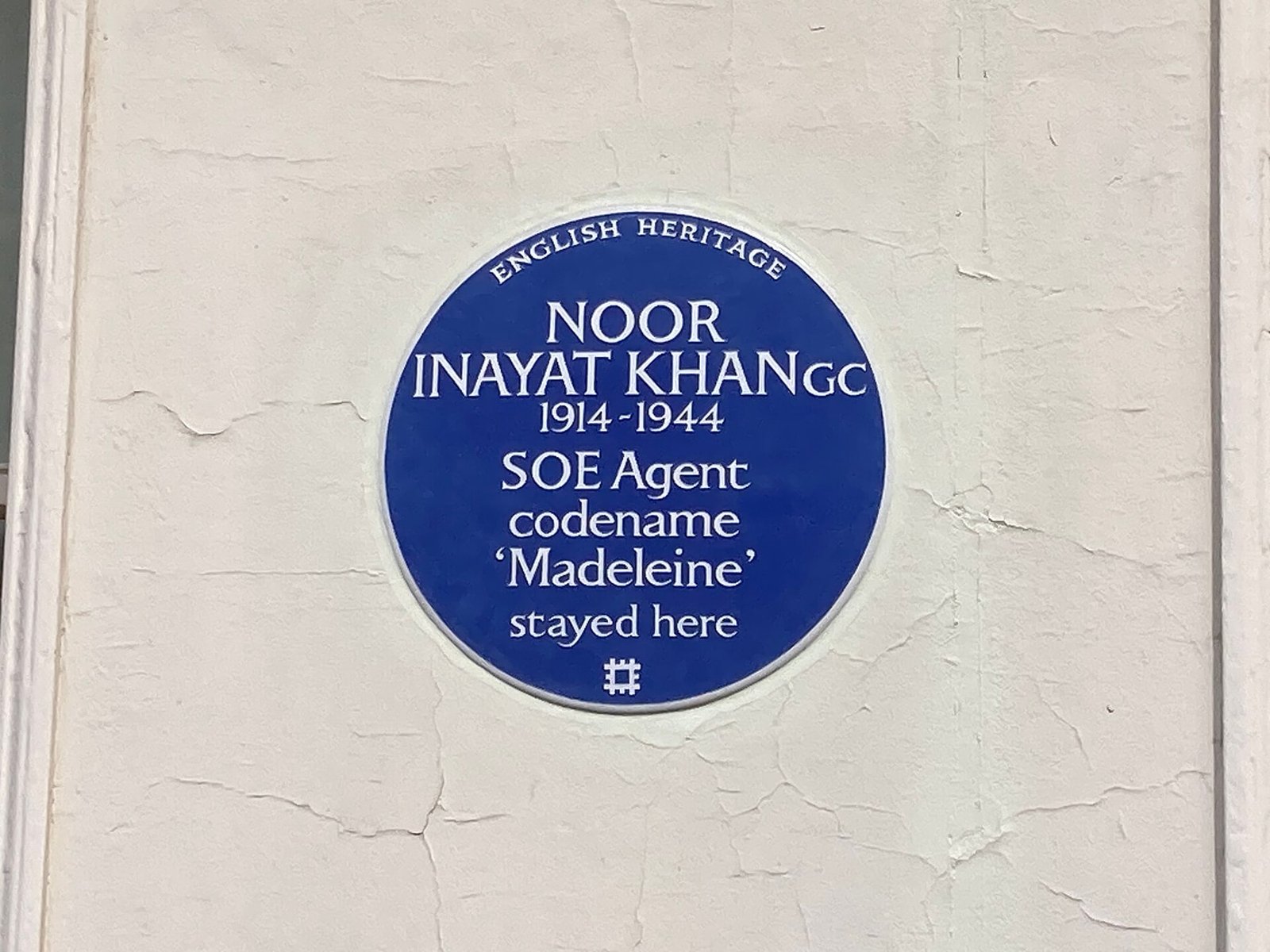
Noor Inayat Khan tried to escape German custody twice while being held at 84 Avenue Foch in Paris in 1943. The first attempt came almost immediately after her arrest. The second, more elaborate attempt came six weeks later, when she and two fellow prisoners reached the roof and then an adjoining building before an air-raid alert helped expose the breakout.
Neither attempt succeeded. Their importance lies elsewhere.
Noor had been sent into occupied France by Britain's Special Operations Executive as a wireless operator. By October 1943, after repeated arrests devastated the SOE networks around Paris, she had become one of the most important remaining links with London. Her capture removed that link. Her repeated efforts to escape—and her refusal after the second attempt to promise that she would stop trying—help explain why German security authorities decided she was too dangerous to keep in Paris.
At a Glance
- Captured: 13 October 1943 is the strongest institutional date
- Detention site: 84 Avenue Foch, Paris, headquarters used by the German Sicherheitsdienst for interrogation and detention of captured agents
- Escape attempts: 2
- First attempt: Shortly after capture, using a bathroom window on the fifth floor
- Second attempt: Night of 24–25 November 1943
- Second-attempt companions: SOE agent John Renshaw Starr and French resistance/intelligence leader Léon Faye
- Second-attempt route: Through loosened window or skylight grilles, onto the roof, then into a neighboring building
- Why it failed: An air-raid alert triggered a security check that exposed the missing prisoners
- Aftermath: Noor and Faye refused to promise not to attempt another escape; Noor was sent to Germany and later imprisoned at Pforzheim
- Final fate: Executed at Dachau concentration camp on 13 September 1944
From wireless operator to prisoner
Noor Inayat Khan entered occupied France in June 1943 under the field name Madeleine. Her mission was radio communication. Wireless operators were among the most vulnerable SOE personnel because German direction-finding teams could locate transmissions if an operator remained on the air too long or reused locations carelessly.
The danger became more severe almost immediately. Arrests shattered the resistance network with which Noor was working, and London offered her the chance to return to Britain.
She remained. The National Archives preserves SOE records showing that she continued communications from the Paris region even as the organization around her collapsed. A later recommendation by SOE chief Colin Gubbins emphasized both the danger and her refusal to abandon the post.
By October, German security forces were actively hunting the remaining operators. Noor was arrested on 13 October 1943 according to the RAF Museum and French resistance archival resources, although some later narratives vary by a day or two. She was taken to 84 Avenue Foch, a building used by the Sicherheitsdienst, or SD, for interrogation, wireless counter-intelligence, and the detention of captured Allied agents.
This was not a normal civilian prison. Rooms on the upper floor had been turned into guarded detention spaces inside a security-service headquarters.
The first attempt
The official postwar record establishes the most important fact: Noor made two unsuccessful attempts to escape while being held at Avenue Foch. The details of the first attempt survive mainly through later reconstruction based on postwar testimony.
Kate Vigurs's modern history of the women of SOE describes Noor asking to take a bath after hours of interrogation. The interrogator allowed her privacy but remained suspicious. Noor climbed through the bathroom window and moved onto the exterior roof area or ledge.
She did not get far enough to leave the building. The interrogator spotted her from an adjoining room and stopped the attempt. Other retellings describe a rain gutter, ledge, or upper roofline, but those fine physical details are less important than the secure core: within a very short time of entering Avenue Foch, Noor had already tried to get out through a fifth-floor bathroom window.
That immediate attempt is revealing because it predates any long period of confinement. She had not resigned herself to being a prisoner.
It also shaped how her captors viewed her. A prisoner willing to attempt an exit from a high floor within hours of arrest could not be treated as securely contained merely because the doors were guarded.
Detention on the fifth floor
Noor remained at 84 Avenue Foch for several weeks. Other captured agents were held there as well. Among them were John Renshaw Starr, an SOE organizer, and Léon Faye, a senior figure in the French Alliance intelligence network.
The building's fifth floor contained detention rooms, a guardroom, and interpreter space. Prisoners could communicate imperfectly across the improvised detention area.
Later accounts say Noor, Starr, and Faye passed notes through shared sanitary spaces and used tapping or Morse-like signals through walls. Those details come from postwar testimony and modern reconstructions rather than a surviving German daily log.
What is clear is that the three coordinated a second attempt. This one was not improvised in a bathroom. It required preparation over time.
Preparing the second escape
The central mechanical detail was access through the barred openings above their detention rooms. Starr obtained a screwdriver while performing a small repair task for the Germans. The tool was then passed among the prisoners so that they could loosen or remove the metal grilles over windows or skylights.
Later reconstructions describe the prisoners disguising disturbed plaster with bread, face cream, or powder. Such details are plausible and well rooted in the postwar source tradition, but they should not be presented as though photographed or documented in real time.
The purpose is easier to establish: create an opening to the roof without alerting the guards. The night selected was 24–25 November 1943.
This date is supported across French resistance sources, modern scholarship, and SOE histories. Some English summaries simply give 25 November because the decisive phase occurred after midnight.
Onto the roof
During the night, the three prisoners got through the openings and reached the roof. That marks a meaningful difference from the first attempt. Noor was no longer merely halfway out a bathroom window. The group had escaped the immediate detention rooms and moved outside the controlled interior of 84 Avenue Foch.
They then used lengths of bedding—described as sheets or blankets tied together—to descend toward a neighboring building. Modern scholarship places them on a balcony or roof connected to an adjoining residence, where they entered through a window.
At that stage, the escape had succeeded in one narrow sense: the prisoners had physically left their cells and crossed beyond the roof of their detention building. They had not, however, broken through the wider German security cordon.
The air raid that changed the timing
Paris was under air-raid threat that night. An air-raid alert triggered a security procedure that required German staff to check prisoners. The missing detainees were discovered much sooner than the escape party had expected.
The alarm turned a carefully prepared breakout into a race against a rapidly tightening search. Sources agree that Noor, Starr, and Faye were recaptured in or very near the neighboring buildings.
The fine details of the recapture are less stable. Some later accounts say one of the male prisoners was shot and wounded, but they disagree over whether the injured man was Starr or Faye. That conflict is not necessary to resolve Noor's part of the case. The secure conclusion is that all three were recaptured before they could disappear into Paris.
Refusing the promise
Hans Josef Kieffer, the SD officer responsible for 84 Avenue Foch, responded by demanding that the three prisoners give their word that they would not attempt another escape. John Starr agreed.
Noor Inayat Khan and Léon Faye refused. That refusal is one of the best-attested parts of the aftermath. It appears in SOE history, French resistance accounts, and the official British award citation.
For Noor, the decision had immediate consequences. German authorities obtained permission to remove her from France for what the postwar British citation called "safe custody." The phrase meant the opposite of safety for her: she was to be held under substantially harsher conditions where another escape would be far more difficult. Within days of the November attempt she was transferred into the German prison system.
Pforzheim
Noor was eventually held at Pforzheim prison in southwestern Germany. The postwar British record described her as a particularly dangerous and uncooperative prisoner. She was kept in solitary confinement and shackled for long periods.
The transfer is sometimes presented as punishment simply for refusing to cooperate under interrogation. Her escape record was also central.
The George Cross citation published in 1949 explicitly linked her two escape attempts, her refusal to promise that she would stop, and the German decision to seek permission to move her to Germany. This makes the Paris attempts more than dramatic episodes in a spy biography. They materially changed the conditions under which she was imprisoned. Noor remained in German custody for the rest of her life.
What she did and did not reveal
Noor's resistance under interrogation became part of her postwar reputation. The official British citation said she refused to give information about her work or colleagues. Hans Kieffer's postwar testimony likewise portrayed her as consistently resistant.
Historians have added important qualifications. German security officers found notebooks and radio material associated with her work, and the Germans used captured SOE communications systems in deceptive transmissions to London. The extent to which particular German successes resulted from Noor's captured papers, other compromised networks, or broader SOE security failures has generated substantial historical criticism.
That question should not be confused with a claim that Noor voluntarily collaborated. The strongest evidence supports her continued refusal to cooperate meaningfully about her operational network, alongside the separate fact that German security services exploited materials already in their possession. For an escape history, the important point is simpler: her behavior in custody was persistently oppositional.
Two attempts, not one
Popular biographies sometimes blur the two attempts together. They should remain separate.
The first was an almost immediate solo attempt after interrogation: bathroom window, upper exterior or roof, rapid recapture. The second was a planned group breakout more than a month later: coordinated communication, removal of grilles, movement across the roof, descent into a neighboring building, and recapture after an air-raid alert exposed their absence.
The official record confirms two attempts even where it does not preserve every mechanical detail. This distinction also changes the interpretation of Noor's captivity. She did not make one desperate gesture and then stop. She tried again after the Germans already knew she was an escape risk. When the second effort failed, she still refused to give her word that she would not attempt a third.
The limits of reconstruction
The broad chronology is strong. Noor was captured in October 1943 and held at 84 Avenue Foch. She attempted escape twice. The second attempt took place on the night of 24–25 November with Starr and Faye. The three reached the roof and a neighboring building, were exposed by an air-raid security check, and were recaptured.
The first attempt's fine details depend more heavily on later recollections, including the exact route from the bathroom and precisely how far Noor moved along the exterior. The second attempt's fine details are better supported but still not perfectly uniform. Accounts differ over whose grille caused delays, which man was wounded during recapture, and some of the exact path through the adjoining building.
Those disagreements do not affect the central finding. Noor Inayat Khan repeatedly tried to escape German custody in Paris. Her captors considered the risk serious enough that, after she refused to renounce further attempts, they removed her to harsher imprisonment in Germany.
She was ultimately transferred to Dachau and executed on 13 September 1944. Her Paris escape attempts did not save her life. They remain among the clearest surviving evidence of how she responded once the clandestine war had turned into captivity.
Evidence discipline
What the record supports
Status labels distinguish secure conclusions from uncertainty and rejected claims. Color is never the only signal.
MYTH
Noor made only one escape attempt while held in Paris.
The National Archives and her George Cross citation explicitly state that she made two unsuccessful attempts while detained at Avenue Foch.
Sources: SRC-001, SRC-002LATER CLAIM
The first attempt occurred shortly after her arrest and involved a fifth-floor bathroom window.
This detail comes from postwar testimony and later scholarly reconstruction rather than the terse official citation, which confirms two attempts but does not describe the first mechanically.
Sources: SRC-003DOCUMENTED
The coordinated second breakout occurred on the night of 24–25 November 1943.
The date and three-person escape are consistently preserved in French resistance sources, SOE histories, and modern scholarship.
Sources: SRC-003, SRC-004MYTH
The second attempt failed because the prisoners never got out of their cells.
They reached the roof and an adjoining building before the escape was detected and the group was recaptured.
Sources: SRC-003, SRC-004DISPUTED
One specific male escapee can be stated with certainty to have been shot and wounded during recapture.
Later accounts conflict over whether Starr or Faye was wounded. The injury identity is not needed to reconstruct Noor's escape and is not canonicalized.
Sources: SRC-003, SRC-004MYTH
Noor agreed after the November attempt that she would stop trying to escape.
She refused to sign or give the requested assurance, a refusal explicitly highlighted in her official award citation.
Sources: SRC-002MYTH
Noor voluntarily gave German interrogators operational information about her SOE colleagues.
The official postwar British record states that she refused cooperation and information. German exploitation of captured notebooks and communications material is a separate issue from voluntary disclosure.
Sources: SRC-001, SRC-002Evidence diagram
Two Paris escape attempts
The two failed attempts are separated from the harsher custody that followed the November rooftop breakout.
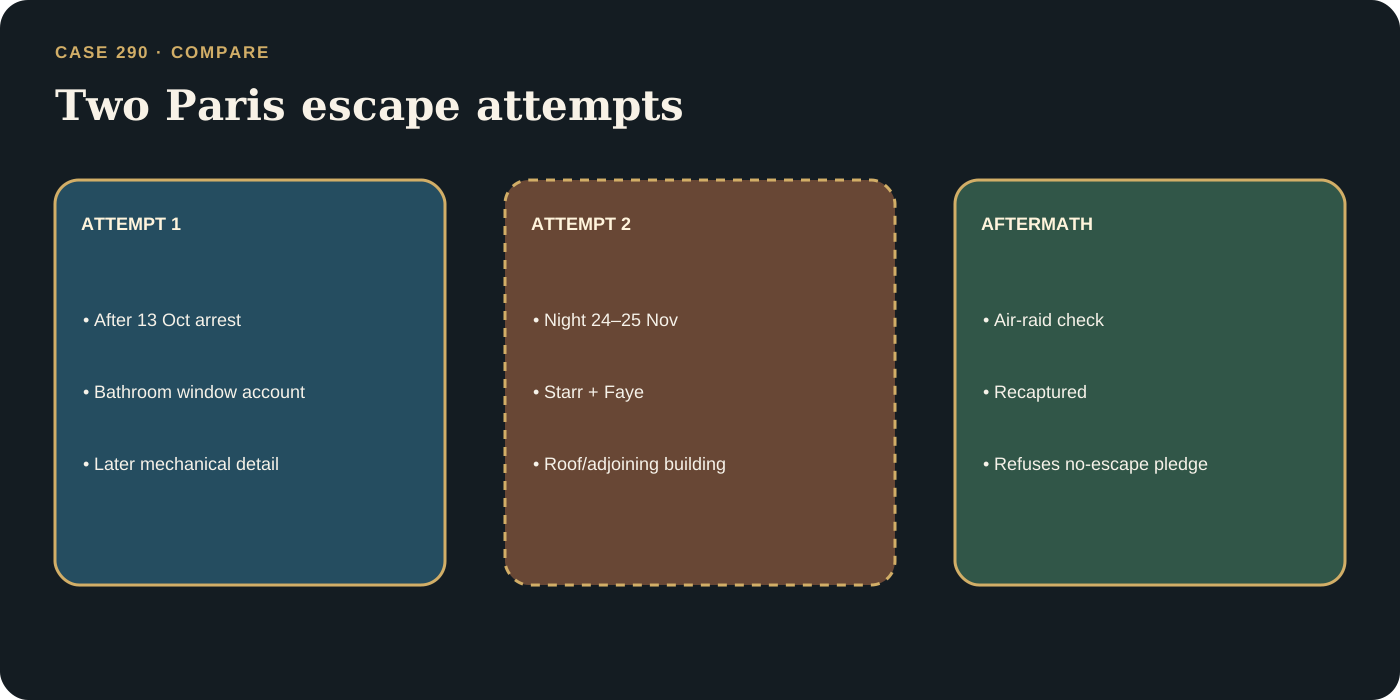
The two failed attempts are separated from the harsher custody that followed the November rooftop breakout.