
Alexander Godunov’s defection was complete before the most famous part of the story began. By the time an Aeroflot aircraft sat immobilized at John F. Kennedy International Airport, the Bolshoi star had already left his company’s control, requested asylum, and received protection from the United States.
The airport confrontation was about someone else. Godunov’s wife, Bolshoi ballerina Lyudmila Vlasova, wanted to fly back to Moscow. American officials feared Soviet authorities might be forcing that decision and refused to let the aircraft leave until they believed they had heard her choice directly.
At a Glance
- Defector: Alexander Godunov
- Company: Bolshoi Ballet
- City: New York
- Leaves tour control: 21 August 1979
- Formal asylum request: 22 August
- Asylum granted: 23 August
- Wife: Lyudmila Vlasova
- Aircraft stopped at JFK: 24 August
- Standoff resolved: 27 August
- Core U.S. question: Was Vlasova returning voluntarily?
- Vlasova’s answer: She wished to return to the Soviet Union
- Godunov’s outcome: Remained in the United States
- Vlasova’s outcome: Returned to Moscow
- Marriage: Divorced in 1982
The Bolshoi abroad
For the Soviet Union, the Bolshoi Ballet was more than a performing company. It was one of the country’s most prestigious cultural institutions and a visible demonstration of Soviet artistic achievement abroad. Foreign tours therefore carried political value as well as artistic prestige.
They also created a contradiction. Elite dancers who normally lived within Soviet controls could suddenly see and work inside foreign societies. Earlier defections by Rudolf Nureyev, Natalia Makarova, and Mikhail Baryshnikov had already shown how international ballet tours could become opportunities to leave. Godunov brought that danger directly to the Bolshoi.
A star with reasons to leave
Godunov had become one of the Bolshoi’s leading male dancers. He had won major competition honors and performed prominent classical and dramatic roles, but his career still developed inside a system where artistic advancement, travel permission, and political trust could not be cleanly separated.
Later testimony suggests he had considered leaving before 1979. When he finally explained himself publicly in New York, however, he did not offer a sweeping ideological speech. He emphasized his work. At his first post-defection press conference, Godunov said he had defected for artistic reasons. He spoke of reaching a point where an artist had to decide whether to remain where he was or continue developing, and he complained that he had not been allowed to dance as much as he wanted.
That explanation was personal, but it was not outside politics. The Soviet state controlled foreign travel and the professional environment of elite cultural figures, so the desire to control one’s own artistic life could become a political break.
21 August
The physical separation came on 21 August 1979. Godunov left the Bolshoi tour environment in Manhattan and did not return. Contemporary and later accounts describe a company watched closely while abroad, with Soviet supervision extending beyond the theater. Retellings add colorful details about the Mayflower Hotel, people watching the dancers, and Godunov’s exact movements that evening.
The broad fact is enough. He left the controlled tour environment and stayed away long enough that returning could cost him the opportunity to defect. This date should not be confused with the date of his formal asylum request.
22 August
On 22 August, Godunov entered the American asylum process. Contemporary Washington Post reporting states that he formally requested political asylum at the New York district office of the U.S. Immigration and Naturalization Service. The distinction matters. On the 21st he physically separated himself from Soviet control; on the 22nd he formally asked the United States to protect the decision.
His request moved quickly.
23 August
The United States granted Godunov asylum on 23 August. He was kept at an undisclosed location while American officials and his private contacts dealt with the immediate consequences. By then, the escape itself had succeeded. Godunov’s next concern was his wife.
Lyudmila Vlasova
Vlasova was not simply “the defector’s wife.” She was an accomplished Bolshoi dancer in her own right, with her own career, family ties, and reasons for deciding where she wanted to live. Godunov had not arranged a successful joint departure with her. His later public explanation was that once he had stayed away too long, returning to the hotel to speak with Vlasova could have ended his chance to defect.
He nevertheless believed that she might choose to remain if they could talk. That belief became one of the forces driving the airport crisis.
Two days without contact
Godunov disappeared without directly warning Vlasova. The later State Department interview records her describing a period in which she did not know what had happened to him. The two spouses therefore entered the crisis from different positions. Godunov had made a secret decision because secrecy helped him get away, while Vlasova experienced the same secrecy as her husband vanishing during a foreign tour.
Godunov’s conviction that she might remain was sincere. It was not evidence of what she actually wanted.
The American concern
Godunov and his lawyer, Orville Schell, wanted an opportunity for Vlasova to make a decision outside Soviet control. American officials shared enough of that concern to raise the issue formally with Soviet representatives.
A declassified State Department telegram records that on 23 August U.S. officials said Vlasova should be interviewed before leaving the country. The purpose was to determine whether any decision to return was voluntary. The next day, the issue became urgent.
24 August
On 24 August, Vlasova boarded a Moscow-bound Aeroflot aircraft at John F. Kennedy International Airport. Contemporary reporting identifies the aircraft as an Ilyushin Il-62. The interview the United States wanted had not occurred under conditions American officials considered adequate.
The plane was denied permission to depart. A private marital split had become an international confrontation.
The U.S. position
The American argument was that Vlasova needed to express her wishes in a setting where she understood she could safely choose any outcome. State Department officials objected to treating statements made only inside a Soviet aircraft and in the presence of Soviet representatives as automatically sufficient. Washington therefore wanted a non-coercive interview and initially pressed for Vlasova to leave the aircraft. From the American perspective, holding the plane protected the possibility of an independent choice.
The Soviet position
Moscow regarded the same act as interference with a citizen who had already decided to go home. Soviet officials said Vlasova had expressed her wishes clearly and argued that the United States was trying to manufacture a second defection. The disagreement was not merely over what Vlasova had said. It was over what conditions had to exist before either government would accept her answer as free. That argument reached Leonid Brezhnev and Jimmy Carter.
Brezhnev’s message
Brezhnev sent Carter a direct message protesting the continued detention of the Soviet aircraft. He said Vlasova had already declared that she was returning voluntarily and objected to an American demand that she leave the plane. The Soviet leader also proposed a compromise. A trusted American official could speak with Vlasova aboard the aircraft and confirm her wishes.
The message did not immediately resolve the dispute, but it demonstrated how far the affair had escalated. A dancer’s defection had become a direct issue between the leaders of the two superpowers.
Two definitions of a free interview
The American and Soviet governments claimed to be defending the same principle while accusing each other of violating it. Washington argued that the Soviet aircraft and official presence could create coercion. Moscow argued that forcing Vlasova off the aircraft in order to prove she was free would itself disregard her stated decision to leave. Both positions contained a political interest. Neither made Vlasova’s own answer unnecessary.
The question was how to hear it in a form the United States would accept.
The plane remains at JFK
The impasse continued through the weekend. Other Moscow-bound passengers were caught in the delay while diplomats, immigration officials, lawyers, and political leaders argued over procedure. Contemporary reports give different totals for the people who remained aboard or associated with the delayed flight. The differences appear to reflect changing conditions and different ways of counting passengers and crew.
The number is not necessary to understand the confrontation. One disputed decision had immobilized an international airliner.
Godunov waits
Godunov remained outside the aircraft confrontation. He wanted to speak with Vlasova, and his lawyer continued pressing for conditions that would allow her to decide without Soviet pressure. Godunov believed a direct conversation might persuade her to stay. That hope later shaped how the story was remembered, because it is easy to assume the spouse of a defector must also have wanted to defect. The surviving record points in another direction.
Vlasova’s choice had to be established from Vlasova.
The mobile lounge
A compromise was reached on 27 August. A mobile airport lounge was drawn up to the Aeroflot aircraft, and Vlasova entered it for an interview. The American delegation included Donald McHenry, Deputy U.S. Representative to the United Nations; State Department officer Edward Hurwitz; an INS representative; a Public Health Service physician; an interpreter; and Godunov’s lawyer, Orville Schell.
Soviet diplomatic and medical representatives were also present. The setting therefore was not the fully private interview the United States had initially sought. It was a negotiated middle ground.
Three options
McHenry explained why the Americans wanted to hear from Vlasova. He told her that she could remain in the United States. She could delay a final decision and take more time. Or she could return to the Soviet Union.
The United States, he made clear, would protect whichever choice was hers. Vlasova chose the third option.
Vlasova’s answer
The State Department record shows Vlasova repeatedly stating that she wanted to return to the Soviet Union. She said Godunov had disappeared for two days without warning her and that she herself had asked to be sent home. McHenry made clear that she could stay. Her answer did not change. When asked whether she wanted to see anyone before departing, she said no.
What the Americans concluded
The State Department account did more than record Vlasova’s words. It also recorded what the American participants thought about her condition and manner.
They found her calm, relaxed, quick in her answers, in control of what she was saying, and apparently in good spirits. The U.S. physician saw no indication that changed the conclusion. Godunov’s own lawyer was present.
The American group found no evident reason to doubt that Vlasova was expressing her own wishes. That judgment ended the standoff.
A criticism from inside Washington
The American record was not unanimous about the quality of the procedure. National Security Council official Marshall Brement later criticized McHenry’s interview as too brief. He believed Vlasova should have been given a fuller explanation of why the aircraft had been stopped and should have been told more explicitly that Godunov wanted to meet her. That criticism matters because it shows U.S. officials examining their own conduct rather than simply declaring the process perfect.
It does not establish the opposite conclusion. Brement did not produce evidence that Vlasova’s stated desire to return was false.
The aircraft leaves
Once American officials accepted Vlasova’s answer, the plane was permitted to depart. She returned to Moscow without Godunov. The Soviet government presented the outcome as a victory against American pressure. The United States emphasized a different point: it had refused to allow a disputed departure until it believed the person involved had been given a meaningful opportunity to choose.
Both governments claimed a principle. Vlasova had supplied the answer.
Godunov speaks
Godunov appeared before reporters after the confrontation ended. He said he did not understand why his wife had chosen to return and remained convinced that a conversation between them might have changed the outcome. At the same time, he thanked the American government for giving her the opportunity to make a choice. That response is important. Godunov disagreed with Vlasova’s decision, but his public position did not require historians to deny that the decision belonged to her.
Vlasova remembers 1979
Sixteen years later, Vlasova gave a long interview about the episode. She said she could have left the aircraft and joined Godunov. She chose not to. Her explanation centered on attachment to Russia and especially to her mother. She also said she understood why Godunov had wanted to leave.
The later testimony reinforces the contemporary interview without reducing either spouse to a propaganda symbol. They wanted different lives.
Her view of the airport ordeal
Vlasova did not remember the American intervention fondly. She described the airport confrontation as frightening and resented the security presence around the aircraft. That reaction is compatible with her choice to return. A person can believe that officials are treating her badly and still be expressing her own preference about where to live. The distinction keeps the history from becoming an argument that one government must have been entirely benevolent before her agency can be accepted.
The marriage does not recover
Godunov and Vlasova did not reunite in person after the defection. Their marriage ended in divorce in 1982. The political crisis had lasted only days, but the personal separation became permanent. Vlasova continued working in the Soviet Union. Godunov built a new career in the United States.
The outcome was not a failed reunion. It was two lives moving in opposite directions after one spouse crossed a political boundary the other did not want to cross.
Godunov in America
Godunov joined the American Ballet Theatre and continued dancing in the West. His relationship with the company and with artistic director Mikhail Baryshnikov later became strained, and he increasingly pursued guest performance and acting. He appeared in films including Witness, The Money Pit, and Die Hard. On 4 March 1987, Godunov became a U.S. citizen.
That legal milestone confirmed the permanence of the choice he had made in New York eight years earlier.
A Bolshoi precedent
Contemporary American reporting described Godunov as the first dancer to defect from the Bolshoi Ballet. The formulation needs the Bolshoi qualifier. Nureyev, Makarova, and Baryshnikov had already become famous Soviet ballet defectors, but they were associated with the Kirov/Leningrad tradition. Godunov’s decision struck directly at Moscow’s premier ballet company and at a major Soviet cultural showcase. That symbolic importance helps explain the attention surrounding his disappearance even before the Vlasova crisis began.
The tour continues
The Bolshoi’s American tour did not immediately collapse. It continued while Soviet officials dealt with the political consequences of Godunov’s absence. Other defections followed. In September, Bolshoi dancers Leonid and Valentina Kozlov sought asylum in the United States. Godunov therefore belongs to a wider history of Soviet cultural exchange in which foreign touring offered prestige to the state and escape opportunities to artists who no longer wanted to return.
Flight 222
The airport confrontation later entered Soviet popular culture through Flight 222, a 1985 Lenfilm drama directed by Sergei Mikaelyan. The film fictionalized the couple and transformed the confrontation into a Soviet political drama. It belongs to the history of how the incident was remembered, not to the evidentiary record of how the 1979 negotiations unfolded. Vlasova later criticized the film as propaganda.
Her reaction is revealing. Choosing to return to Moscow did not mean she wanted her decision turned into a state-owned morality tale.
Why the case matters
Godunov’s physical escape was simple compared with tunnels, hidden vehicles, or border flights. He was already in New York and needed to move from a Soviet-controlled tour environment into U.S. protection. The difficult historical question emerged after that success.
If one person chooses to leave a closed political system, what happens when the person closest to him chooses not to? The answer is not that one of them must have misunderstood freedom.
Two governments claim to protect choice
The United States treated possible coercion seriously enough to hold a Soviet aircraft for days. The Soviet Union treated the hold as coercion by the United States. The documentary record does not require accepting either government’s propaganda framing in full. American concern about involuntary removal was real and documented. Soviet statements that Vlasova wanted to return ultimately matched what she repeatedly told American officials and what she said again years later.
Those facts can coexist.
The strongest chronology
The sequence becomes clear when the two people are kept on separate tracks. Godunov left the Bolshoi-controlled tour environment on 21 August. He formally requested asylum on the 22nd and received it on the 23rd. Vlasova boarded a Moscow-bound aircraft on the 24th. The United States stopped its departure because officials did not believe her decision had yet been verified under acceptable conditions.
Three days of negotiation followed. On 27 August she was told she could stay, delay, or return. She chose return. The United States accepted the answer and released the aircraft.
One defection, two choices
The stranded Soviet jet became the unforgettable image of the affair, but the deeper history is about agency. Godunov wanted a different artistic and personal life and accepted the consequences of leaving the Soviet Union. Vlasova did not want the same future. The United States spent three days refusing to assume that her answer was genuine. When officials finally accepted that it was, they let her go.
Godunov’s freedom did not require Vlasova to make the same choice.
Evidence discipline
What the record supports
Status labels distinguish secure conclusions from uncertainty and rejected claims. Color is never the only signal.
WELL-SUPPORTED
Godunov physically separated from the Bolshoi tour environment on 21 August 1979.
Contemporary and retrospective reporting uses 21 August for his disappearance, while the formal asylum request occurred the following day.
Sources: SRC-009, SRC-010DOCUMENTED
Godunov formally requested asylum on 22 August and was granted asylum on 23 August.
Contemporary Washington Post reporting distinguishes the request and grant dates.
Sources: SRC-005DOCUMENTED
Godunov's main publicly stated reason for defecting was artistic development.
At his post-defection press conference he explicitly described his reasons in artistic terms.
Sources: SRC-007MYTH
Vlasova wanted to defect with Godunov but Soviet officials forced her back to Moscow.
Godunov believed she might stay, but the 27 August interview records Vlasova repeatedly choosing return. U.S. participants including Godunov's lawyer accepted that she was expressing her own wishes, and her 1995 testimony says she chose to return.
Sources: SRC-003, SRC-006, SRC-008MYTH
The U.S. concern that Vlasova might be leaving under coercion was invented solely for propaganda.
The State Department record documents U.S. concern and efforts to obtain an interview before departure.
Sources: SRC-001MYTH
Vlasova was interviewed completely alone with no Soviet officials present.
The published participant list shows both American and Soviet representatives at the mobile-lounge interview.
Sources: SRC-003DOCUMENTED
The 27 August interview convinced the U.S. participants that Vlasova was expressing her own wish to return.
The State Department record says the American participants found her calm, in control, and apparently expressing her own wishes.
Sources: SRC-003MYTH
The U.S. government regarded the final interview procedure as flawless and beyond criticism.
NSC official Marshall Brement criticized the interview as too short and insufficiently explanatory, although he did not establish that Vlasova's stated choice was false.
Sources: SRC-004DOCUMENTED
Brezhnev personally intervened in the Vlasova case.
FRUS publishes Brezhnev's direct oral message to President Carter protesting the aircraft detention and proposing an interview.
Sources: SRC-002DISPUTED
The exact number of passengers who remained throughout the standoff is securely fixed.
Contemporary reports use differing totals and appear to count passengers, crew, and those who left the aircraft differently.
Sources: SRC-006, SRC-009MYTH
Flight 222 is a reliable documentary reconstruction of the Godunov-Vlasova incident.
The 1985 Soviet drama fictionalized the incident, and Vlasova later criticized the treatment as propaganda.
Sources: SRC-008, SRC-012Documentary reconstruction
A completed defection and a separate decision
A case-local editorial visual separates the documented sequence from uncertainty without implying exact modern geography or operational detail.
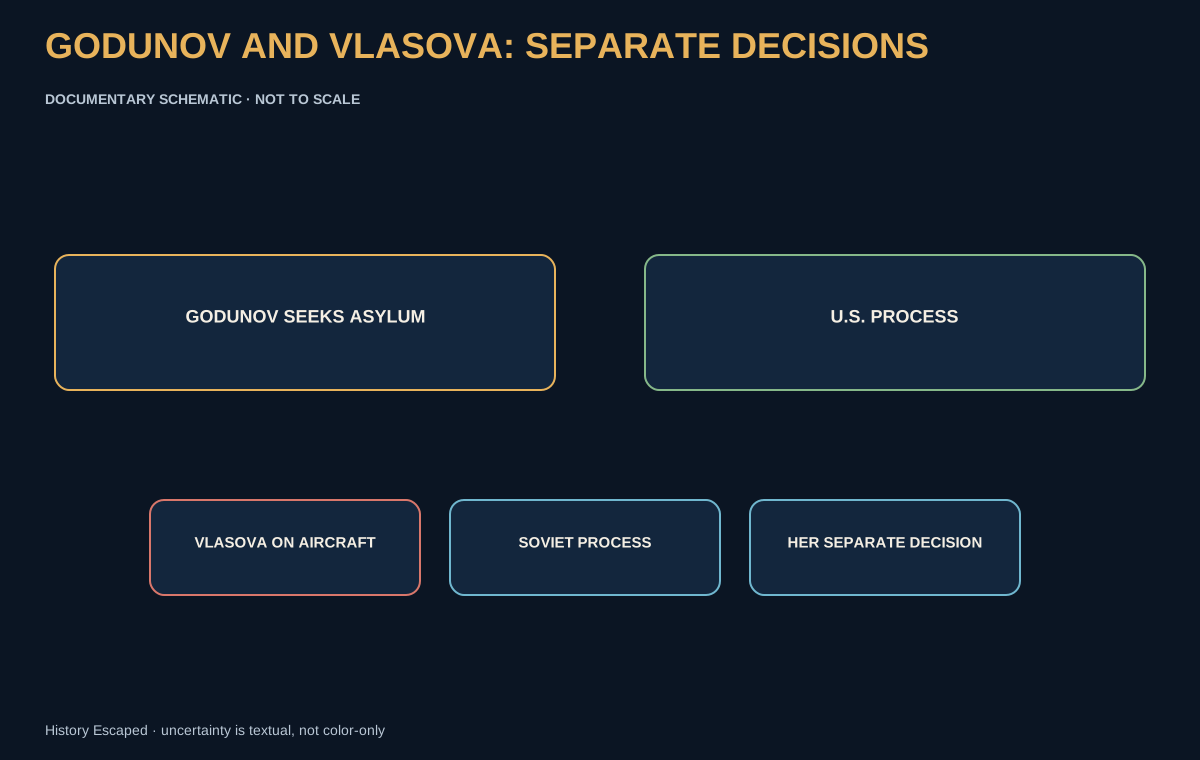
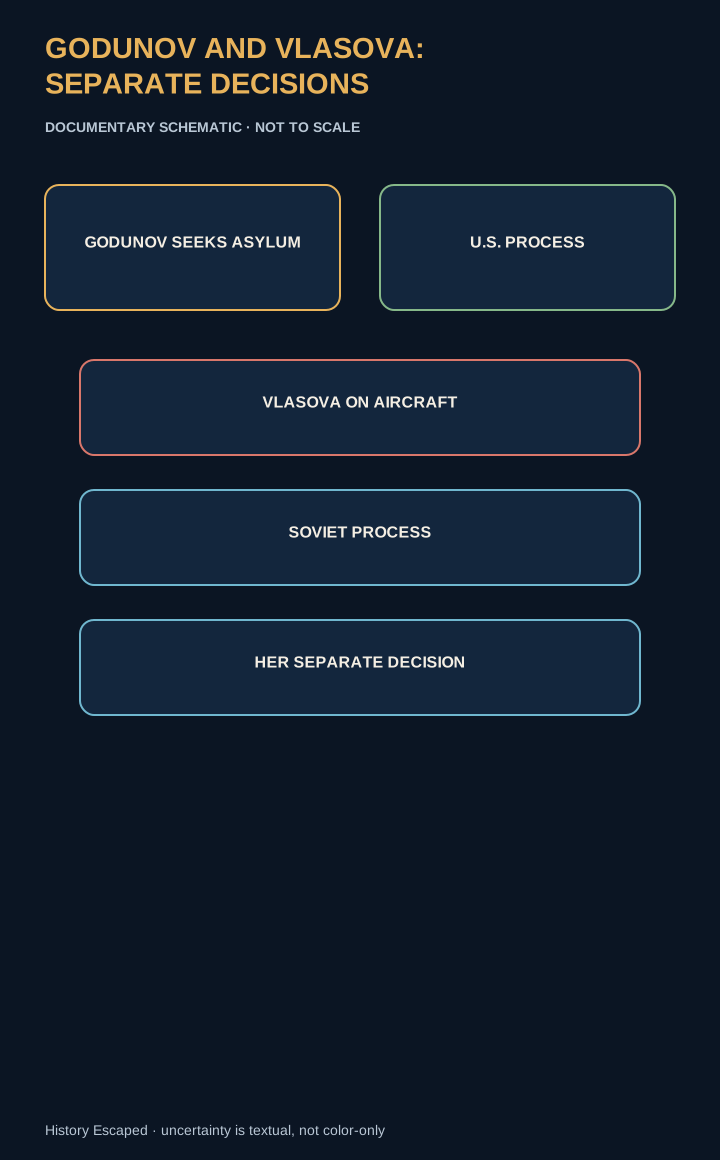
Simplified editorial reconstruction based on the cited historical record; not to scale. Uncertainty is stated directly in the visual and adjacent text.