
By November 1647, Charles I was a defeated king who was still trying to turn captivity into political leverage. He had lost the First English Civil War, but Parliament, the New Model Army and the Scots remained divided over what settlement should follow. Hampton Court Palace gave him more room, ceremony and access than a conventional prison. It also gave him an opportunity to leave.
On 11 November 1647 Charles disappeared from the palace. The escape itself worked: his guards discovered an empty room, a discarded cloak and letters explaining his withdrawal. What followed was less successful. Within days he had moved south to Hampshire, allowed his supporters to approach the parliamentary governor of the Isle of Wight, and placed himself within that governor's reach. Hampton Court was behind him, but durable freedom was not.
At a Glance
Charles I escaped from guarded custody at Hampton Court Palace on 11 November 1647, late in the afternoon. A contemporary printed account placed his departure between four and five o'clock, while Oliver Cromwell's report to the Speaker of the House of Commons said that Charles's cloak was found in a private passage and that he had gone by the back stairs and vault toward the waterside.
The broad sequence after he cleared the palace is also well supported. Royalist associates including John Ashburnham, Sir John Berkeley and William Legge assisted his flight. Charles reached Place House at Titchfield in Hampshire. Ashburnham and Berkeley then contacted Colonel Robert Hammond, Parliament's governor of the Isle of Wight. Instead of providing a secure royalist refuge, Hammond became Charles's custodian. Sources differ over whether to date the beginning of the island captivity to 13 or 14 November, but by that point the Hampton Court escape had ended in renewed confinement.
A captive king still negotiating
Charles had been in parliamentary and army custody since the military defeat of his cause. He placed himself in Scottish hands in 1646; the Scots later handed him over to the English Parliament. During 1647 the New Model Army took physical control of the king, and in August he was installed at Hampton Court while negotiations continued.
His confinement there was real but comparatively loose. Charles retained attendants, received visitors and continued political discussions. Hampton Court was a palace whose private apartments, galleries, stairs and service routes were poorly suited to ordinary prison security, especially when guards were expected to treat the captive as a king. Colonel Edward Whalley, the officer responsible for him, was trying to guard a man whose rank still carried assumptions of privacy and deference.
That political environment was deteriorating. The army itself was divided; radical soldiers and Leveller arguments sharpened fears about what might happen to the monarchy. Charles had also become increasingly dissatisfied with the settlement proposals before him. His ability to bargain depended on preventing any one faction from controlling both his person and the political process.
The possibility of escape was therefore not an isolated impulse. Charles had earlier given Whalley an assurance that he would not flee, but he withdrew that assurance as relations worsened and security tightened. Reports of danger to his life circulated as well. Those reports mattered, but the surviving evidence does not justify reducing the escape to a single assassination scare.
Why Charles left
Charles left two especially important explanations behind. In his public declaration, he argued that prolonged restraint was damaging both him and the prospect of a political settlement. He presented withdrawal as a way to seek safety while insisting that he remained willing to be heard if he could negotiate with freedom, honour and security.
A private note to Whalley complicates the story further. Charles specifically denied that a warning letter shown to him that day had made him decide to escape. He instead objected to the prospect of becoming a close prisoner under the stated justification of protecting his life. That distinction matters. Charles could fear a worsening security situation without having fled because one particular warning frightened him into immediate action.
Later accounts sometimes turn the episode into a Cromwellian trap: Cromwell, in this version, frightened the king with rumours of assassination so that Charles would flee into a more controllable position. There is no secure contemporary evidence that establishes such a deliberate scheme. Cromwell did communicate warnings about threats to the king, and political advantage could later be drawn from Charles's flight, but those facts do not prove that the escape was engineered for that purpose.
Charles's own motives were political as well as personal. He wanted to escape a tightening form of custody, preserve his physical safety and recover room to bargain. Those motives were compatible with one another. The record becomes weaker only when later writers insist that one of them explains everything.
The late-afternoon disappearance
The most secure account of the timing comes from a printed relation issued immediately after the event. It placed the private departure on 11 November between four and five in the afternoon. That is more precise than later descriptions of a nighttime escape. In mid-November the light would already have been fading, which helps explain why later summaries sometimes compress the episode into a flight under darkness, but the contemporary evidence supports late afternoon rather than an unspecified midnight breakout.
Charles used the privacy available within his apartments to get beyond his immediate guards. Cromwell's report, based on the information sent from Hampton Court, records that the king was expected for supper and then found missing. His cloak had been left in the gallery along a private way. The report says he passed by the back stairs and a vault toward the waterside.
Historic Royal Palaces also describes a passage through the Privy Garden and an escape associated with the Thames. These details fit the general direction of the contemporary report, but they should not be converted into a modern floor plan of the breakout. The palace has changed, later narratives add route details of uneven reliability, and the exact sequence from room to garden, river crossing and rendezvous is not documented with the precision that a diagram of footsteps would imply.
What is clear is that the palace's ceremonial and domestic spaces created an opening. Charles was not smashing through a barred cell or overpowering guards. He exploited a custody system that still granted him royal privacy, moved out of immediate observation and connected with a prepared support network outside.
The men who helped him
John Ashburnham and Sir John Berkeley are central to the next stage, with William Legge also associated with the escape party and arrangements. Their later recollections, however, require caution. Berkeley's surviving account was written several years afterward among royalist exiles. The British Library describes its central theme as the failure to get Charles to France and notes that it makes sense as an exercise in self-justification.
That is an unusually useful warning from the archive itself. The later royalist accounts preserve details unavailable elsewhere, but their authors were also defending their judgment in a decision that ended badly. Differences over who proposed the Isle of Wight, what Hammond was believed to have promised, and whether another destination should have been chosen cannot simply be resolved by accepting whichever memoir offers the neatest story.
The broader movement is less controversial. Charles and his helpers moved away from Hampton Court and eventually reached Titchfield in Hampshire. Place House belonged to Thomas Wriothesley, 4th Earl of Southampton, a major royalist figure. From there the question was no longer how to get out of the palace. It was where a fugitive king could go without falling immediately back into enemy hands.
No settled destination
The destination is one of the episode's most important uncertainties. It is tempting to describe the escape as a planned journey from Hampton Court to Carisbrooke Castle, because that is where Charles ended up. The evidence does not support so tidy a plan.
English Heritage states that Charles was on the run without a clear plan that can now be detected. Later royalist accounts preserve discussion of the Isle of Wight, while other reconstructions point to the possibility of reaching a ship and continuing toward Jersey or France. The island could appear attractive as a temporary refuge: it was within the kingdom, separated from the mainland, and its new governor, Colonel Robert Hammond, was thought by some of Charles's associates to be potentially sympathetic.
The decisive problem was that no reliable arrangement with Hammond had been secured in advance. Ashburnham and Berkeley crossed the Solent to sound him out. Hammond was a New Model Army officer and parliamentary governor. Whatever hopes the royalists attached to his attitude, he did not promise the freedom Charles needed.
The advisers then brought Hammond back with them. This was the strategic turning point. Instead of a hidden refuge or a vessel carrying Charles beyond parliamentary reach, the fugitive king now had direct contact with an officer who owed his position to the regime from which Charles had just escaped.
From refuge to renewed custody
Charles chose to proceed with Hammond rather than attempt another immediate flight. That decision is better described as submission to an uncertain protection arrangement than as a battlefield recapture. There was no pursuing patrol that physically seized him on the road from Hampton Court. The escape from the palace had succeeded; the political and logistical plan that followed it failed to preserve his liberty.
English Heritage dates Charles's island captivity from 13 November 1647, while an Oxford historical reference gives 14 November for his flight to Carisbrooke. The difference is small but should remain visible. The transition involved travel, meetings and the move into Hammond's authority, so different sources may be dating different moments in that process. A precise hour of renewed imprisonment is not established by the surviving evidence.
Once on the Isle of Wight, Hammond wrote to Parliament. Charles was again a prisoner, though initially not under the tightest possible conditions. He continued bargaining from Carisbrooke and in December reached the secret Engagement with Scottish representatives. The agreement promised Scottish military support in return for religious concessions in England and helped create the political conditions for the Second Civil War in 1648.
The new war ended in another royalist defeat. Army leaders increasingly concluded that settlement with Charles was impossible. He was eventually brought to trial, convicted of high treason by the specially created High Court of Justice and executed outside the Banqueting House at Whitehall on 30 January 1649.
What the escape actually achieved
Measured narrowly, Charles escaped Hampton Court. He left guarded custody without being stopped and remained beyond Whalley's control. Measured by the larger objective of regaining freedom of action, the result was poor. Within days he had exchanged a relatively loose palace confinement for the authority of a parliamentary governor on an island where escape would become considerably harder.
That outcome has encouraged generations of retrospective blame. Royalist narratives faulted advisers for the Isle of Wight decision. Anti-royalist narratives could present Charles's flight as further evidence of duplicity. Later conspiracy theories made Cromwell the hidden director of the whole affair. Each framing captures a political attitude more easily than it reconstructs the evidence.
The strongest surviving record supports a more restrained conclusion. Charles made an intentional escape from deteriorating custody on 11 November 1647. He was assisted by loyal associates. He had political and personal reasons to seek greater freedom, but the exact balance of those motives cannot be reduced to one fear or one scheme. His route south is broadly recoverable, while some palace and road details remain dependent on later testimony. Most consequentially, his supporters approached Hammond without a binding guarantee of liberty. The king escaped the palace; he did not escape the struggle over who would control him.
Evidence discipline
What the record supports
Status labels distinguish secure conclusions from uncertainty and rejected claims. Color is never the only signal.
DOCUMENTED
Charles escaped Hampton Court on 11 November 1647 between four and five in the afternoon.
A contemporary printed relation delivered to the Commons gives the date and late-afternoon time window.
Sources: SRC-001WELL-SUPPORTED
Charles used back stairs and a vault in the direction of the waterside.
Historic Royal Palaces reproduces Cromwell's report to the Speaker describing the cloak in the private way and the king's movement by the back stairs and vault toward the waterside.
Sources: SRC-004UNKNOWN
Every exact step of the palace exit and Thames crossing can be reconstructed.
Contemporary evidence establishes direction and broad mechanics but not enough geometry for a precise room-by-room or crossing reconstruction; later accounts add details of varying reliability.
Sources: SRC-001, SRC-004, SRC-006DISPUTED
A specific warning of assassination caused Charles to flee that day.
Threat reports circulated, but Charles's private note to Whalley explicitly said the warning letter shown to him that day did not cause his resolution to leave.
Sources: SRC-003DISPUTED
Cromwell deliberately engineered Charles's escape as a trap.
Later suspicion exists, but the sources used here do not establish a deliberate Cromwellian operation; the king himself denied that the warning shown to him had triggered the decision.
Sources: SRC-003, SRC-004DISPUTED
Carisbrooke Castle was Charles's fixed destination from the beginning.
English Heritage states that no clear plan can now be detected, while Berkeley's later account is explicitly characterized by the British Library as self-justifying and focused on the failure to reach France.
Sources: SRC-005, SRC-006MYTH
Charles was physically recaptured by a pursuing force after the Hampton Court breakout.
The surviving sequence instead shows his supporters approaching Hammond and Charles proceeding into the governor's authority; 'recaptured' is useful shorthand for renewed custody but misleading if read as a roadside seizure.
Sources: SRC-005, SRC-006DISPUTED
Charles's Isle of Wight captivity began on one uncontested date.
English Heritage dates the captivity from 13 November 1647, while the Oxford Companion summary gives 14 November for the move to Carisbrooke. The difference likely reflects stages in the transfer and should not be falsely harmonized.
Sources: SRC-005, SRC-008Documentary reconstruction
Secure departure and uncertain route details
A case-local editorial visual separates the secure historical sequence from uncertainty without exposing reusable modern operational detail.
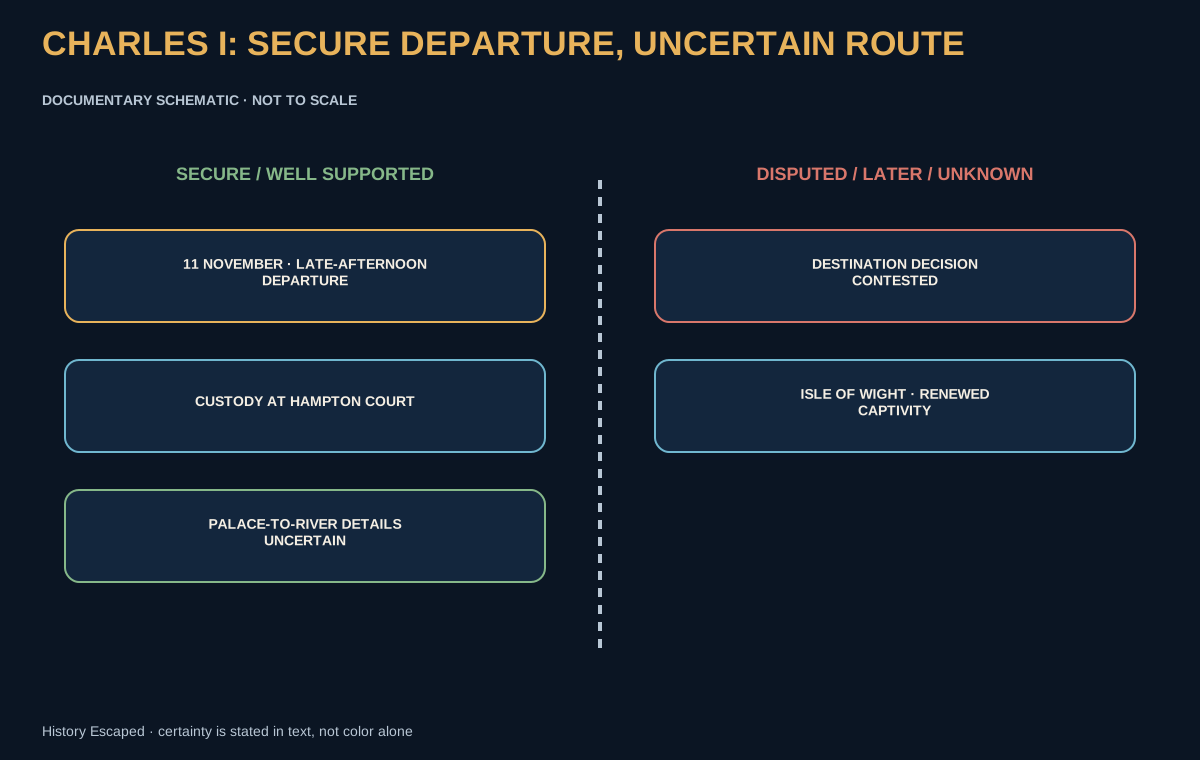
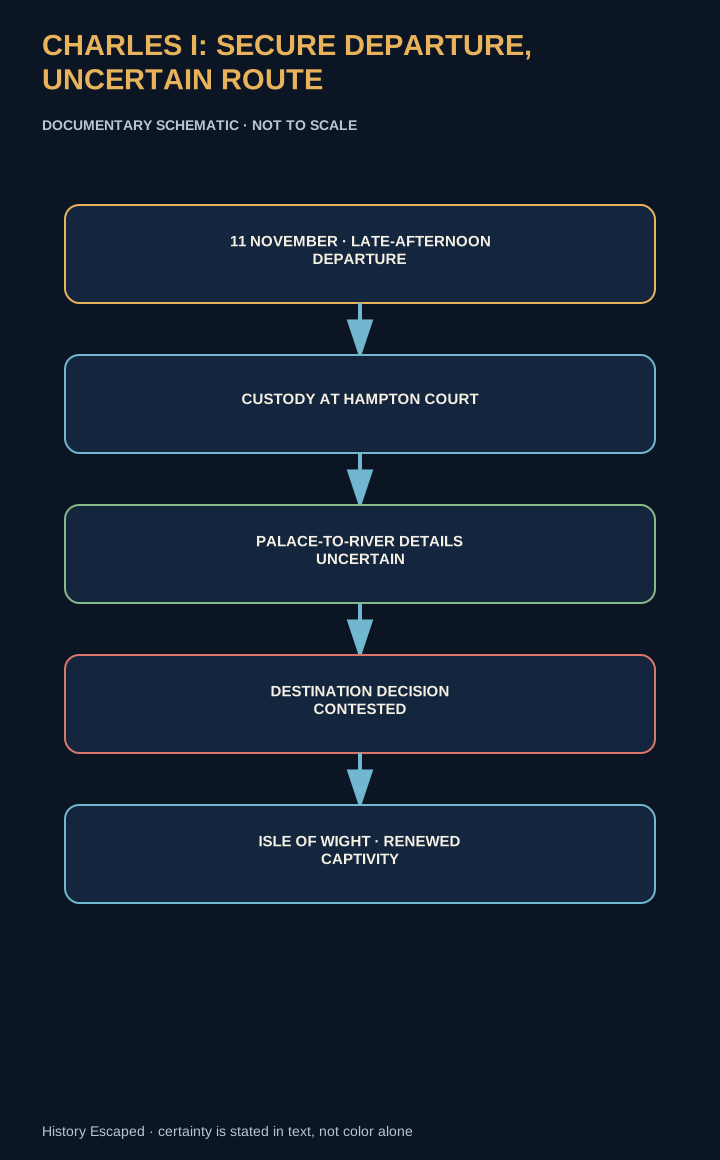
Simplified evidence-led editorial reconstruction based on the cited record; not to scale. Uncertainty is stated directly in the visual and adjacent text.
