
Timothy Leary’s September 1970 escape from a California prison became almost immediately entangled with the mythology surrounding him. Leary himself encouraged that process. He cast imprisonment as political repression, described escape in spiritual and revolutionary language, and later retold the event with the dramatic elasticity that marked much of his public life. Yet the basic story does not need embellishment: a nationally known psychedelic advocate serving a California marijuana sentence crossed the perimeter of a minimum-security prison, entered a clandestine Weather Underground extraction network, left the United States under a false identity, and spent more than two years moving through Algeria, Switzerland, and other countries before being forced back toward American custody.
The strongest evidence is also less cinematic than many later versions. Prison officers knew where Leary was shortly after 9:30 p.m. on September 12, 1970, and found his bed empty during the 11:40 count. Investigators later found blue ink on a cable running from inside the institution across the fence to a telephone pole outside. Leary later told an FBI agent that he had “gone over the wire.” Those facts establish the essential mechanism without requiring every tree, rooftop, spotlight, sharpshooter, disguise, and roadside handoff that accumulated around the story to be treated as equally certain.
At a Glance
- Escape: California Men’s Colony, West Facility, near San Luis Obispo, California
- Date: September 12, 1970
- Custody: California state imprisonment for marijuana possession while a separate federal marijuana-importation conviction was also on appeal
- Immediate method: Perimeter crossing using an overhead cable, followed by pickup and transfer into an underground support network
- Outside assistance: Weather Underground members, with Rosemary Leary involved in arranging the escape and subsequent flight
- Financing: Brotherhood of Eternal Love money is well supported; the exact amount varies across later accounts
- Exile: Algeria, then Switzerland, followed by travel through Europe and toward Afghanistan
- Return: January 1973, after Afghan authorities and U.S. officials became involved and Leary’s passport was revoked
- Outcome: Convicted of the prison escape and sentenced to an additional five years
Why Leary was in prison
Leary’s 1970 imprisonment is often reduced to a slogan: twenty years for two marijuana “roaches.” That shorthand blurs two distinct criminal cases. In 1965, Leary was stopped after an unsuccessful attempt to enter Mexico at Laredo, Texas. His first federal convictions produced a thirty-year sentence, but the U.S. Supreme Court reversed one count and sent another back for further proceedings in 1969. A federal retrial followed, and on March 2, 1970, he received a ten-year sentence for transportation after illegal importation of marijuana.
The California case arose from a separate December 1968 arrest in Laguna Beach. Leary, his wife Rosemary, and his son were stopped in a vehicle; the resulting prosecution led to Leary’s California conviction for marijuana possession on March 16, 1970. California law exposed him to a term of six months to ten years, and the state court committed him to the Department of Corrections. He passed through Chino and Vacaville before being transferred on May 13 to California Men’s Colony West.
Leary believed his treatment was political and presented himself as a prisoner of the emerging drug war. There is no need to adopt that framing as historical fact to recognize that he had become a highly visible target in a period when drug policy, counterculture, policing, and national politics were increasingly intertwined. At the same time, his imprisonment was not legally the product of a single possession case, and his federal sentence cannot be collapsed into the California sentence he was actually serving when he escaped.
The night he disappeared
The California Court of Appeal later preserved unusually specific evidence from the prison itself. On the evening of September 12, an officer saw Leary on his assigned bed in Dorm 325 at about 8:15 p.m. and again saw him in a corridor at about 9:30. During the 11:40 count, the officer found Leary missing.
A typed statement was left behind in Leary’s locker. It denounced imprisonment, compared contemporary jailers with persecutors of Socrates and Jesus, and urged guards to “follow me to freedom.” The note matters less as a literal account of the escape than as evidence of how quickly Leary converted the event into political theater.
Physical traces supplied the harder evidence. A towel under his mattress was stained with blue ink. At roughly 5 a.m. the next morning, an employee at a Highway 101 service station found prison denim bearing Leary’s number in a restroom trash can. An investigator also found blue ink on a cable that ran from inside the prison, over the perimeter fence, to a telephone pole outside, as well as on the pole’s climbing spikes.
Later accounts supply a much fuller sequence: Leary climbing a tree, moving over a roof, pulling himself along a cable, dropping beyond the perimeter, reaching a roadside pickup point, changing clothes, dyeing his hair, and being moved through several vehicles and safe houses. Some of those details are plausible and recur in accounts by participants and biographers. They are not all supported at the same evidentiary level. The court record establishes the cable crossing, the discarded clothing, and the timing window far more securely than the dramatic choreography surrounding them.
An extraction, not a solo vanishing act
Leary crossed the prison barrier himself, but remaining free required an organization outside it. Rosemary Leary worked with the Weather Underground to arrange the escape. The Weather organization then publicly claimed responsibility, describing the prison as a “POW camp” and Leary’s removal as a revolutionary liberation.
That rhetoric should not be mistaken for a neutral operational record, but the group’s involvement is independently well supported. Leary later described Weather members to the FBI, and a 1974 California appellate opinion records him telling an agent that after he went “over the wire,” he was taken to a gasoline station and then picked up by the Weathermen for the rest of his journey. Weather participants also recalled the operation in later interviews.
The Brotherhood of Eternal Love, the Southern California psychedelic-drug network that regarded Leary as an important spiritual figure, supplied money for the operation. The exact figure is less secure than the fact of financial support. Later accounts give totals ranging from about $17,000 to $50,000, with $20,000 or $25,000 appearing frequently. Treating one of those numbers as unquestioned fact would create false precision.
The network moved Leary through safe locations, altered his appearance, and obtained false identification. Later accounts place his final departure from the United States on a flight from New York using a false passport. By October he was publicly known to be in Algiers with Rosemary.
Algeria: asylum and a collapsing alliance
Algeria initially looked like a durable refuge. The country had emerged from an anti-colonial war against France and had become a center for revolutionary movements. Eldridge Cleaver, himself a fugitive from the United States, headed the Black Panther Party’s international section in Algiers. On October 20, 1970, reports said the Algerian government had granted Leary political asylum.
Leary’s arrival was therefore more than a fugitive finding a country without an easy extradition route. It linked three very different strands of American radicalism: psychedelic counterculture, the clandestine antiwar underground, and the Black Panther international project. Leary responded by issuing revolutionary statements and presenting his escape as part of a wider war against the American state.
The alliance deteriorated quickly. Cleaver and other Panthers regarded Leary’s drug-centered politics and behavior as unserious and potentially damaging. Archival material at the New York Public Library preserves a 1971 Cleaver radio statement renouncing an alliance with Leary and rejecting psychedelic drug culture. Later accounts describe Cleaver imposing restrictions on Timothy and Rosemary that amounted to house arrest.
Leary later portrayed the episode as another escape from captivity. That description captures his experience of the conflict but should not be confused with a formally documented state imprisonment. The better-supported conclusion is that his relationship with Cleaver’s group broke down badly enough that Algeria ceased to be a viable sanctuary.
Switzerland and the shrinking map of refuge
In 1971, Timothy and Rosemary Leary reached Switzerland. The country became the longest phase of his fugitive life. His presence there is unusually well anchored by independent witnesses: chemist Albert Hofmann met him in Lausanne on September 3, 1971, and again in Switzerland in February 1972. Archival finding aids likewise place him there for an extended period.
Switzerland did not simply hand him back to the United States. American authorities sought extradition, but the Swiss rejected the request. That decision gave Leary breathing room without providing permanent security. His residence remained provisional, his movements attracted official attention, and by the end of 1972 Swiss authorities expected him to leave.
The Switzerland period also loosened the personal and political structure of his original flight. Timothy and Rosemary separated. Leary became involved with Joanna Harcourt-Smith, who joined him during the last phase of the exile. He moved away from the Panthers and Weather Underground as immediate protectors and toward a more improvised network of wealthy patrons, lawyers, publishers, acquaintances, and potential sanctuary countries.
That shift mattered. The September 1970 escape had been a planned extraction. By late 1972, Leary was a famous fugitive with fewer reliable options and a passport vulnerable to U.S. action.
Kabul and the contested return
Leary left Switzerland near the end of 1972 with Harcourt-Smith. After a short stay in Austria, the pair traveled toward Afghanistan, where Leary hoped to remain beyond straightforward U.S. extradition. The attempt ended in Kabul in January 1973.
Here the record contains an important conflict. A later U.S. Senate hearing stated that drug-enforcement agents located Leary in Kabul on January 14, 1973, and that he was returned to Los Angeles on January 18. The California appellate record gives the most detailed account of what happened next, but the published opinion prints January 1972 dates. Those dates cannot be reconciled with independent evidence placing Leary in Switzerland through 1972, including Hofmann’s February 1972 meeting with him. The 1972 year in the appellate text is therefore best treated as a reporting or transcription error, while the underlying testimony remains valuable.
According to FBI agent Burke’s testimony, the U.S. consul in Kabul had custody of Leary’s revoked passport. Burke boarded the aircraft, and Leary and Harcourt-Smith later entered it. Once airborne, Burke told them the passport had been seized because the State Department had revoked it and gave Leary documentation valid for direct return to the United States. The aircraft continued through several European stops.
Leary and Harcourt-Smith described the episode much more coercively. Leary testified that Afghan police had detained him, held him at a “police hotel,” refused his demand for a hearing, and took him to the aircraft after telling him he had to leave Afghanistan. Harcourt-Smith said she passed a note to passengers saying that Leary was being kidnapped. In London, Leary requested political asylum; British authorities rejected the request. He then asked to be sent to Algeria, Switzerland, or Austria and was told those options were unavailable.
The appellate court ultimately rejected Leary’s argument that the manner of his return deprived California courts of jurisdiction. For historical purposes, the important point is narrower: “captured by U.S. agents at Kabul airport” is too simple. Afghan custody, U.S. passport revocation, an FBI presence on the aircraft, denied asylum in London, and Leary’s own claim of abduction all formed part of the return.
The escape and the myth
Leary was a gifted maker of stories about himself, and his September 1970 escape offered ideal material. His farewell note transformed a prison break into a moral indictment of incarceration. His post-escape communiqué folded it into revolutionary warfare. His later books and interviews supplied vivid physical detail and cosmic interpretation.
The documentary record neither destroys that story nor validates all of it. It confirms that Leary planned to get away, crossed the prison perimeter by using a cable, entered an organized underground extraction, traveled under false identity documents, reached political asylum in Algeria, lost that refuge, avoided U.S. return through Switzerland for an extended period, and finally came back after a contested sequence in Afghanistan and Europe.
What remains less secure are the details that make the story read like a film: precisely who stood at each pickup point, every vehicle used, the exact amount paid for the operation, every rooftop and tree traversed, and whether later participants remembered their roles without reshaping them to fit the legend. Those are not trivial differences. They mark the boundary between an escape that can be reconstructed from evidence and a countercultural epic continuously rewritten by its own participants.
Aftermath
Back in California, Leary was prosecuted for the escape. A jury convicted him, and on April 23, 1973, he received an additional five-year state sentence. He challenged the conviction by arguing, among other things, that he had been unlawfully abducted from Afghanistan, but the California Court of Appeal affirmed the judgment in 1974.
His relationship with the underground also changed sharply after recapture. In 1974 he began giving the FBI information about people involved in his escape, including Weather Underground figures. FBI files released years later confirmed the cooperation. That episode complicates any simple reading of Leary as either a principled revolutionary or merely a victim of political repression: he accepted help from clandestine radicals to regain freedom and later cooperated with federal investigators while seeking his own release.
Leary left prison in 1976. By then, the most consequential escape of his life had become several stories at once: a documented prison break, a clandestine political extraction, a fugitive journey through Cold War sanctuary networks, and a myth that Leary himself never stopped revising.
Evidence discipline
What the record supports
Status labels distinguish secure conclusions from uncertainty and rejected claims. Color is never the only signal.
DOCUMENTED
Leary escaped California Men’s Colony on September 12, 1970.
The later escape prosecution, prison officer testimony, and contemporary reporting agree on the event and date.
Sources: SRC-001, SRC-004DOCUMENTED
The essential perimeter mechanism involved an overhead cable.
Investigators found matching blue ink on the cable and pole; Leary later said he had gone 'over the wire.'
Sources: SRC-001LATER CLAIM
The full tree-roof-cable choreography in later narratives is established in every detail.
Participant accounts and biographies add a tree, rooftop movement, precise pickup choreography, and other dramatic details. The court record securely establishes the cable crossing but not every element of those later reconstructions.
Sources: SRC-001, SRC-013WELL-SUPPORTED
The Weather Underground assisted Leary after he crossed the perimeter.
The organization publicly claimed responsibility, Leary later described its role, and archival accounts from Rosemary Leary’s papers agree.
Sources: SRC-005, SRC-007, SRC-001WELL-SUPPORTED
The Brotherhood of Eternal Love financed the operation.
Multiple independent later accounts agree on Brotherhood financing, but reported amounts vary substantially.
Sources: SRC-013, SRC-014DISPUTED
The Brotherhood paid exactly $25,000.
Later accounts give approximately $17,000, $20,000, $25,000, or as much as $50,000. The existence of financing is stronger than any exact figure.
Sources: SRC-013, SRC-014DOCUMENTED
Algeria granted Leary political asylum in October 1970.
Contemporary reporting from October 20–21, 1970 described the Algerian government’s asylum decision.
Sources: SRC-009DISPUTED
Leary was simply arrested by U.S. agents at Kabul airport and extradited.
The later court record describes Afghan detention, U.S. passport revocation, an FBI agent aboard the flight, Leary’s claim of involuntary removal, and a denied asylum request in London. The appellate court rejected his jurisdictional challenge but did not erase the conflicting accounts of custody.
Sources: SRC-001, SRC-011MYTH
The Kabul return occurred in January 1972, as printed in the California appellate opinion.
The appellate opinion prints 1972, but independent evidence places Leary in Switzerland during 1972 and the 1973 Senate record states he was located in Kabul in January 1973 and returned to Los Angeles on January 18, 1973. The printed year is internally and externally inconsistent and is treated here as a reporting/transcription error.
Sources: SRC-001, SRC-006, SRC-011Documentary reconstruction
Escape, underground extraction and exile
A case-local editorial visual separates the documented sequence from uncertainty without implying exact modern geography or operational detail.
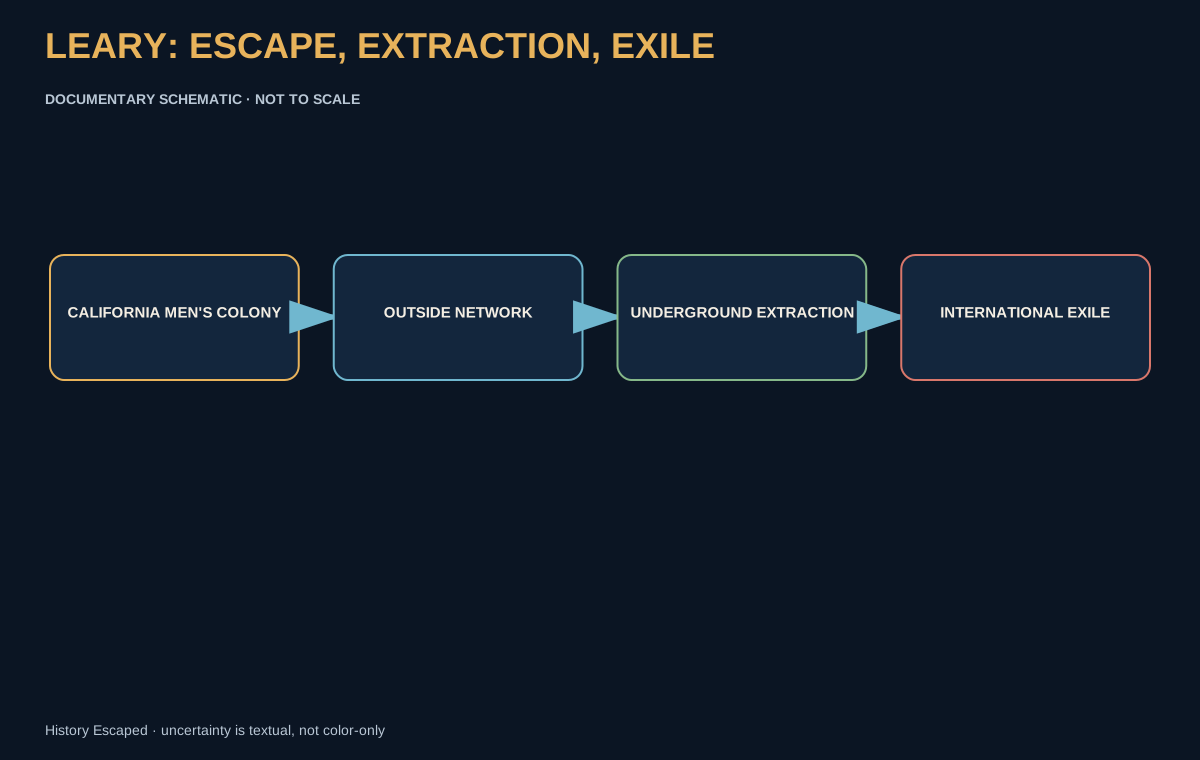
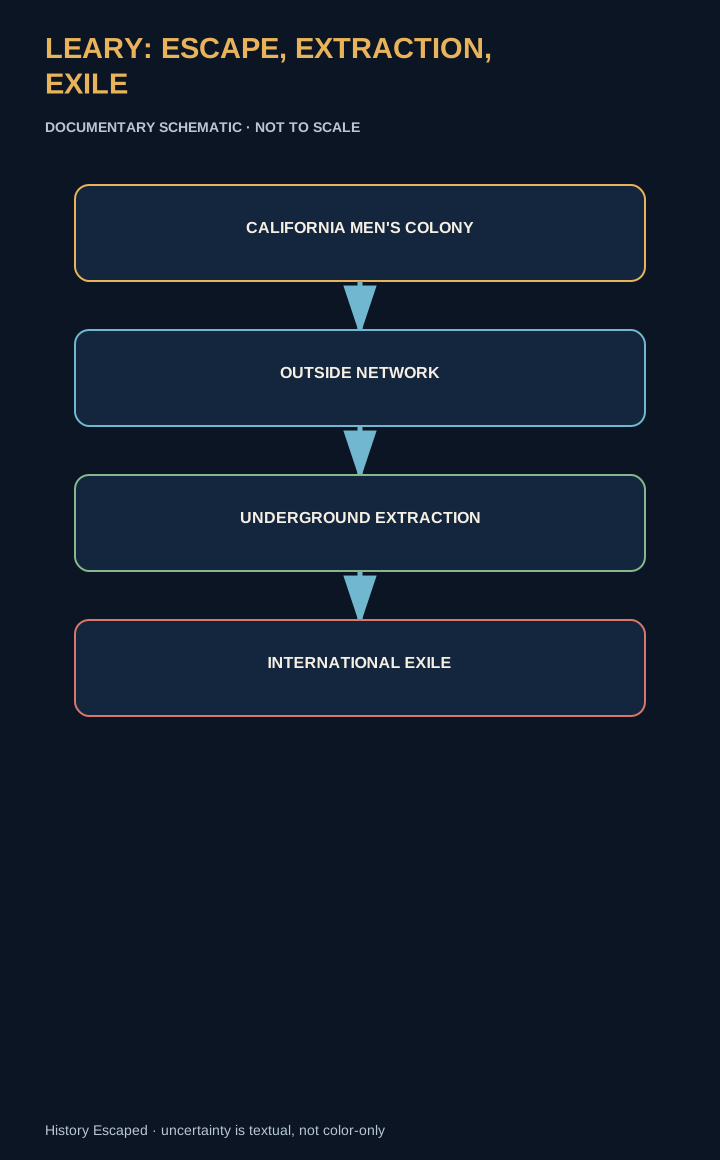
Simplified editorial reconstruction based on the cited historical record; not to scale. Uncertainty is stated directly in the visual and adjacent text.