
Six Australian prisoners survived the Sandakan catastrophe of 1945. Every one of them survived because he escaped.
That simple statement can obscure how different their escapes were. Owen Campbell and Richard “Dick” Braithwaite broke away from the second forced march from Sandakan toward Ranau. Keith Botterill, William Moxham, and Nelson Short escaped later from the POW camp at Ranau as part of a four-man group whose fourth member died in the jungle. William Sticpewich escaped Ranau in a separate pair; his companion also died before rescue.
Their survival also depended on people outside the POW columns and camps. Sabahans hid the escapees, fed men who were severely malnourished and sick, moved them by canoe, carried messages, and made contact with Allied forces despite the possibility of Japanese punishment. The six survivors were Australian. The escape network that kept them alive was not.
At a Glance
System: Sandakan POW camp, forced marches to Ranau, and Ranau POW camps in Japanese-occupied British North Borneo.
Reconciled January 1945 count: 2,434 Australian and British POWs; 2,428 died; six survived.
The survivors: Owen Campbell, Richard Braithwaite, Keith Botterill, William Moxham, Nelson Short, and William Sticpewich.
Escape pattern: Two survivors escaped separately from the second death march; four survivors escaped from Ranau in two later groups.
Important denominator: More than six POWs escaped or attempted escape. Six is the number who survived the Sandakan/Ranau catastrophe to the end.
Local assistance: Essential to every successful survival path.
Sandakan Before the Marches
Australian and British prisoners had been sent from Singapore to Sandakan in British North Borneo beginning in 1942. They were used as forced labour to build and maintain a Japanese military airfield.
Conditions deteriorated severely during 1943 and 1944. Beatings increased, rations fell, disease spread, and punishment became more brutal. By the beginning of 1945 the prisoners were already weakened by prolonged deprivation.
As Allied forces advanced toward Borneo and air attacks made the Sandakan airfield unusable, Japanese authorities began moving prisoners west toward Ranau. The track crossed swamps, rivers, jungle, and mountain country. Men who were already malnourished and sick were required to carry loads and continue walking with little food or medical care.
The first groups began leaving Sandakan in late January. Hundreds died on the route, at Paginatan, or after reaching Ranau. Evidence gathered after the war showed that prisoners who became unable to continue were frequently killed.
The second major movement began on 29 May. About 530 prisoners were forced out of the ruined Sandakan camp. Only 183 eventually reached Ranau.
Escape offered no safe alternative. Earlier attempts had ended in recapture and extreme punishment. Gunner Albert Cleary, for example, escaped Ranau with Wally Crease in March, was recaptured, and died after prolonged abuse. Crease escaped again but was later shot. The men who attempted escape in June and July therefore knew that failure could mean more than simply being returned to custody.
Owen Campbell: One Survivor from a Five-Man Break
Owen Campbell left the second march with four other prisoners in June 1945. A post-rescue statement attributed to Campbell dates their break from the column to 7 June, while the major Department of Veterans’ Affairs history identifies the episode more generally as one of the June escapes.
The group used the confusion of an Allied air attack to get out of sight of the guards and into the jungle. Campbell’s later account and subsequent historical reconstruction describe five men beginning the escape together.
They did not survive together. Illness rapidly weakened the party. Edward Skinner died after becoming severely sick. Other members of the group were killed or died as the escape deteriorated. Campbell was eventually alone.
His survival changed when local people intervened. DVA identifies two canoeists, Lap and Galunting, who took him toward Kampong Muanad. There he came under the protection of Kulang, a local headman and anti-Japanese guerrilla leader. The village concealed and cared for Campbell while he was seriously ill.
Kulang later helped move him toward an Australian Services Reconnaissance Department party operating behind Japanese lines. Campbell was eventually evacuated from Borneo.
This was not simply a successful break from a marching column. The physical escape created only the possibility of survival. Local protection converted that possibility into rescue.
Richard Braithwaite: From the Column to Libaran Island
Richard Braithwaite also escaped during the second march. He was suffering from malaria and understood that falling behind the column could be fatal.
Rather than remain in the march, he slipped out of sight and tried to work back toward water that might lead him toward the coast. DVA’s reconstruction, drawing heavily on Braithwaite’s later testimony, describes a difficult movement through swamp and jungle before he reached the Labuk River.
There he encountered an elderly local man identified as Abing. Braithwaite was taken into a village, hidden, and then moved downriver. The historical accounts describe him being concealed beneath vegetation during the canoe journey toward Libaran Island.
On 15 June 1945—Braithwaite’s twenty-eighth birthday—an American patrol torpedo boat took him to safety.
Braithwaite’s survival became one of the earliest Allied sources of information about what was happening to the prisoners from Sandakan. His later papers, now held by the Australian War Memorial, include maps, witness material, medical reports, and manuscripts relating to the catastrophe.
Ranau in July
The prisoners who actually reached Ranau found no refuge.
Disease, starvation, overwork, and beatings continued. By late June only a small number from the earlier march groups remained alive, even before survivors of the second march arrived. Deaths continued through July.
The difference between staying and escaping was impossible to calculate with certainty. Escape meant jungle, hunger, sickness, possible betrayal, and the risk of execution after recapture. Staying meant remaining inside a camp where prisoners were dying daily and where evidence now shows the remaining men were eventually killed.
Two successful escape actions came out of Ranau in July. Both included men who died after getting out. That distinction is crucial: escaping custody and surviving the escape were not the same outcome.
Botterill, Moxham, Short—and Anderson
On 7 July, Keith Botterill, William Moxham, Nelson Short, and Francis Douglas “Andy” Anderson escaped from Ranau.
Their histories before that night were not identical. Botterill and Moxham had endured the earlier forced-march system; Short had come through the second march. By July all were severely weakened.
The four initially hid close to the Ranau area. DVA records that after one dangerous encounter they came into contact with a local man called Bariga. An Australian War Memorial record connected to Anderson renders the helper’s name as Baragh Katus, a metadata variation that has not been resolved here.
Bariga fed and hid the men despite the danger of Japanese searches and rewards for escaped POWs. His help extended over weeks.
Anderson did not live to reach Allied forces. He died of dysentery on 29 July and was buried by his companions. Botterill, Moxham, and Short remained in hiding with local assistance.
Even the Japanese surrender on 15 August did not instantly make them safe. Japanese units in the area had not all acknowledged the end of the war, and the three men were far too sick simply to walk out on their own. Bariga and other local people helped them move toward Australian personnel operating in the region.
By late August they had reached Allied hands.
Their escape is sometimes reduced to three famous survivors because those were the men photographed afterward. Historically, it was a four-man escape. Anderson got out of Ranau too. He did not survive long enough to become one of the six.
Sticpewich and Reither
The final escape that produced a survivor came later in July.
William Sticpewich learned that the remaining prisoners were in grave danger. On 28 July he left Ranau with Herman “Algie” Reither. A later Australian Defence honours inquiry, relying on Sticpewich’s postwar statement, places their departure at about 9:30 p.m.
The two hid near the camp while searches were under way and then moved toward Ranau. They were eventually sheltered by a local Christian, Dihil bin Ambilid.
Dihil refused to betray them despite the continued Japanese presence. He cared for the two men and later carried a message toward Allied personnel. Medicines and food came back.
They arrived too late for Reither. Suffering from dysentery and malnutrition, he died on 8 August. Australian War Memorial records state that Sticpewich was rescued the following day.
Again, a one-name survivor story conceals a two-man escape. Reither successfully broke out of Ranau. He simply did not survive the physical destruction already inflicted by captivity.
Six Survivors Does Not Mean Six Escapes
The most common Sandakan statistic is also the easiest to misunderstand.
Six men survived, but at least eight men were involved in the four escape actions that produced those survivors: Campbell’s group began with five; Braithwaite escaped separately; the 7 July Ranau group contained four; and Sticpewich left with Reither. Several of those companions died or were killed after escaping.
Other prisoners also attempted escape and failed. Cleary and Crease are only two examples. Earlier in the war other men had escaped from Sandakan under different circumstances. The “six” therefore measures the final survivor population, not the total number who resisted captivity through escape.
The larger denominator is catastrophic. Current official commemorative accounting in Sabah gives 2,434 Australian and British POWs at Sandakan in January 1945, with 2,428 deaths and six survivors. Older institutional sources often round the population to roughly 2,400 or 2,500, but the conclusion does not change: survival was exceptional, and every final survivor had left Japanese custody before the prisoners remaining at Sandakan and Ranau were dead.
The Sabahans Who Made Survival Possible
The survivor list is usually printed as six Australian names. A complete escape history requires another list beside it.
Lap and Galunting brought Campbell toward Muanad. Kulang protected him and helped connect him with Allied personnel. Abing sheltered and transported Braithwaite. Bariga sustained the Ranau group. Dihil bin Ambilid protected Sticpewich and Reither and carried a message toward Allied forces.
There were others.
Their assistance was dangerous. Japanese authorities had already executed local people involved in resistance and prisoner-support networks. Helping an escaped POW could expose a village or family to punishment.
The Australian and British governments recognized that debt soon after the war. In 1946–47 a joint Reward Mission led by Major Harry Jackson for Australia and Major R. K. Dyce for Britain returned to North Borneo. The mission investigated claims, interviewed local helpers, and distributed money, medical assistance, and goods to people who had helped prisoners.
Australian War Memorial photographs from that mission preserve some of those helpers by name. They are unusually important images because they correct the visual imbalance of the story. The six Australians supplied the testimony that made the catastrophe visible outside Borneo; Sabahans were among the people who made that testimony possible by keeping the escapees alive.
Witnesses After the War
The six survivors became central witnesses to Sandakan, the marches, and Ranau because virtually no other Allied prisoner remained alive to describe the final months.
Their evidence was not the only evidence. Australian investigators gathered statements from Japanese and Formosan guards, local workers and villagers, recovered records and personal effects, and searched burial sites along the route. Survivor recollections could therefore sometimes be compared with testimony from other sides of the camp system.
William Sticpewich later gave evidence in war-crimes proceedings and returned to Borneo in postwar search work. His surviving papers include statements on POW treatment, records of forced marches and escape, translated local testimony, and documents connected with the recovery of the dead.
That distinction matters when reading later histories. Botterill, Short, Campbell, Braithwaite, Moxham, and Sticpewich remembered events after starvation, disease, violence, and extreme physical collapse. Their testimony is indispensable, but exact dialogue, precise day-to-day sensations, and every remembered sequence should not automatically be treated as if written down at the moment.
The central escape history does not depend on doing that. Two men survived by getting off the second march. Four survived after breaking out of Ranau. Each depended on local assistance. Two additional men escaped with the Ranau groups but died before rescue, and Campbell’s companions also failed to survive.
Six Australians came home. The evidence they carried with them helped establish what had happened to the thousands who did not.
Evidence discipline
What the record supports
Status labels distinguish secure conclusions from uncertainty and rejected claims. Color is never the only signal.
MYTH
Only six POWs escaped from the Sandakan–Ranau system.
Six is the number of final survivors. Other men escaped or attempted escape but were killed, recaptured, or died afterward. Anderson and Reither both escaped Ranau but died before rescue.
Sources: SRC-001, SRC-004, SRC-008, SRC-013MYTH
All six survivors escaped from the same death march.
Campbell and Braithwaite escaped from the second march; Botterill, Moxham, Short, and Sticpewich survived after two separate escapes from Ranau.
Sources: SRC-001, SRC-003WELL-SUPPORTED
Campbell escaped on exactly 7 June 1945.
A reproduced post-rescue statement attributed to Campbell gives 7 June. The major DVA historical synthesis places the escape in June but does not independently provide the exact day.
Sources: SRC-001, SRC-006UNKNOWN
Braithwaite’s exact escape date is securely documented.
The broad early-June escape is secure and his rescue is dated to 15 June, but the strong institutional record does not lock an exact day for his departure from the march.
Sources: SRC-001, SRC-007MYTH
The survivors reached safety through endurance alone.
Official Australian and Sabah sources repeatedly document essential assistance from local people who hid, fed, transported, and guided the escapees and linked them with Allied forces.
Sources: SRC-001, SRC-009, SRC-014, SRC-015DISPUTED
The Ranau helper’s name is uniformly recorded as Bariga.
DVA’s major history uses Bariga, while an Australian War Memorial record concerning Francis Anderson gives Baragh Katus. The relationship between the forms remains unresolved.
Sources: SRC-001, SRC-008DISPUTED
Exactly 2,500 prisoners formed the January 1945 Sandakan denominator.
Institutional summaries often use rounded figures around 2,400 or 2,500. Current official Sabah commemoration gives a reconciled 2,434, with 2,428 dead and six survivors.
Sources: SRC-002, SRC-003, SRC-014Documentary reconstruction
Four escape actions and six survivors
A case-local editorial visual clarifies the evidence structure without adding false precision or reusable operational detail.
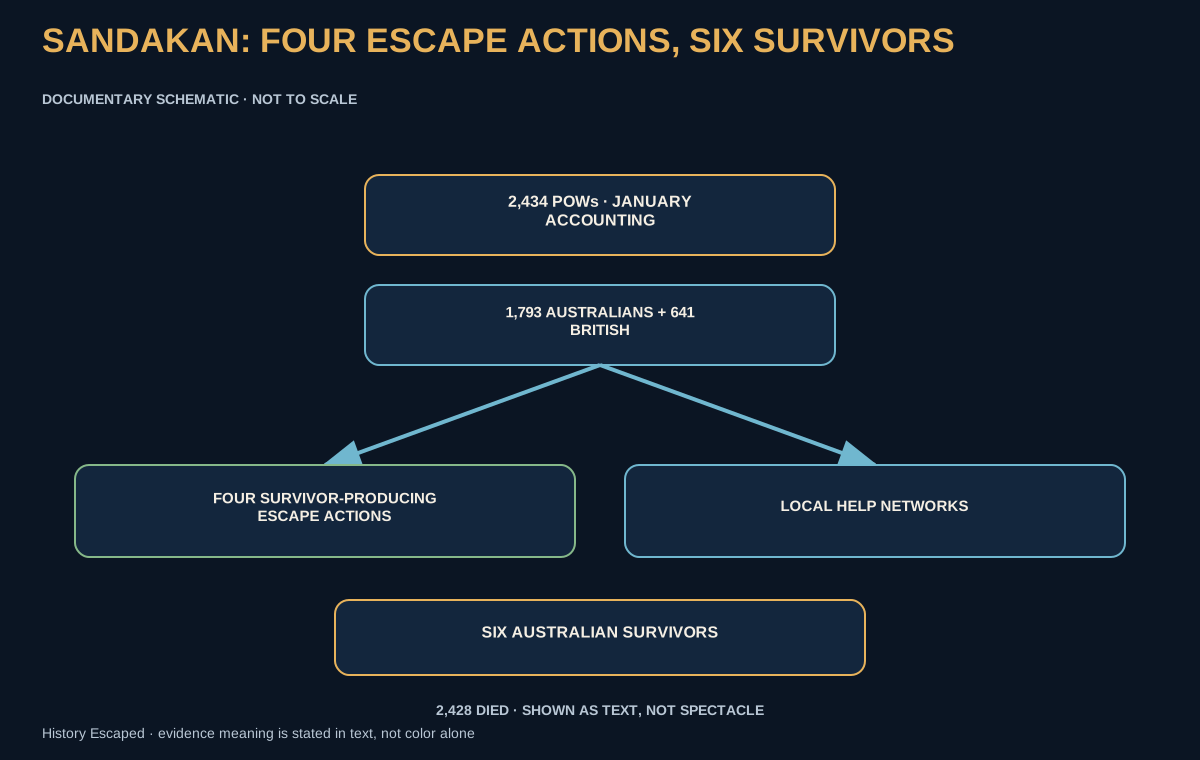
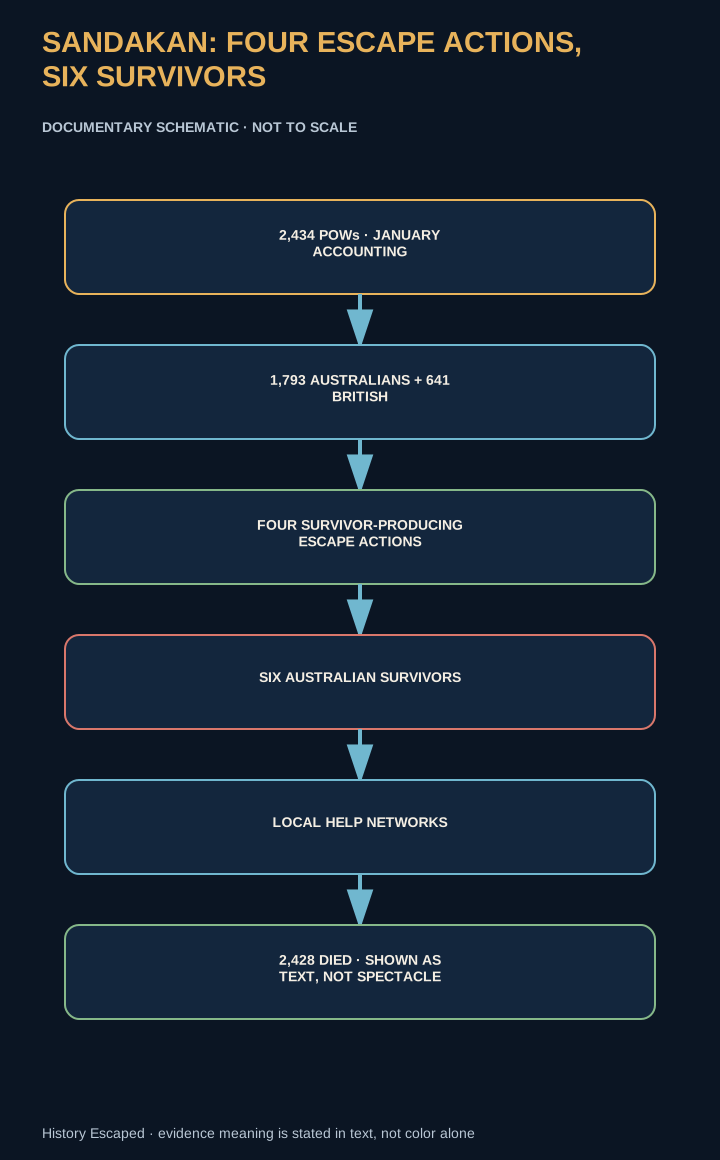
Simplified evidence-led editorial reconstruction based on the cited record; not to scale. Uncertainty is stated directly in the visual and adjacent text.
