
Roland Garros spent nearly three years as a German prisoner of war before escaping in February 1918. The aviator who had become famous before the war for crossing the Mediterranean and during it for experimenting with forward-firing armament did not escape alone. His partner was Lieutenant Anselme Marchal, another French pilot with his own history of capture and failed escape attempts.
The successful breakout came from the Kavalier Scharnhorst at Magdeburg, a fortress installation used to hold officers and repeated escapees. Garros and Marchal left disguised as German officers, crossed Germany toward the neutral Netherlands, and eventually returned to France by way of Britain. The broad outline is secure. Some of the details that later made the episode sound effortless—guards saluting them, exact numbers of sentries, stolen civilian clothes, false passes, and the precise day on which they crossed the camp threshold—are less uniform across the surviving accounts.
At a Glance
- Capture: 18 April 1915, after Garros was forced down behind German lines in Belgium
- Captivity: Nearly thirty-four months in a succession of German POW camps
- Successful escape: February 1918; 15 February is the strongest current French institutional date
- Companion: Lieutenant Anselme Marchal
- Final camp: Kavalier Scharnhorst, Magdeburg
- Method: Disguise as German officers followed by overland movement toward the Netherlands
- Outcome: Both men reached neutral territory and returned to France
- Aftermath: Garros retrained, returned to combat, and was killed in action on 5 October 1918
Capture in 1915
Garros entered military aviation as a volunteer in August 1914. By early 1915 he had become associated with a Morane-Saulnier equipped with metal deflectors on the propeller blades, allowing a machine gun to fire forward through the propeller arc without every bullet striking the blades. The system was crude compared with later synchronization gear, but it gave a single-seat aircraft a direct forward-firing weapon.
On 18 April 1915, Garros was forced to land behind German lines in Belgium after his aircraft developed trouble during a mission in the Courtrai area. French Ministry of the Armed Forces histories agree on the date and on the essential consequence: he was captured before he could completely destroy the aircraft.
The captured machine attracted immediate German technical interest. That episode became part of Garros’s wartime legend, but it should not overshadow what followed. His imprisonment lasted far longer than his brief 1915 run of aerial victories.
A Prisoner Who Kept Trying
Garros did not remain at one camp. Later biographies and local German research place him in a succession of sites as German authorities moved officers who were considered persistent escape risks. The exact sequence varies by retelling, but Magdeburg eventually became the decisive location.
The Kavalier Scharnhorst was part of the old Magdeburg fortress system. Local historical research records Garros among the notable prisoners held there, and the city’s own heritage documentation identifies the surviving Kavalier as part of Magdeburg’s former fortifications. By late 1917 Garros was back at Magdeburg after earlier failed efforts to get free.
There he was reunited with Anselme Marchal.
Marchal had flown a remarkable long-range mission in June 1916 that carried him over Berlin with propaganda leaflets before an engine problem forced him down in enemy-held territory. He had already attempted escape more than once during his own captivity. His 1919 memoir, Après mon vol au-dessus de Berlin: ma captivité, mes évasions, became one of the most important later sources for his captivity and escapes.
The two pilots therefore brought different advantages to the plan. Garros was an experienced and determined escape planner; Marchal spoke German well enough to make impersonation more credible. Later accounts consistently identify disguise as the central method.
The German-Officer Disguise
The strongest institutional histories say that Garros and Marchal escaped Magdeburg dressed as German officers. The French Ministry of the Armed Forces and ECPAD both preserve that detail, and the Magdeburg episode is also remembered in later German local history.
Beyond that point, caution is necessary.
Popular retellings say the two prisoners fabricated rough German uniforms, prepared false passes, walked through the main gate, and were even saluted by the guards. Some versions specify four sentries. Those details may well derive from Marchal’s own memoir and later accounts based on it, but they are not equally confirmed by the institutional summaries available today.
The exact preparation process is therefore less secure than the underlying deception. It is reasonable to say that they adopted the appearance of German officers and used that disguise to get out of the Magdeburg prison. It is less defensible to reconstruct every exchange at the gate as if a contemporary guard report survived.
This was not an escape won by overpowering guards or breaching a wall. Its central problem was identity: could two French prisoners appear ordinary and authoritative enough to pass through a controlled German military environment without triggering immediate arrest?
For a short period, they could.
When Did They Leave?
Even the date illustrates why the story needs source discipline.
The current French Ministry of the Armed Forces gives 15 February 1918. The Musée de l’Air et de l’Espace and multiple ECPAD image records use the same date. A Magdeburg municipal historical document also gives 15 February.
Other published accounts differ. Jacques Mortane’s 1930 aviation history gives 14 February, while a later French Air Force research article gives 17 February. Modern secondary works sometimes repeat one or the other.
There is no need to hide that disagreement. The weight of current French institutional evidence favors 15 February, so that is the canonical date here. The variation probably reflects the difficulty of fixing a multi-stage escape to one moment—departure from confinement, movement away from Magdeburg, or successful flight into neutral territory—but the surviving sources do not establish that explanation conclusively.
The safest historical conclusion is simple: Garros and Marchal escaped from Magdeburg in mid-February 1918, with 15 February the best-supported specific date.
Across Germany
Getting out of Kavalier Scharnhorst did not end the escape. The men still had to cross wartime Germany and reach a neutral border.
French institutional accounts agree that they made their way to the Netherlands and from there continued through Britain before returning to France. The route is important because it distinguishes a prison breakout from a completed escape. Until they reached neutral Dutch territory, the two French officers remained fugitives inside an enemy state.
Later retellings add civilian clothing and false travel documents to the journey. Those details fit the demands of clandestine movement and appear repeatedly in secondary accounts, but the exact sequence of clothing changes, railway journeys, checkpoints, and border crossing is not reconstructed here as settled fact. Doing so would give later narrative detail the same weight as the better-attested endpoints.
The result is nonetheless clear. Both men reached the Netherlands. They then passed through Britain and returned to France.
Return as Escaped Prisoners
Their return was quickly public.
Contemporary French material shows Garros and Marchal being celebrated together after the escape. The Bibliothèque nationale de France catalogue records photographs of receptions for the two escaped aviators in 1918. ECPAD preserves a photographic series in which Garros and Marchal were decorated on the Somme front after their return.
The ECPAD records are especially useful because they confirm both men’s joint escape and identify 15 February as the escape date. They also correct a common distortion of the story: this was not simply “Roland Garros escapes Germany.” Marchal was his partner in the successful operation and was publicly recognized alongside him.
Garros was promoted within the Légion d’honneur and immediately wanted to return to combat. That decision required more than simply finding another airplane.
Three Years Had Changed Air Warfare
Aviation in 1918 was not the aviation Garros had left in April 1915. Aircraft were faster, more powerful, and more specialized. Formation tactics and air-combat doctrine had changed. Garros had also spent almost three years away from flying.
The International Encyclopedia of the First World War notes that he had to retrain on modern aircraft such as the SPAD XIII and adapt to new combat methods. French military histories similarly describe a period of training before he rejoined SPA 26.
His captivity had also affected his health, including his eyesight. Even so, he insisted on returning to operational flying rather than remaining in a technical or instructional role.
By August 1918 he was back with his combat unit. On 2 October he gained another confirmed aerial victory. Three days later, on 5 October 1918, he was killed in combat near Vouziers in the Ardennes.
The escape therefore bought Garros less than eight months of life. It did, however, restore his freedom and permit him to choose his own return to military service.
The Story That Grew Around the Escape
Garros’s fame encouraged later writers to compress the episode into a polished adventure: famous aviator, German fortress, homemade uniforms, saluting guards, dash across Germany, triumphant return.
The broad arc is real. The polished edges require more care.
The successful escape involved two men, not one. The best-supported date is 15 February, but other published dates exist. Disguise as German officers is strongly supported, while the exact construction of the uniforms, documents carried, number of sentries passed, dialogue at the gate, and clothing changes afterward belong more heavily to memoir and later retelling.
Even Garros’s earlier failed attempts are difficult to enumerate with precision. French military sources agree that there were several. Later stories describe tunnels, maritime schemes, coded communications, and even plans for an aircraft-assisted rescue, but those anecdotes come from biographies and commemorative literature rather than a single contemporaneous escape file.
None of that weakens the documented achievement. It clarifies it.
Garros and Marchal escaped from a German officer POW installation by impersonating members of the enemy’s own officer class, then crossed a belligerent state until they reached neutral territory. The hardest part of the reconstruction is not proving that they escaped. It is resisting the temptation to treat every later flourish as if it had been recorded on the night itself.
Evidence discipline
What the record supports
Status labels distinguish secure conclusions from uncertainty and rejected claims. Color is never the only signal.
WELL-SUPPORTED
The exact escape date was 15 February 1918.
The current French Ministry of the Armed Forces, ECPAD, the Musée de l’Air et de l’Espace, and a Magdeburg municipal historical document use 15 February. Other published accounts give 14 or 17 February, so the date is strong but not source-unanimous.
Sources: SRC-001, SRC-002, SRC-003, SRC-007, SRC-009MYTH
Garros escaped alone.
The successful escape was a joint operation with Lieutenant Anselme Marchal, who is identified alongside Garros by French military institutions and contemporary post-escape imagery.
Sources: SRC-001, SRC-002, SRC-004LATER CLAIM
The guards saluted Garros and Marchal as they walked through the main gate.
This vivid detail is common in later retellings but is not independently established by the institutional summaries used here.
Sources: SRC-004, SRC-005LATER CLAIM
Exactly four sentries were passed during the breakout.
The four-sentry detail appears in derivative retellings and is not treated as independently documented.
Sources: SRC-004LATER CLAIM
The fugitives definitely used false passes and then stole civilian clothing.
Such details are plausible and appear in later narratives, but the strongest institutional sources establish the German-officer disguise and route to neutral territory without proving every later accessory.
Sources: SRC-004, SRC-005Documentary reconstruction
Garros and Marchal: record and later detail
A case-local editorial visual clarifies the evidence structure without adding false precision or reusable operational detail.
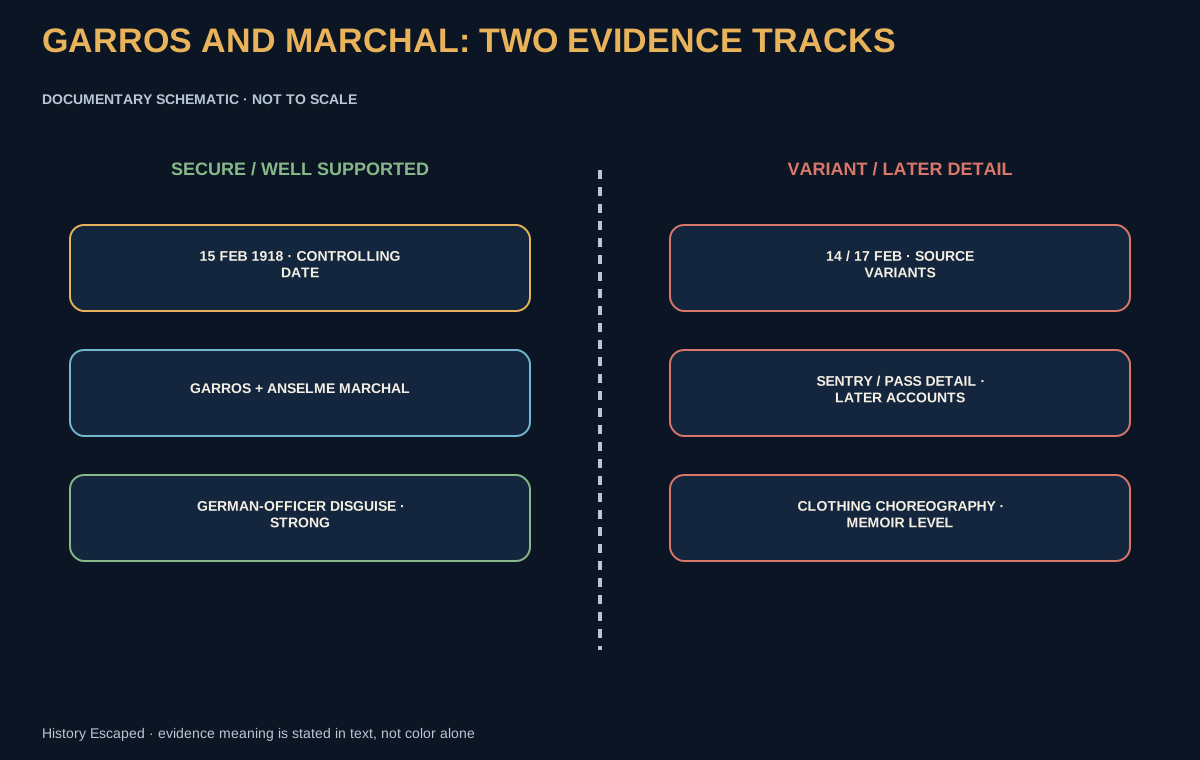
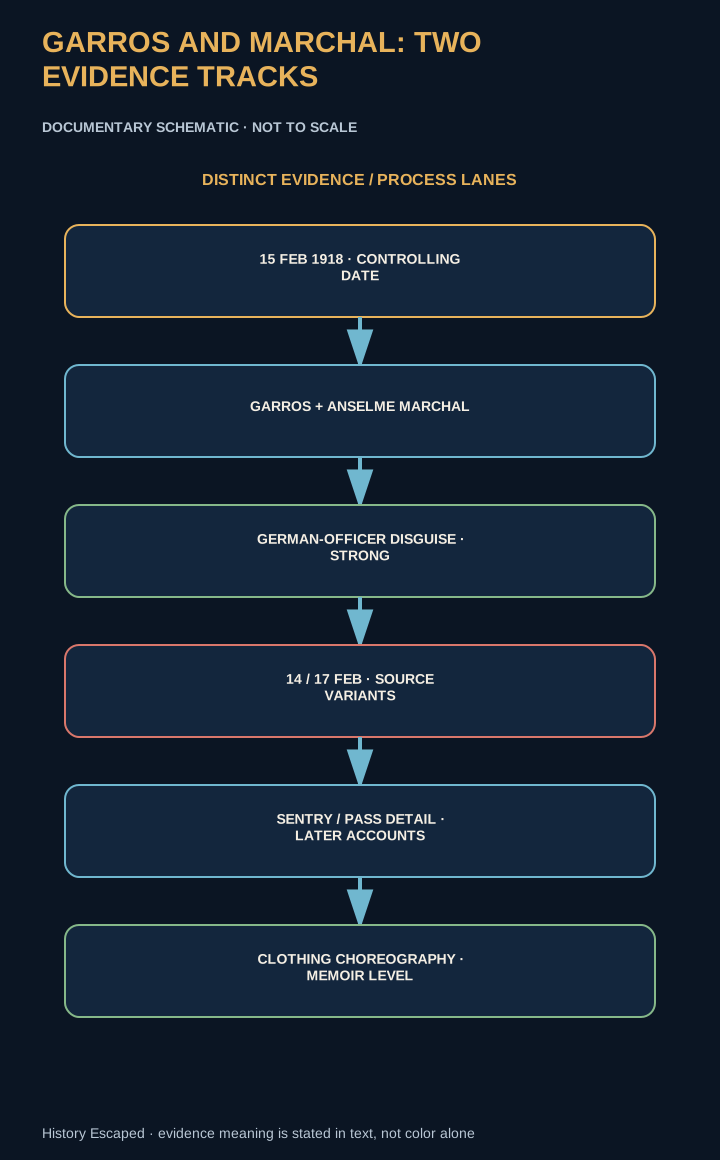
Simplified evidence-led editorial reconstruction based on the cited record; not to scale. Uncertainty is stated directly in the visual and adjacent text.
