
On a September night in 1864, more than two hundred Māori prisoners left Kawau Island for the New Zealand mainland.
They had no prison wall to climb. Kawau itself was the barrier.
The detainees had been moved there only weeks earlier from the prison hulk Marion, and the colonial government had replaced a military guard with looser civilian supervision. Boats were available for fishing, though their normal oars were locked away at night. The prisoners used that freedom to leave.
At a Glance
- Departure: Night of 10–11 September 1864
- Place: Kawau Island, Hauraki Gulf
- People involved: About 200–220 Māori detainees
- Largest prisoner group: Kīngitanga fighters captured at Rangiriri
- Other captives: Men taken in later Waikato and Tauranga engagements
- Legal status: Held without ordinary charge or trial; constitutional/legal basis contested
- Method: Boats, improvised paddles and probable mainland assistance
- Mainland gathering point: Ōtamahua, in the Omaha–Matakana area
- Outcome: No mass recapture; the group eventually moved back toward Waikato
- Major correction: The Kawau group was not simply “the 183 Rangiriri prisoners”
The Prisoners After Rangiriri
The largest part of the Kawau prisoner body came from Rangiriri, one of the decisive battles in the British invasion of Waikato.
On 21 November 1863, British forces took around 180 Kīngitanga defenders prisoner after the central redoubt was surrounded. Modern NZ History gives 183 captives.
Archival paperwork gives another number: 178 men in the first Rangiriri group transferred into colonial custody. A printed prisoner list survives with 178 names.
Those figures do not necessarily contradict each other. “Captured at the battle” and “received into a particular detention system” were not always the same administrative count. More importantly, the prisoner population did not remain fixed.
Not Only Rangiriri
As the war continued, colonial authorities added smaller groups of prisoners taken elsewhere.
Official papers identify men captured at Waiari, Rangiaowhia, Gate Pā, Ōrākau and other engagements. Ten prisoners from Te Ranga arrived as late as June 1864.
The surviving lists record more than totals. They contain individual names, hapū and remarks.
That matters because the language of nineteenth-century government papers often flattened detainees into “rebel natives” or “Waikatos.” In reality, the prisoners came from different communities, held different ranks, and had different histories before and after captivity. Some were released before the Kawau departure.
The prominent chief Te Oriori, for example, had been captured at Rangiriri but was later released on parole and used as an intermediary with those who remained. He was not one of the men who left Kawau in September.
Why the Numbers Keep Changing
The prison hulk records reached a reported maximum of 214 prisoners.
Other contemporary documents use figures near 200. After the escape, officials repeatedly reported around 220 Waikato men gathered on the mainland.
These are snapshots from different dates, compiled for different purposes. A figure of 183 describes Rangiriri. A figure of 178 describes the first colonial Rangiriri cohort.
A figure of 214 describes a recorded hulk maximum after later additions. A figure of roughly 200–220 describes the mass of men associated with the Kawau departure and the group subsequently gathered at Ōtamahua. There is no single number that can replace all four.
Selected chronology
Selected chronology
Rangiriri prisoners taken
British forces capture roughly 180 Kīngitanga defenders at Rangiriri; NZ History gives a total of 183.
Detention on the Marion
The Rangiriri prisoners are confined on the prison hulk Marion in Waitematā Harbour while the government debates their status.
Later prisoners are added
Men captured at later engagements including Waiari, Rangiaowhia, Gate Pā, Ōrākau and Te Ranga are added to the detainee population.
Transfer to Kawau Island
The Marion is towed to Kawau and the detainees are established on the island under a more open civilian-supervision scheme.
Mass departure from Kawau
The prisoner body uses boats to cross to the mainland; the absence is discovered on Sunday morning.
Fugitives reported near Matakana
Early reports place the group at Waikauri near Matakana after crossing from Kawau.
Ōtamahua becomes the main encampment
The group establishes a defensible mainland position while officials and Māori intermediaries negotiate over its future.
The group begins moving toward Waikato
Grey reports that the former prisoners have abandoned Ōtamahua and are moving south under a developing safe-conduct approach.
The Marion
Before Kawau, the prisoners were confined aboard the Marion in Waitematā Harbour. The arrangement soon became controversial.
Medical evidence raised concerns about ventilation, confinement, depression and the danger of disease. Government reports also emphasized bathing, food and attempts at schooling and medical care.
Both can be true. The men were not being held in a conventional criminal prison, but they were confined for months in a crowded hulk while the government struggled to decide what legal process, if any, should follow their capture.
Prisoners of War, Subjects in Rebellion, or Detainees?
The language of the records shifts because the government itself had not settled the question cleanly. Some official correspondence called the men prisoners of war. Other papers treated them as British subjects engaged in rebellion who might be tried under the Suppression of Rebellion Act 1863.
That Act gave the Governor sweeping emergency powers and allowed courts martial. Yet it did not end disagreement over whether the prisoners could simply be detained indefinitely without trial.
Governor George Grey repeatedly challenged his ministers over that issue. Grey argued that prolonged detention without bringing the men promptly before a lawful tribunal could be illegal.
His responsible ministers disagreed with parts of that interpretation. They argued that detention prevented captured fighters from returning to the war and had political value while hostilities continued. They also found the proposed trial process legally and practically difficult.
No ordinary criminal trial resolved the matter. The prisoners remained in custody.
A Different Kind of Confinement
By mid-1864, continuing to keep the men on the Marion was becoming harder to defend politically and medically. A new plan placed them on Kawau Island, about 30 miles north of Auckland and owned privately by Governor Grey. The proposal was not to build another prison.
The detainees would cultivate land, build structures and gain much greater freedom of movement. The scheme was sometimes described in official correspondence as resembling a small agricultural or missionary settlement.
On 2 August 1864, the Marion was towed to Kawau. The military guard was withdrawn. Civilian officers remained responsible for supervision.
Freedom on an Island
The new arrangement gave the prisoners more room and a healthier environment. It also made escape possible.
They cultivated land in different parts of Kawau and were permitted to use small boats for fishing. According to later institutional histories, the oars and rowlocks were secured at night.
The sea was expected to function as the outer wall. It did not.
Did They Give Parole?
This became one of the arguments after they left. Auckland newspapers claimed that the prisoners had given no parole and therefore had broken no pledge of honor.
Superintendent T. A. White later supplied a different account.
White said that before the Kawau transfer he had gathered the chiefs and asked them to promise that they would not leave without government permission. He said the group agreed. He also claimed that he repeated the question on 1 August and again received a collective promise.
No signed individual parole covering the whole group is known. The safest conclusion is that White believed he had obtained an oral collective commitment, while its formal status and binding character remained contested.
Planning and Fear
The departure was not simply one sudden reaction. Tapihana Tiriwa, one of the prisoners’ leading speakers, later told White that he had thought about an escape earlier and developed the idea as circumstances allowed. At the same time, genuine fear shaped the decision.
White’s reports say prisoners had heard that they might be returned to the hulk. Some had also heard a more frightening rumor: that if the Waikato war resumed, the prisoners might be towed out to sea and drowned.
There is no evidence that the government had such a plan. But the rumor was real enough to affect the men.
Gunfire from a warship practicing near Kawau appears to have intensified the fear. The prisoners were also homesick and acutely aware of what they had lost: freedom, land, political authority and contact with their communities.
Documentary reconstruction
Custody, numbers and movement to the mainland
A case-local editorial visual separates the documented sequence from uncertainty without implying exact modern geography or operational detail.
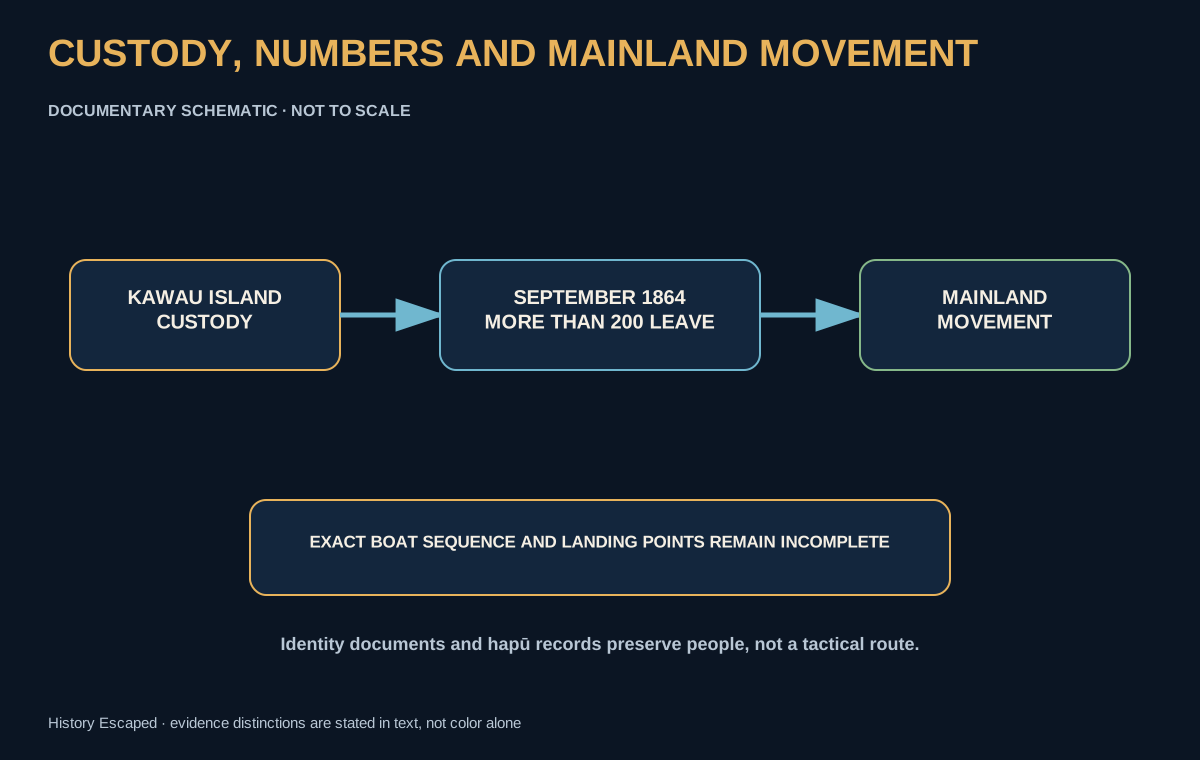
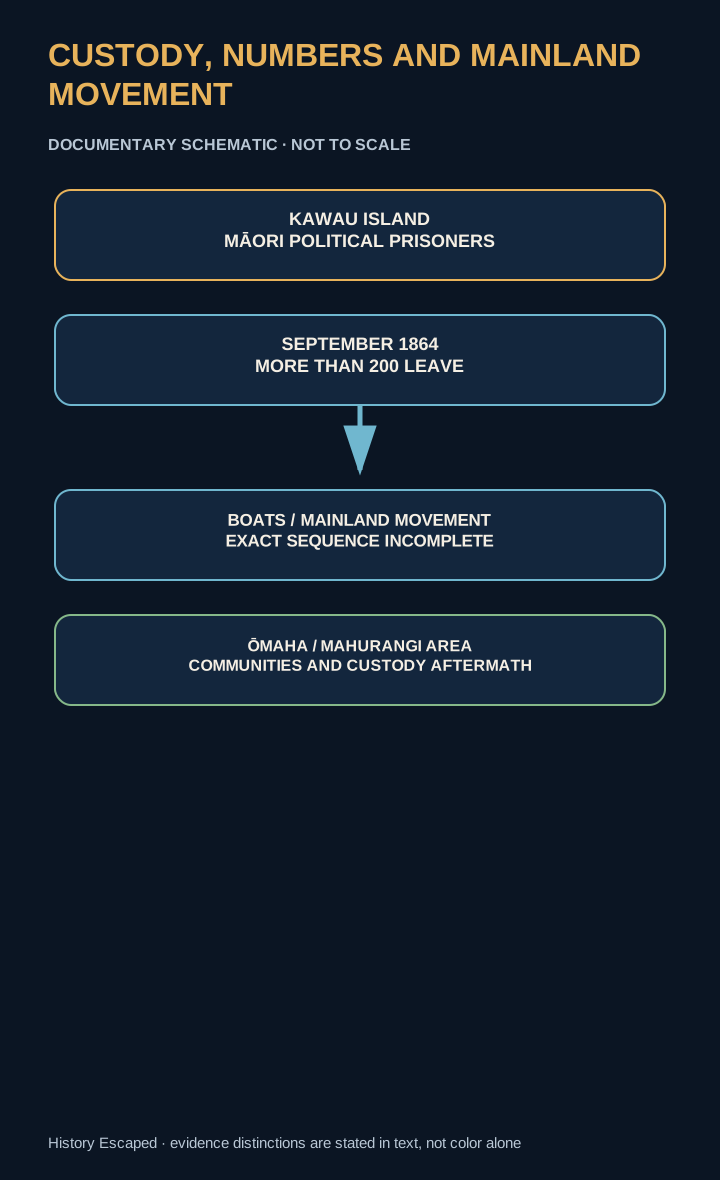
Simplified editorial reconstruction based on the cited historical record; not to scale. Uncertainty is stated directly in the visual and adjacent text.
The Crossing
Modern NZ History dates the escape to 11 September 1864. A later military report gives 10 September, while colonial papers indicate that movement across the channel may have taken place over more than one night before the absence was discovered on Sunday morning. The best description is therefore the night of 10–11 September, while acknowledging that some crossings may have begun earlier.
The prisoners took boats belonging to the Kawau establishment. Te Ara records that, because regular oars were unavailable, they used shovels and shaped boards as paddles. Official papers also refer to assistance from additional boats associated with Māori on the mainland.
That helps explain a practical problem noticed immediately by contemporary newspapers: the few small island boats seemed insufficient to move more than two hundred people in one trip. The precise ferry sequence is lost. The mass departure is not.
Waikauri and the Mainland
By Sunday morning, local reports placed the fugitives at Waikauri near Matakana. They moved away from the coast and toward high ground in the Omaha district.
The government did not know whether the escape would become another front in the war. Auckland reacted with alarm.
Warships, officials and troops were put on alert. Settlers worried that the men might move south toward the city or draw northern iwi into conflict. The escapees instead gathered around Ōtamahua.
The Position at Ōtamahua
At Ōtamahua the former prisoners established huts and a defensive position. A government report later described a long, narrow pā or entrenchment and counted roughly 220 Waikato men, joined by some supporters and family members. They were no longer physically confined.
They were also not yet safely home. The authorities could still attempt recapture, and the group had to decide whether to return to Kawau, accept a new settlement, stay in the north, or try to reach Waikato.
Ngāpuhi Responses Were Not One Thing
Some modern summaries say that Ngāpuhi fed and protected the escapees. That happened, but not as a single iwi-wide policy. Some northern Māori supplied food, weapons or political support.
Other leaders worked with officials, warned settlers or tried to mediate. Eruera Maihi Patuone, one of the best-known northern rangatira of the period, appears in reports as an intermediary rather than a commander of the escaped group.
Other northern communities were reluctant to become involved in a renewed war. The government’s fear was precisely that a forcible attack on the prisoners might push more northern Māori into their cause.
Why the Government Did Not Storm Them
The colonial authorities had the power to send troops. They chose not to mount a large assault on the main group.
Part of that decision was practical. Fighting men entrenched on difficult ground could produce casualties.
Part was political. A violent recapture risked widening the conflict north of Auckland. Officials instead used negotiation.
T. A. White returned to speak with the prisoners. Te Oriori, already released from custody, also acted as an intermediary. The fact that a former Rangiriri prisoner could be sent to negotiate with those who had left Kawau shows again why the story cannot be told as one anonymous block of “rebels.”
Evidence discipline
What the record supports
Status labels distinguish secure conclusions from uncertainty and rejected claims. Color is never the only signal.
MYTH
Exactly 183 prisoners escaped from Kawau Island.
183 is the modern count captured at Rangiriri, not the final Kawau population. Later captives were added and some earlier prisoners were released; post-escape totals generally fall around 200–220.
Sources: SRC-001, SRC-004, SRC-006MYTH
Every Kawau escapee had been captured at Rangiriri.
Official prisoner records include men taken at later engagements such as Waiari, Rangiaowhia, Gate Pā, Ōrākau and Te Ranga.
Sources: SRC-004, SRC-012MYTH
The detainees had been convicted of rebellion in ordinary courts.
Modern institutional histories state that they were held without charge or trial. Contemporary officials disputed how prisoners of war, alleged rebels and emergency-law detainees should legally be treated.
Sources: SRC-002, SRC-003, SRC-004, SRC-005DISPUTED
The legal basis of indefinite detention was settled and uncontested.
Governor Grey repeatedly questioned the legality of prolonged detention without prompt trial, while colonial ministers defended continued custody on military, political and emergency-law grounds.
Sources: SRC-004, SRC-005MYTH
All prisoners signed individual parole agreements promising not to leave Kawau.
No signed individual parole for the whole group is established. T. A. White later reported two collective oral promises not to leave without permission.
Sources: SRC-004, SRC-006, SRC-009MYTH
The government planned to tow the prisoners to sea and drown them.
Post-escape reports show that prisoners feared or had heard this rumor, but no evidence establishes such a government plan.
Sources: SRC-006MYTH
The departure was wholly spontaneous panic.
Immediate fears mattered, but White reported that Tapihana said he had conceived and developed the idea of escape earlier.
Sources: SRC-006MYTH
All Ngāpuhi uniformly supported the escapees.
Some northern Māori supplied food, weapons or political support, while others mediated, warned settlers or distanced themselves from renewed conflict.
Sources: SRC-002, SRC-006, SRC-010MYTH
Colonial troops recaptured the Kawau group by force.
No mass assault or recapture occurred. Negotiation and safe conduct eventually allowed the group to move back toward Waikato.
Sources: SRC-001, SRC-003, SRC-007MYTH
Te Oriori was one of the men who escaped Kawau in September.
He had been released on parole before the mass departure and was later used as an intermediary with the escaped prisoners.
Sources: SRC-004, SRC-006Offers, Refusals, and Distrust
The negotiations were unstable. At different points the men discussed returning, settling on different land, or remaining where they were. They feared that surrender might mean renewed imprisonment or punishment for leaving Kawau.
Officials were equally suspicious that allowing them to move freely could return experienced fighters to Kīngitanga resistance. The legal ambiguity that had existed aboard the Marion had become a political stalemate in the hills. Neither side wanted to create a new battle if it could be avoided.
Safe Conduct Toward Waikato
By November the government was moving toward a different answer. Instead of mass recapture, Grey and ministers considered allowing the former prisoners to travel back toward Waikato under assurances of safe conduct. Friendly chiefs and escorts could help prevent clashes with settlers during the journey.
On 18 November, Grey reported that the group had abandoned its position at Ōtamahua and had already begun moving south. Modern NZ History summarizes the final outcome in a phrase that would have seemed unlikely when the men first crossed from Kawau: They returned toward Waikato unmolested.
What the Escape Changed
The Kawau departure embarrassed the colonial government. Grey and the Whitaker–Fox ministry blamed one another over custody, guard levels, legal responsibility and the entire Kawau scheme. Military officials worried that the escape might force troops to remain near Auckland instead of being sent to other campaigns.
The feared northern war did not follow. But the men were returning to a Waikato transformed by invasion.
Land confiscation was already becoming a central instrument of colonial policy. The escape did not cause confiscation, but it returned the former prisoners to communities facing its consequences.
An Escape From an Unsettled Legal Category
The most revealing feature of Kawau is not that guards made a mistake. It is that the colonial state had never comfortably decided what the prisoners were. They had been captured in battle but not exchanged like conventional prisoners of war.
They were subjects of the Crown, according to colonial law, yet they were not brought through ordinary criminal trials. Emergency legislation existed, but Governor and ministers argued over whether it justified what they were doing. Then the men were placed on an island with more freedom than a prison but without permission to leave.
In September 1864, they settled the practical question themselves. They took the boats and went home. ---

