
Juan Francisco Manzano’s autobiography ends at the moment he leaves. It is after midnight. The night is cold and rainy. Manzano has never saddled a horse before, but he fastens the saddle and bridle with shaking hands, kneels to pray, puts on his hat and climbs on. As he starts away, a voice from the darkness wishes him well and tells him to hurry.
Then the surviving story stops. That flight did not happen in 1836. It happened around 1817, nearly two decades before Manzano finally became legally free.
At a Glance
- Physical flight: c. 1817
- Destination: Havana
- Escapee: Juan Francisco Manzano
- Enslaver fled: María de la Concepción Valdés, Marquesa de Prado Ameno
- Immediate helper: A free servant in the household
- Method: Secret nighttime departure on horseback
- Objective described by Manzano: Reach Havana, seek protection or legal intervention, and change his condition
- Immediate aftermath: Not preserved in the surviving first-person manuscript
- Legal manumission: 1836
- Major correction: Manzano’s escape and his legal freedom were separate events
A Life Written Under Slavery
Manzano was born enslaved in Cuba, probably in 1797. His parents, María del Pilar and Toribio de Castro, were also enslaved. His early childhood was unusual within Cuban slavery because the Marquesa Jústiz de Santa Ana treated him with forms of domestic favor and intimacy that Manzano later remembered vividly.
That did not make him free. His legal condition depended on the people who claimed ownership over him, and changes within the household could transform his life without his consent. After the death of his first mistress, Manzano passed into a much harsher period under the Marquesa de Prado Ameno.
The Marquesa de Prado Ameno
Manzano’s surviving autobiography repeatedly returns to punishment. He describes beatings, confinement, humiliation, false accusations and forced movement between town houses and rural properties. His exact chronology is sometimes difficult to reconstruct because he wrote from memory in 1835 and occasionally admitted uncertainty about dates.
The emotional pattern is clearer. Periods of relative security could end suddenly. A minor accident or allegation could send him back toward punishment at El Molino, an estate he increasingly associated with fear.
Manzano also understood that other lives were possible. He had spent time in Havana. He had learned trades and artistic skills. He knew free people of color. He had experienced households in which he was treated differently.
Havana therefore became more than a city. It became the place he imagined when he thought about changing his condition.
The First Attempts to Control His Own Future
Before the final flight, Manzano tried less drastic strategies. At one point, while being ordered back into the Marquesa’s direct service, he asked for the paperwork that could allow him to seek another owner. The request was rejected.
His mother’s death created another conflict. Manzano believed that money and property she left behind should benefit her children. The Marquesa claimed authority over the inheritance and reacted angrily when he pressed the matter.
Manzano later wrote that after losing hope in that inheritance, he thought increasingly about flight. Even then, leaving was not simple.
Why Havana Was So Difficult to Reach
Manzano asked how far Havana was from where he was staying. He was told about twelve leagues.
He doubted that he could cover the distance on foot in one night and temporarily abandoned the plan. The problem was not only distance.
An enslaved man traveling alone risked detention by local officials, recognition, forced return and punishment as a fugitive. Manzano had a personal example in mind: an uncle who had tried to flee toward Havana and had been captured and brought back as a cimarrón.
He wanted to leave. He also understood what failure could mean.
A Bath, a Broken Barrel and Another Threat
The final crisis began with an ordinary act. Manzano went to bathe before changing clothes, as he understood the household routine required.
His mistress called for him and demanded to know whether he had permission. He said he did not.
In the confrontation that followed, Manzano describes his nose being injured badly enough that he bled. Later he was ordered to carry a barrel of water. The load was too heavy. He fell, the barrel rolled, and both ended up in the water.
The accident was interpreted as another offense. Manzano was threatened again with being sent to El Molino and into the hands of the administrator he feared, Don Saturnino. The idea of Havana returned.
The Free Servant
The next day, while other people were at Mass, a free servant called Manzano aside. This person is one of the most important figures in the escape and one of the least recoverable.
Manzano does not build a heroic biography around the helper. Instead, he records practical advice.
The servant told him that someone with his abilities could find another purchaser. More importantly, he said Manzano could go to the tribunal of the Captain-General in Havana, explain how he was being treated and seek redress.
He showed Manzano the road. This detail changes the meaning of the escape.
Manzano was not describing a plan to disappear permanently into a maroon community beyond colonial government. He was attempting to get away from an abusive enslaver and reach a city where law, patronage and a different owner might improve his position.
It was still flight from slavery’s coercion. It was not yet legal emancipation.
Don Saturnino Arrives
On Monday morning, Don Saturnino arrived. Manzano immediately feared that the administrator had come to take him away.
Later that day he overheard servants discussing the same possibility. His fear became physical. In the autobiography he remembers trembling, a severe headache and images of being bound, shorn, dressed in rough cloth and marched back to El Molino.
The threat might have been real. It might also have been partly rumor among servants.
Manzano understood it as immediate danger. He decided to go.
Help With the Horse
The free servant reappeared. He told Manzano to move the horse so that it would not make noise near the house later. He gave him spurs and pointed out the saddle.
The assistance stopped short of a fully documented escape network. There is no surviving roster of helpers, no route map and no evidence of a coordinated organization waiting between the estate and Havana.
What survives is more intimate: one free servant making departure possible, other enslaved people apparently noticing Manzano’s preparations, and nobody raising the alarm. Manzano still hesitated.
He thought about his younger siblings. He thought about traveling alone on unfamiliar roads.
He thought about his uncle being captured. Then Don Saturnino asked where Manzano slept. That question settled it.
After Midnight
Everyone went to bed early. Manzano waited until after midnight.
The weather was cold and somewhat rainy. He saddled the horse for the first time in his life. His hands shook so badly that he struggled with the equipment.
Before leaving, he knelt and prayed. Then he mounted.
Manzano believed he was unseen, but a voice called after him with a blessing and an instruction to ride hard. He later learned that several enslaved people had watched. None stopped him.
Where the Autobiography Stops
This is the point at which historical confidence changes sharply. Manzano ends the surviving autobiography by saying that what happened next would appear in a second part.
That continuation is not available as a surviving first-person narrative equivalent to the first. The absence matters.
The surviving evidence does not support a detailed scene of Manzano arriving in Havana, entering the Captain-General’s tribunal, meeting a specific protector or negotiating a new owner unless another source independently documents it. Later scholarship can reconstruct portions of his subsequent life. The escape itself cannot simply be extended past the final line of the manuscript.
The Flight Was Not Manumission
Modern chronologies place the horseback flight around 1817. Yet Manzano was still enslaved years later.
He published poetry in 1821 and again in 1830 while remaining legally owned. His situation and owners changed, and the nearly two decades between the flight and his final legal freedom remain much less fully documented than the autobiography’s dramatic ending.
By the 1830s he was associated with María de la Luz de Zayas. That fact exposes a distinction often lost in retelling his life.
Manzano had successfully escaped the immediate control of the Marquesa de Prado Ameno. He had not escaped the legal institution of slavery.
Writing the Autobiography
By 1835, Manzano had become known as a poet. The Havana intellectual Domingo del Monte asked him to write an account of his life under slavery.
Manzano accepted while he was still enslaved. That fact shaped the text.
He was writing about powerful white families who remained alive. He was writing for an elite literary circle. He was also writing in a colony in which slavery was central to wealth and political power.
The result is not a simple abolitionist pamphlet dictated by someone else. The autograph manuscript is Manzano’s own writing. But it is writing produced under pressure.
His Own Manuscript, Later Hands
The Biblioteca Nacional José Martí preserves an autograph version in Manzano’s handwriting. Its spelling and punctuation are highly individual. That manuscript gives historians direct access to a text he physically wrote.
What happened afterward created several additional layers. Members of Del Monte’s circle copied and corrected Manzano’s work. Anselmo Suárez y Romero produced a heavily regularized version. Other portions passed through additional hands, and a continuation disappeared.
The Irish physician and antislavery advocate Richard Robert Madden later translated a revised form into English. In 1840 it appeared in London as part of Poems by a Slave in the Island of Cuba, Recently Liberated.
The English publication made Manzano internationally useful to antislavery campaigning. It was not identical to the autograph text he had written in Cuba.
The Price of Legal Freedom
In 1836, Del Monte’s circle organized a subscription to secure Manzano’s manumission. The strongest contemporary anchor is a letter Del Monte wrote on 23 July 1836.
He reported that the money had been gathered and delivered to María de Zayas. The same letter referred to Manzano as a freed man already earning money through confectionery work.
Most scholarship gives the payment as about 800 pesos. Other manuscript traditions give 850 or 968.
Those discrepancies matter less than the larger fact. Money changed hands because the legal system still treated Manzano as property whose freedom required a recognized act of manumission.
Assistance Without Erasing Agency
The subscription mattered. Without the people who contributed money, Manzano’s legal freedom in 1836 might have been delayed further.
But the story becomes distorted if the literary circle is cast as a group of enlightened rescuers who created Manzano’s freedom for him. Manzano had been struggling for control over his life long before Del Monte entered the documented story.
He had tried to change owners. He had thought about legal remedies.
He had learned trades. He had developed literacy under conditions that restricted it.
He had fled on horseback when he believed punishment was imminent. He had built the literary reputation that made white patrons pay attention.
The subscription completed a legal process. It did not begin his resistance.
Cuban Law and the Distance Between Rights and Reality
Spanish Cuban law gave enslaved people some avenues unavailable in certain other slave societies. Manumission through payment, coartación, valuation and petitions for a change of owner could create legal possibilities.
Modern historians caution against treating those possibilities as reliable rights. Enslavers resisted valuations, obstructed payments, manipulated custom and retained enormous practical power.
Manzano’s life illustrates that gap. The free servant who urged him toward Havana believed colonial institutions might help. Nearly nineteen years later, a cash payment was still needed to make freedom legally secure.
Why the Date Matters
Calling this “Manzano’s 1836 escape” compresses two different historical acts into one. Around 1817, Manzano physically removed himself from an enslaver he feared.
In 1836, he obtained legal manumission through a subscription that paid the woman who then claimed ownership over him. The first event shows an enslaved man choosing flight despite the risk of capture.
The second shows how difficult it was for flight alone to defeat slavery as a legal system. Manzano’s own text preserves the first moment more vividly than anything that came after.
A trembling young man saddles a horse, prays, hears a voice wish him safety and rides toward Havana. The law takes almost two decades longer to catch up.
Evidence discipline
What the record supports
Status labels distinguish secure conclusions from uncertainty and rejected claims. Color is never the only signal.
MYTH
Juan Francisco Manzano physically escaped slavery in 1836.
The physical flight described in his autobiography is generally dated to about 1817. The year 1836 marks legal manumission.
Sources: SRC-003, SRC-004, SRC-011MYTH
The c. 1817 flight made Manzano legally free.
Manzano remained legally enslaved for nearly two more decades and required a recognized manumission payment in 1836.
Sources: SRC-003, SRC-004, SRC-006MYTH
Manzano's escape was a plan to disappear permanently into maroon territory.
His own account says the free servant advised him to go to Havana, report his treatment to the Captain-General's tribunal and seek another purchaser or legal improvement in status.
Sources: SRC-001, SRC-003MYTH
Domingo del Monte organized Manzano's physical escape.
The c. 1817 flight predates the documented Del Monte relationship. Manzano identifies an unnamed free household servant as the immediate helper.
Sources: SRC-001, SRC-004UNKNOWN
The exact route Manzano rode to Havana is known.
Manzano says he was shown the road and was told Havana lay about twelve leagues away, but the surviving narrative ends at departure.
Sources: SRC-001MYTH
The immediate outcome after Manzano reached Havana is fully documented in his surviving autobiography.
The surviving autograph manuscript stops at the instant of departure and refers to a second part that does not survive in equivalent form.
Sources: SRC-001, SRC-002, SRC-009MYTH
Manzano's autobiography was merely dictated to a white editor.
An autograph manuscript in Manzano's own handwriting survives. Later editors and translators substantially mediated other versions.
Sources: SRC-002, SRC-009, SRC-010MYTH
Madden's 1840 English Life is textually identical to Manzano's autograph manuscript.
The English publication followed copying, revision and translation and was shaped for an international antislavery audience.
Sources: SRC-008, SRC-009, SRC-010DISPUTED
The exact manumission payment was certainly 850 pesos.
A contemporary Del Monte letter supports about 800 pesos, while later notes and manuscript traditions preserve 850 and 968 peso figures.
Sources: SRC-002, SRC-003, SRC-006Documentary reconstruction
Physical flight and legal freedom
A case-local editorial visual separates the documented sequence from uncertainty without implying exact modern geography or operational detail.
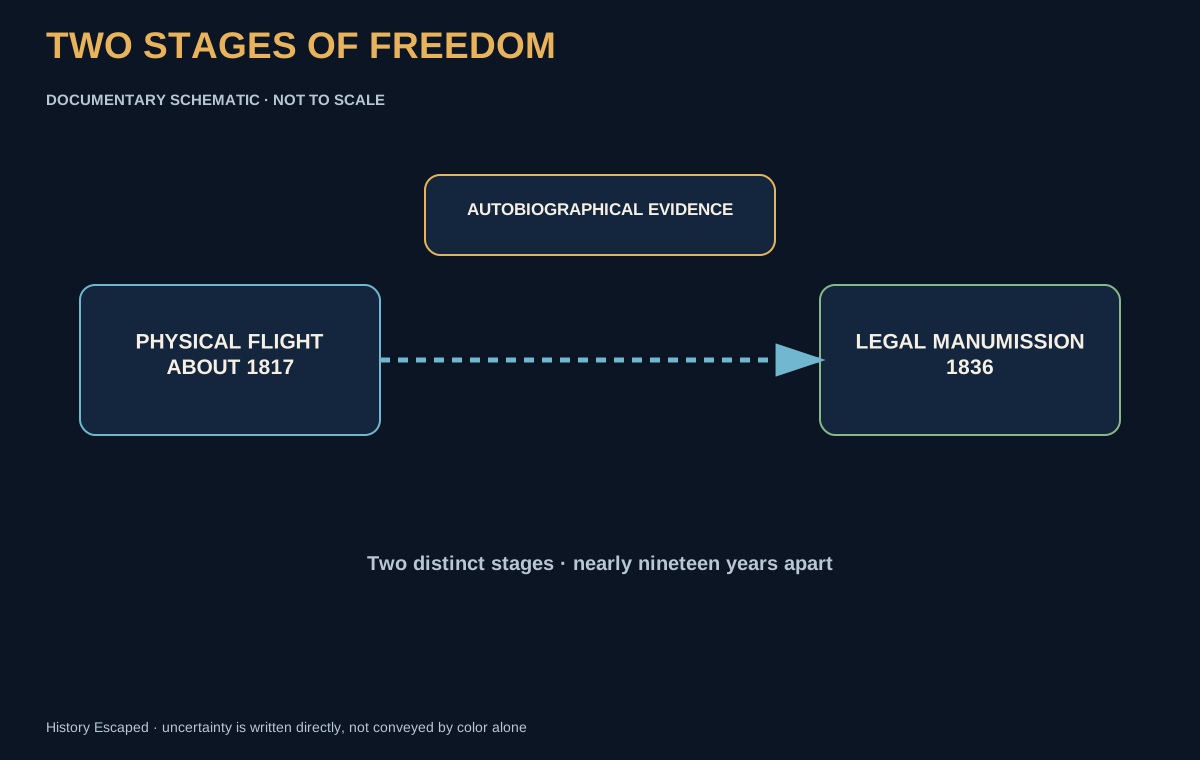
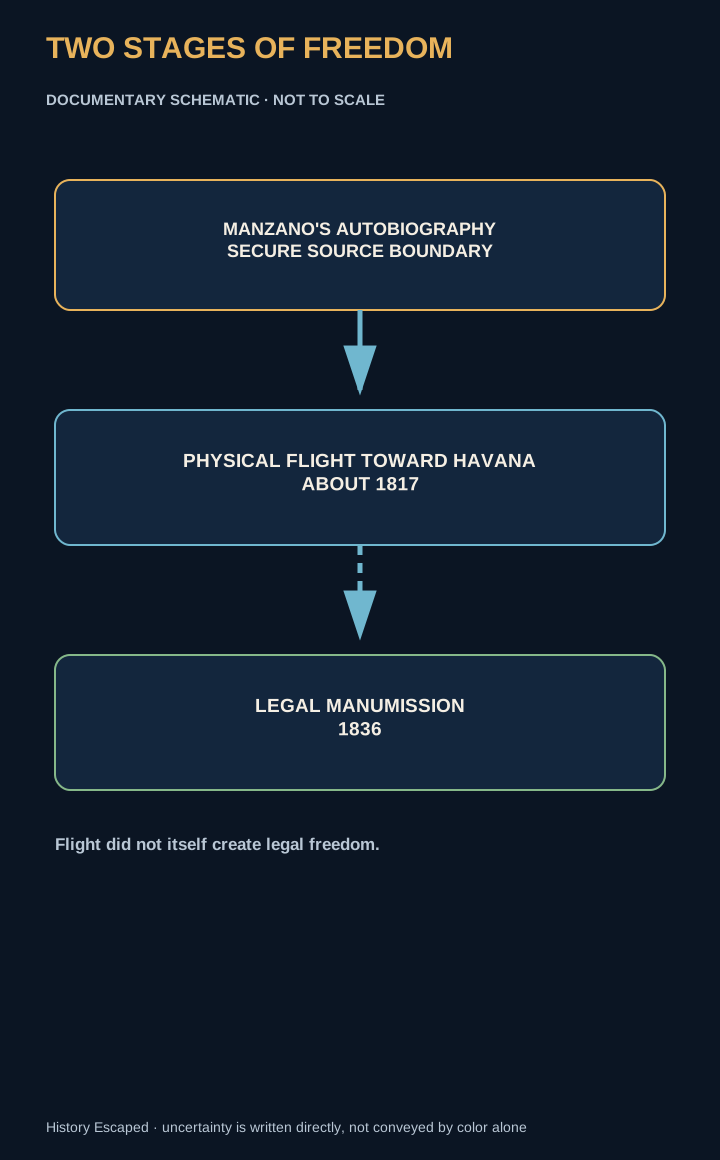
Simplified editorial reconstruction based on the cited historical record; not to scale. Uncertainty is stated directly in the visual and adjacent text.
