
Fulbert Youlou’s escape in March 1965 covered only a short physical distance. Politically, it crossed a much larger one.
The former president of Congo-Brazzaville had been under government control since his overthrow in August 1963. He was first held in military installations and later kept under guard in a villa. On the night of 25–26 March 1965, he got out, reached the Congo River, crossed to Léopoldville on the opposite bank, and placed himself under the protection of Moïse Tshombe.
The escape immediately generated competing stories. One said Congolese paratroopers had effectively rescued him. Later biographies claimed that his successor, Alphonse Massamba-Débat, had helped him flee. French covert networks had previously discussed ways to free him.
Archival work by historian Jean-Pierre Bat points to something less cinematic: Youlou appears to have relied on compromised guards and a small circle of trusted supporters, slipped away quietly, and crossed the river before the larger political networks around him even knew he had succeeded.
At a Glance
Who: Fulbert Youlou, first president of the Republic of the Congo.
Overthrown: 15 August 1963 after three days of strikes and demonstrations in Brazzaville.
Custody: Initially military detention; later house arrest in a guarded villa.
Escape: Night of 25–26 March 1965.
Route: Brazzaville → Congo River → Léopoldville.
Transport: Contemporary reports say an unidentified small craft; later archive-based reconstruction says a pirogue.
Assistance: Some guard/supporter complicity is strongly indicated; a large commando rescue and direct presidential sponsorship remain disputed.
Destination: Political asylum under Moïse Tshombe in Congo-Léopoldville.
From President to Prisoner
Youlou had led Congo-Brazzaville through independence in 1960 and became the country’s first president. His government grew increasingly authoritarian, and political opposition, labor discontent, and resistance to his proposed single-party system produced the crisis remembered as the “Trois Glorieuses” of 13–15 August 1963.
By 15 August, Youlou had lost control. Contemporary accounts describe the military and popular pressure that forced his resignation while France declined to intervene to restore him. The fallen president was then taken into custody.
There was an irony to the first place of detention: he was interned at a military camp that still bore his own name. The custody soon changed.
In September 1963, Le Monde reported that the new authorities had transferred Youlou outside Brazzaville to the Djoué gendarmerie camp because they feared he might escape. Other later histories describe a further move into residence surveillance at a villa, where he lived under guard with family members.
By March 1965, that villa—not a prison cell—was the place from which he would disappear.
Why He Was Still Dangerous
Youlou had lost office, but he had not lost political importance. He retained supporters inside Congo-Brazzaville, especially among networks that had backed him before 1963. Across the river in Léopoldville, he also had a powerful potential ally: Moïse Tshombe.
Youlou had supported Tshombe during the Katanga secession crisis. By 1964 Tshombe had become prime minister of Congo-Léopoldville. That relationship made Youlou’s detention more than a domestic matter.
His supporters explored rescue plans. Jean-Pierre Bat’s study of the Foccart networks shows that in 1964, Bernard Kolélas and allies across the river discussed a commando operation to remove Youlou. Youlou reportedly rejected at least one such proposal as effectively suicidal.
French-connected operatives also considered scenarios for getting him out. None of those plans, according to Bat, explains what actually happened in March 1965.
The Night of 25–26 March
The first public version of the escape came quickly.
Brazzaville radio confirmed that Youlou had escaped from the villa where he was being guarded during the night of 25–26 March. The broadcast said he had taken advantage of President Massamba-Débat’s absence from Brazzaville and had fled with his wife and children.
The personnel responsible for guarding the villa were arrested for questioning.
From Léopoldville came a more dramatic claim. An AFP dispatch suggested that Congolese paratroopers might have helped remove Youlou from the villa. That story fit the political atmosphere: Youlou had military sympathizers, opponents of the new regime were active, and cross-river plots were real.
It was not the only explanation.
What the Foccart Archives Changed
Historian Jean-Pierre Bat later reconstructed the escape using material from the Foccart archives. His conclusion was that the successful operation was much smaller and quieter than the commando plans surrounding it.
Bat writes that Youlou bought or bribed his guards, relied on a few trusted partisans, reached the river, and crossed in a pirogue. He argues that secrecy was the key to success: only a very small circle knew enough to compromise the plan.
This interpretation also changes the French role. Jacques Foccart’s networks had been thinking about Youlou’s release, and Foccart later recalled learning that a planned rescue had succeeded. But archival correspondence examined by Bat indicates that French officials were actually informed of Youlou’s presence in Léopoldville only after he had arrived there on the morning of 26 March.
The distinction matters. Prior rescue planning existed; that does not prove that the successful escape was a French-run covert operation.
Did Massamba-Débat Help Him?
A second question is harder to resolve. Many later biographies say that President Alphonse Massamba-Débat helped his predecessor escape because Youlou’s life was in danger.
The contemporary reporting points in a different direction. Brazzaville radio said Youlou had exploited Massamba-Débat’s absence while the president was away at Loutété for a cement-plant ceremony. The guards were detained after the escape, which publicly framed the event as a security failure rather than an authorized release.
Bat’s reconstruction likewise focuses on bribed guards and a tiny supporter network. None of this proves that no senior official quietly tolerated the departure; political escapes can succeed because people at different levels choose not to stop them.
What it does mean is that direct presidential sponsorship cannot be treated as established fact. The stronger wording is narrower: Youlou escaped with insider or guard complicity; exactly how high that complicity reached remains disputed.
The River Was the Border
Once out of the guarded villa, the geography favored a fast escape. Brazzaville and Léopoldville faced one another across the Congo River. Reaching the opposite bank changed Youlou’s legal and political position instantly.
Contemporary reporting described the craft as unidentified. Bat later called it a pirogue. No reliable source in the working set gives the exact departure point, landing point, duration of the crossing, or route from the villa to the water.
Those details should remain unknown. By the morning of 26 March, the important fact was established: Youlou was in Léopoldville, outside the custody of the Brazzaville government.
Tshombe’s Asylum
Youlou went directly into the orbit of Moïse Tshombe. Tshombe granted him political asylum. Their alliance made sense historically: Youlou had been one of the African leaders most sympathetic to Tshombe during the Katanga period.
For Congo-Brazzaville, the escape was therefore more threatening than the loss of a single detainee. A former president with a domestic following had crossed into a neighboring capital and reached a friendly government led by a man with his own regional networks, money, soldiers, and foreign contacts.
French officials were immediately concerned about what Youlou intended to do next. Bat’s archival account depicts him arriving with ambitions intact and talking as though a return to power might still be possible. French-connected advisers instead urged caution.
The escape had succeeded. Restoration had not.
Trial Without the Defendant
The Brazzaville government proceeded against Youlou after he was gone. In June 1965, a popular tribunal tried him in absentia and condemned him to death. Contemporary reporting lists accusations involving the repression of the August 1963 protests, alleged misuse of state resources, and support connected with Katanga.
Those were charges and findings of the revolutionary tribunal. They belong in the political aftermath but should not be converted into neutral historical judgments without separate evidence.
The court also ordered the seizure or nationalization of Youlou’s property. His physical escape had therefore become permanent exile.
From Léopoldville to Madrid
Léopoldville did not become a path back to the presidency. Regional politics changed quickly. Tshombe himself lost office later in 1965, and Youlou’s room for political maneuver narrowed.
In early 1966 he attempted to enter France. French authorities refused him admission. He ultimately settled in Spain.
The later exile is less important to the escape than the route by which it began: a guarded residence, a compromised security system, a short journey to the river, and one crossing into a different state.
What the Sources Actually Establish
The core facts are unusually clear.
Youlou was overthrown in August 1963 and held under government control. By March 1965 he was living under guard in a villa. During the night of 25–26 March, he escaped. He crossed the Congo River and appeared in Léopoldville, where Tshombe gave him asylum.
The mechanics are partly recoverable. Contemporary reporting confirms a guarded villa, his disappearance with family, the detention of security personnel, and a river crossing in a small unidentified craft. It also preserves the early rumor that paratroopers may have helped him.
Bat’s later archive-based reconstruction supports a quieter version: bribed guards, a small trusted network, and a pirogue.
What remains unresolved is the level of sponsorship. A large commando rescue is not supported by the archival reconstruction. A French-run operation is contradicted by evidence that Foccart learned of the successful escape after Youlou arrived. Direct help from Massamba-Débat is a later claim that cannot be reconciled cleanly with the contemporary public account.
The strongest historical conclusion is also the most interesting one. Youlou did not need a spectacular raid. He needed people guarding him to stop guarding him effectively, a few trusted supporters, and a boat across the river.
One night was enough to turn house arrest into international exile.
Evidence diagram
Across the river in one night
The escape occurred on the night of 25–26 March 1965. The commando claim remains disputed.
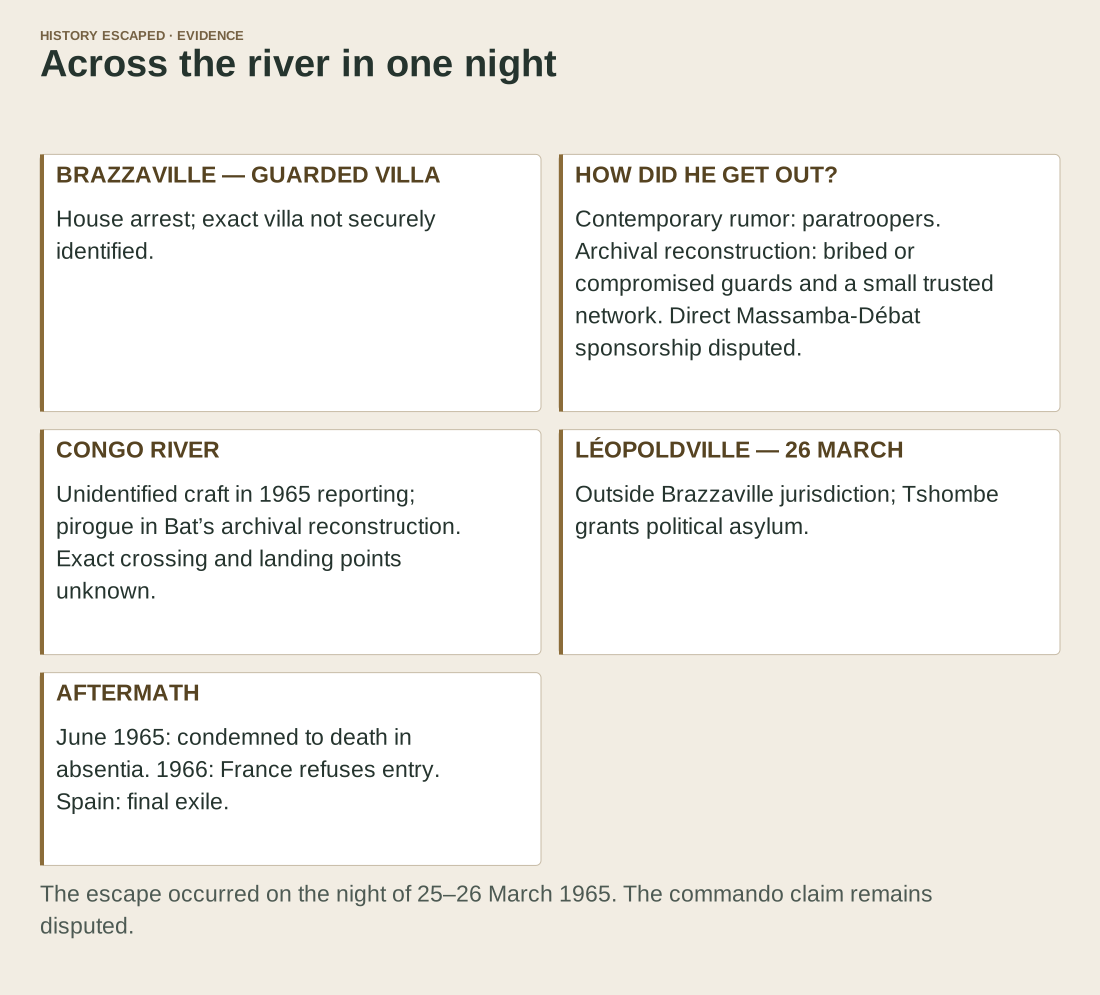
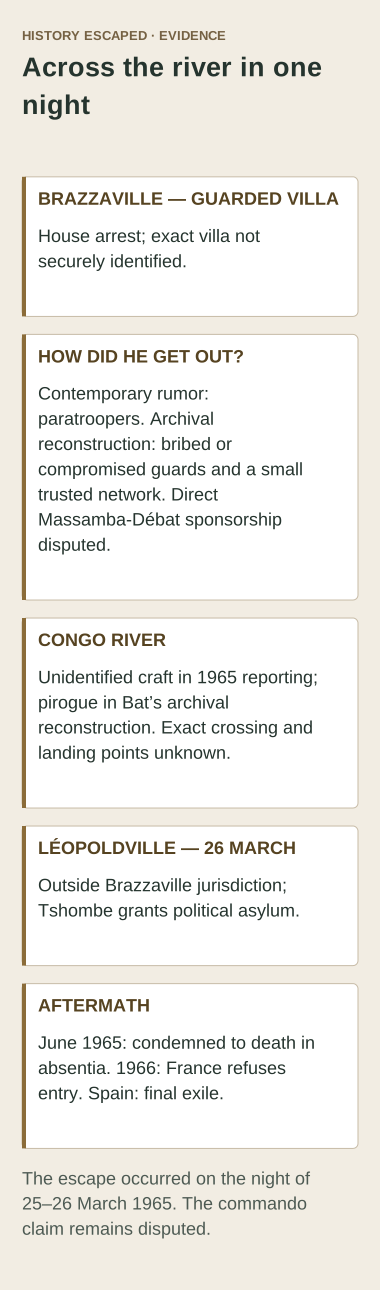
The escape occurred on the night of 25–26 March 1965. The commando claim remains disputed.
Problem → response
Escape was a sequence of problems
Each response solved a practical obstacle while often creating the next one.
- 01→
Obstacle
Guarded residence
Youlou remained under armed or official surveillance inside a villa.
Response
The successful escape appears to have depended on compromised guards and strict secrecy.
- 02→
Obstacle
Risk of political interception inside Brazzaville
A former president with a large following could not move openly toward the border without risking detection.
Response
The escape was conducted at night with only a small trusted circle involved.
- 03→
Obstacle
International border at the Congo River
Reaching safety required leaving Congo-Brazzaville jurisdiction.
Response
Youlou crossed by small craft to Léopoldville and immediately sought political protection.
The final accounting
Outcome
Successful political escape
Youlou escaped from guarded residence and crossed into Congo-Léopoldville.
Immediate asylum
Moïse Tshombe granted Youlou protection in Léopoldville.
Legal-political aftermath
Youlou was condemned to death in absentia and remained in exile rather than returning to power.
Selected chronology
Selected chronology
Youlou resigns and is detained
After the Trois Glorieuses, the former president was taken into military custody.
Transferred because authorities fear escape
Contemporary reporting says Youlou was moved to the Djoué gendarmerie camp because the new government feared he might escape.
Outside rescue plans considered
Youlou supporters and cross-river allies discussed a commando rescue, which Youlou rejected as too dangerous.
Escape from the guarded villa
Youlou left house arrest and reached the Congo River amid disputed levels of guard, military, or political complicity.
Arrival in Léopoldville
Youlou appeared in the neighboring capital and sought protection from Tshombe.
Condemned to death in absentia
A Brazzaville popular tribunal condemned Youlou and ordered the confiscation or nationalization of his property.
France refuses entry
Youlou arrived from Léopoldville but was not admitted into France and ultimately continued toward exile in Spain.
Evidence discipline
What the record supports
Status labels distinguish secure conclusions from uncertainty and rejected claims. Color is never the only signal.
DOCUMENTED
Youlou escaped on the night of 25–26 March 1965.
Contemporary reporting from Brazzaville and AFP fixed the escape to this night.
Sources: SRC-001MYTH
Youlou broke out of a conventional prison cell.
By the time of the escape he was being held under guard in a villa; earlier detention had included military and gendarmerie camps.
Sources: SRC-001, SRC-004, SRC-005DISPUTED
A large paratrooper commando rescued Youlou from the villa.
AFP reported this as an early possibility, but Bat’s archival reconstruction argues that the successful escape was a much quieter operation using compromised guards and a few trusted supporters.
Sources: SRC-001, SRC-002MYTH
French covert networks directly executed the successful escape.
French-connected rescue planning existed, but Bat’s Foccart-archive evidence indicates that Foccart learned of the completed escape only after Youlou reached Léopoldville.
Sources: SRC-002DISPUTED
President Massamba-Débat personally arranged Youlou’s escape.
Later biographies repeat this claim, while contemporary Brazzaville radio said Youlou exploited the president’s absence and Bat’s reconstruction does not establish direct presidential sponsorship.
Sources: SRC-001, SRC-005WELL-SUPPORTED
Youlou crossed the Congo River in a pirogue.
Contemporary reports establish a crossing by unidentified craft; Bat’s archival reconstruction specifies a pirogue.
Sources: SRC-001, SRC-002