
Elias Henry Jones and Cedric Waters Hill did not escape Yozgad by climbing a wall, cutting a fence, or slipping past a guard. On 26 April 1918, Ottoman authorities put them into transport and sent them away from the prisoner-of-war camp themselves.
That was exactly what the two officers had spent months trying to make happen.
Their route out of captivity depended on a long deception involving fake spiritualist messages, a failed buried-treasure scheme, and eventually the deliberate appearance of serious mental illness. The immediate objective was not to reach open country. It was to change how the Ottoman authorities classified them—from ordinary prisoners who belonged at Yozgad to men who needed specialist medical observation elsewhere.
Even after that worked, they were not free. Jones and Hill remained under guard, passed through hospitals and prisoner facilities around Constantinople, underwent medical examinations, and waited months for exchange. Their “escape” was therefore an engineered release from the POW system rather than a conventional breakout.
At a Glance
Who: Lieutenant Elias Henry Jones and Lieutenant Cedric Waters Hill.
Where: Yozgad POW camp in central Anatolia, modern Yozgat, Turkey.
Method: A prolonged deception using fraudulent spiritualism and feigned psychiatric illness to obtain medical transfer and eventual prisoner exchange.
Left Yozgad: 26 April 1918, under Ottoman escort.
Medical result: By August, modern biographical scholarship says both had been certified mentally ill and approved for exchange.
Freedom: Hill entered the repatriation process in October and sailed on 1 November; Jones followed on a later exchange ship.
Key distinction: Leaving Yozgad was one stage of the escape. They remained prisoners until repatriation.
Yozgad and the Problem of Distance
Yozgad appears in British parliamentary records by 1916 as one of the places in the Ottoman Empire where British prisoners of war were held. It was an inland camp in central Anatolia, far from a friendly frontier or coastline.
Jones later argued that the guards themselves were not the greatest obstacle to escape. The more formidable barrier was geography. A prisoner who got outside the camp still faced hundreds of kilometres of unfamiliar country, limited food, no reliable maps, and the difficulty of moving through Ottoman territory without language skills or local support.
The camp also had an internal complication. A private escape could bring restrictions or punishment on the prisoners left behind, and Jones described strong resistance among fellow officers to attempts that might worsen conditions for everyone. The Australian Dictionary of Biography summarizes this by saying Hill and Jones had been forbidden to escape by their own superiors.
The exact social rules inside the camp were more complicated than a formal prison regulation. What mattered was that simply walking away was neither physically easy nor politically cost-free.
Hill and Jones therefore began looking for another route.
The “Spook”
The method grew out of entertainment.
Jones and Hill had experimented with a Ouija board and other spiritualist performances among their fellow prisoners. Hill had an interest in conjuring before the war, while Jones became increasingly adept at creating apparently inexplicable messages. Over time, Ottoman officials also became interested.
The supernatural element needs no historical ambiguity. Jones later said plainly that the messages used in the scheme were invented. He and Hill were not documenting a paranormal event; they were running a confidence trick.
Their fictional source became known as the “Spook.” By making the Spook appear to possess information that its supposed mediums should not have known, the two prisoners built credibility with people around the camp. That credibility could then be turned toward practical goals.
The men eventually recognized that belief in the Spook might do something ordinary escape methods could not: persuade their captors to move them.
A Treasure That Did Not Exist
In early 1918 the plan became more ambitious.
Jones and Hill encouraged the belief that the Spook knew the location of buried treasure. Their intended endgame, according to the Australian Dictionary of Biography, was to persuade the commandant that the treasure could be found if the two mediums were taken toward the Mediterranean coast. Once nearer the sea, they hoped to get away and reach Cyprus.
The plan depended on the commandant wanting the treasure enough to participate.
Jones’s memoir devotes enormous space to staged clues, séances, secret messages, and efforts to manage what different people believed. Those details are entertaining but can make the escape look like a collection of theatrical tricks rather than a strategic effort to alter their location.
The key objective was geographical. Yozgad was the problem. A supposedly supernatural treasure offered a reason for Ottoman officials to take the prisoners closer to a possible route out.
That approach failed. The commandant was warned that the supposed treasure journey could become an escape attempt. The chance of being taken toward the coast disappeared.
Jones and Hill did not abandon the broader idea of making their captors move them. They changed the reason.
Turning Medical Transfer into an Escape Route
The new plan was to appear mentally ill.
Period sources use diagnostic language that belongs to early twentieth-century psychiatry. Hill presented what doctors were expected to interpret as a severe depressive and religious condition. Jones constructed a different pattern of delusion and disordered behavior.
The important part was consistency. They had to persuade not only camp officials but medical professionals who could order further observation. A brief performance in front of one credulous guard would not be enough.
Jones and Hill also built a surrounding story. Their conduct, written material, relationships with camp officials, and previous spiritualist activities were made to look like evidence that their mental condition had deteriorated during captivity.
Jones’s memoir says Ottoman doctors examined them on 13 April 1918. A few days later the camp received an order from Constantinople directing that the two English officers be sent to Haidar Pasha hospital for observation.
The deception had achieved its first major objective.
26 April: Out of Yozgad, Still a Prisoner
Jones gives the departure date precisely: 26 April 1918.
He and Hill left Yozgad for Angora under guard. This was the physical exit from the camp, but describing it as the moment they “escaped” would distort the situation. They had successfully caused the Ottoman system to transfer them, not released themselves from it.
A later Dutch Embassy medical report reproduced in The Road to En-Dor complicates the date slightly by saying Jones had been sent from Yozgad on 10 May. That wording does not fit Jones’s detailed April chronology. It may reflect a later administrative stage, delayed reporting, or imprecise translation. The stronger event chronology keeps 26 April as the departure from Yozgad while preserving the Embassy date as a documentary inconsistency.
During the journey toward Constantinople, Hill and Jones staged a dangerous incident intended to strengthen the appearance of psychiatric crisis. Modern biographical scholarship confirms that the episode nearly killed them.
The mechanics are not necessary to understand the history. Its significance is that the ruse had escalated beyond séances and paperwork into behavior that could cause real injury.
By May the two men were in the Constantinople medical system.
Fooling Doctors Was Harder Than Fooling a Camp
At Yozgad, the men had spent months learning how particular officials reacted to the Spook. In Constantinople they encountered doctors who had no reason to share the camp’s history of belief.
The deception therefore changed again.
They underwent repeated psychiatric examination in hospitals and prisoner facilities. Hill maintained a withdrawn, religiously preoccupied presentation. Jones cultivated a different set of supposed delusions. They also planted or produced material intended to reinforce what the doctors thought they were seeing.
This phase lasted far longer than the two men had expected. The waiting itself became a danger.
Hill’s fasting and the conditions surrounding his hospital treatment contributed to real malnutrition and dysentery. Once genuine illness appeared inside a fabricated psychiatric case, the distinction between acting and physical danger became much less comfortable.
The diplomatic context helped. After the United States entered the war, the Netherlands represented British interests in the Ottoman Empire. British parliamentary records from June 1918 show that the Netherland Legation in Constantinople was receiving information from prisoners and preparing to inspect camps under wartime agreements.
Jones later reproduced Dutch medical reports on their cases. One August report urged Hill’s return because his condition appeared to be worsening and recommended that he be sent back with Jones.
By August, the Australian Dictionary of Biography states, both men had been certified mentally ill and approved for prisoner exchange.
Why Medical Exchange Was a Real Route Out
Jones and Hill could manipulate their diagnoses only because the administrative exit they wanted actually existed.
British parliamentary debate in May 1918 recorded that the Ottoman government had already repatriated one British officer and eighty other ranks as invalids under an exchange arrangement. Medical condition could therefore move a prisoner into a different category from the able-bodied officers who remained in captivity.
That is what made the plan more than theatre. Jones and Hill were trying to force themselves into a recognized channel through which incapacitated prisoners could leave Ottoman hands.
It took months.
Jones later wrote that repeated delays to exchange shipping forced them to continue the deception much longer than expected. Abandoning the performance before final repatriation could expose them as malingerers and undo everything they had achieved.
The escape therefore passed through several bureaucratic thresholds: removal from Yozgad, specialist observation, medical certification, approval for exchange, transfer to an exchange point, and finally departure from Ottoman custody.
October and November 1918
Jones says Hill left Haidar Pasha on 10 October to join sick prisoners assembling for repatriation at Smyrna.
Jones remained behind temporarily. Hill took the first exchange ship; Jones reached Smyrna too late for it and traveled on a second ship a few days later.
The Australian Dictionary of Biography dates Hill’s sailing for England to 1 November 1918. By then the Ottoman Empire had signed the Armistice of Mudros on 30 October, ending hostilities with the Allies.
Jones and Hill met again in Alexandria. Jones recognized the irony: after maintaining the deception for months, they had gained freedom only shortly before the remaining healthy prisoners were released by the collapse of the war.
That does not make the escape meaningless. They could not have known when Ottoman defeat would come, and the medical-repatriation scheme had already removed them from Yozgad months earlier.
What the Sources Can Establish
The most detailed version of the story comes from Jones himself, and that creates both unusual strength and an unusual problem.
Jones openly admits the fraud. He says the supernatural messages were invented and explains the purpose of the deception. That makes the basic mechanism unusually secure as a statement against his own supposed mediumship.
His account also contains documents, dates, and material attributed to other prisoners and diplomats. Some of its chronology is independently supported by Hill’s scholarly biography and Australian War Memorial records.
At the same time, The Road to En-Dor is a crafted memoir written for publication after the events. Its vivid conversations, comic portraits of Ottoman officials, exact reactions to séances, and dramatic medical scenes should not automatically be treated as verbatim records. The book also contains ethnic and religious stereotypes characteristic of its period that add nothing to a modern reconstruction.
Hill later wrote his own account, The Spook and the Commandant, published after his death in 1975. Its existence confirms that the story did not belong only to Jones’s literary voice, but Jones remains the principal detailed source for the sequence used here.
The independent evidence supports the central result. Hill was a POW at Yozgat. He and Jones used fraudulent spiritualism. They tried to induce a transfer, then feigned mental illness. They were sent toward Constantinople for medical evaluation, certified for exchange, and repatriated before the general release of Ottoman-held prisoners.
That is why “escape” remains the right word, provided it is understood correctly. Jones and Hill did not defeat the walls of Yozgad. They persuaded the prison system to carry them through its own gates and, months later, out of captivity.
Evidence discipline
What the record supports
Status labels distinguish secure conclusions from uncertainty and rejected claims. Color is never the only signal.
MYTH
Jones and Hill physically broke out of Yozgad and immediately became free.
Ottoman authorities removed them from the camp under guard for medical observation. They remained POWs for months and gained freedom only through exchange and repatriation.
Sources: SRC-001, SRC-002MYTH
The supernatural messages used in the escape scheme were genuine spiritualist communications.
Jones explicitly states that the messages used by himself and Hill were their own inventions.
Sources: SRC-001WELL-SUPPORTED
Jones and Hill originally intended to use a supposed treasure search to get closer to the Mediterranean.
Jones’s memoir and Hill’s Australian Dictionary of Biography entry independently describe the coast/treasure plan and its intended escape purpose.
Sources: SRC-001, SRC-002WELL-SUPPORTED
They left Yozgad on exactly 26 April 1918.
Jones gives a detailed 26 April departure chronology. A Dutch Embassy report reproduced in the memoir gives 10 May for Jones being sent from Yozgad, creating an unresolved administrative/date wording conflict.
Sources: SRC-001WELL-SUPPORTED
By August both men had been accepted for medical prisoner exchange.
The Australian Dictionary of Biography states that both were certified mentally ill and approved for exchange by August, consistent with Dutch medical reporting reproduced by Jones.
Sources: SRC-001, SRC-002MYTH
The escape succeeded because Ottoman doctors were simply gullible.
The deception involved months of staged behavior, supporting material, camp-official testimony, and repeated examinations. Jones’s own account records sustained medical scrutiny after removal from Yozgad.
Sources: SRC-001, SRC-002Documentary reconstruction
From Yozgad transfer to repatriation
A case-local editorial visual clarifies the evidence structure without adding false precision or reusable operational detail.
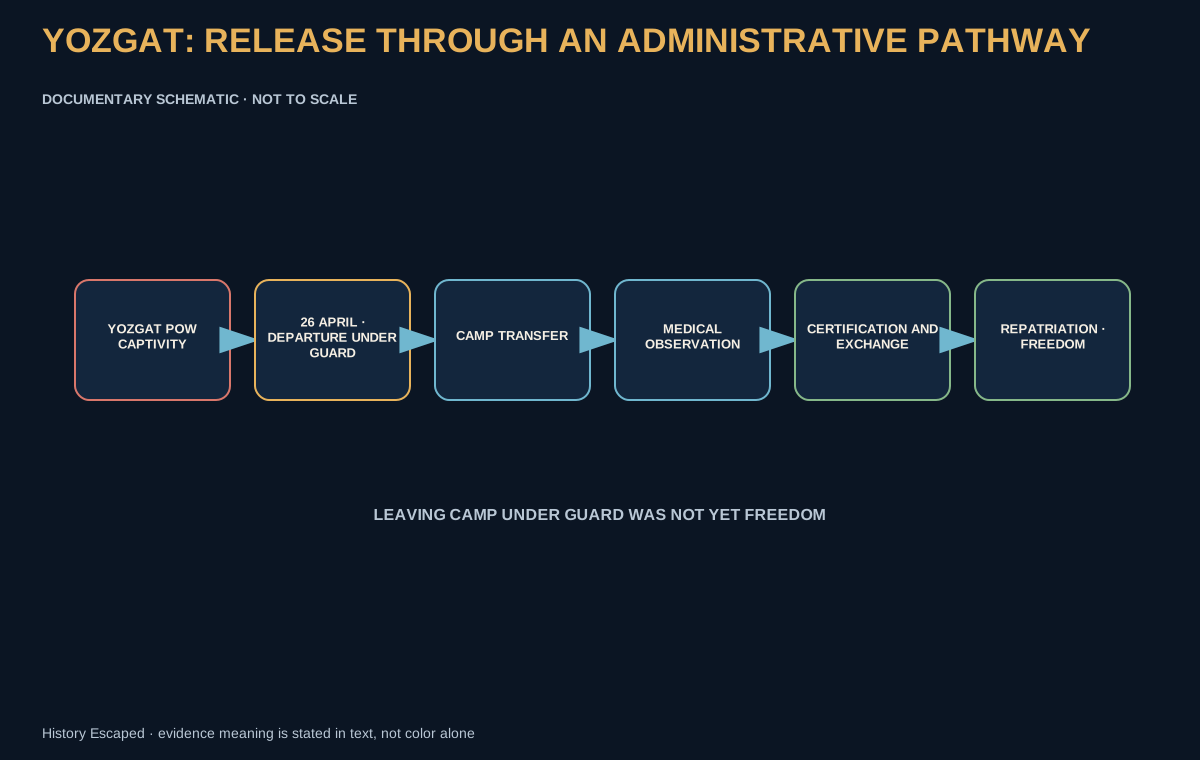
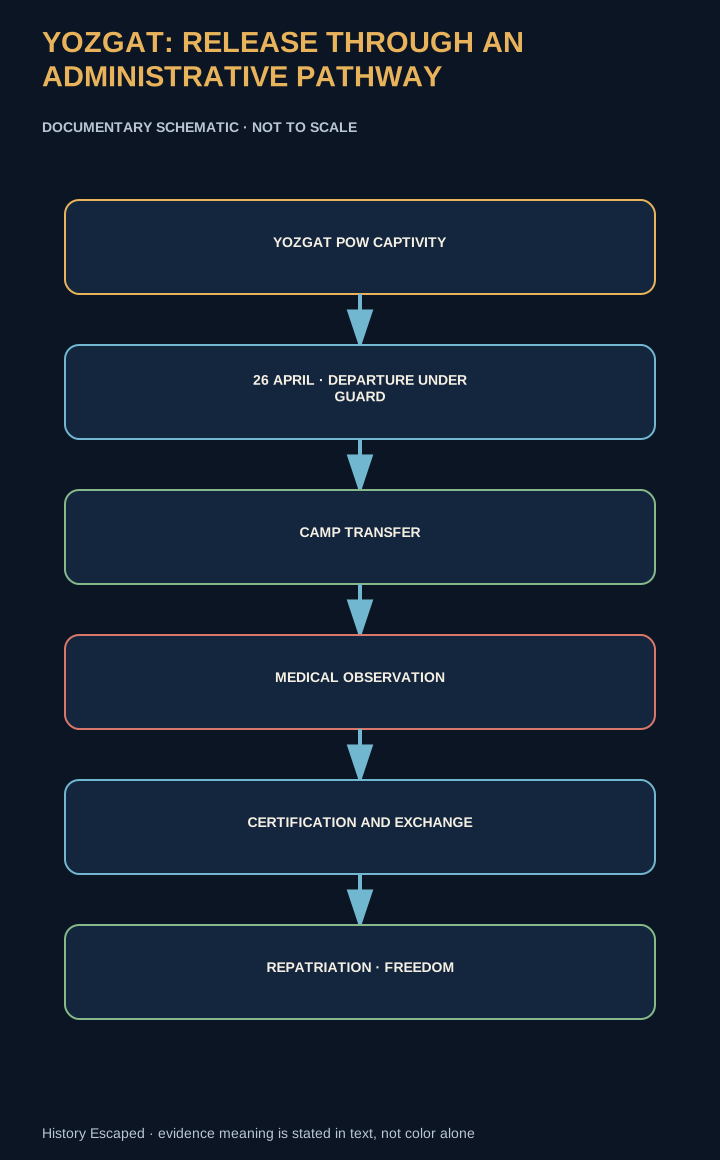
Simplified evidence-led editorial reconstruction based on the cited record; not to scale. Uncertainty is stated directly in the visual and adjacent text.