
Cesare Borgia’s escape from La Mota Castle on 25 October 1506 came after the collapse of the political world that had made him one of the most powerful men in Renaissance Italy. Three years earlier he had commanded papal armies, ruled territories in Romagna, and appeared to Niccolò Machiavelli as a case study in the acquisition and defense of political power. By 1506 he was a prisoner in Castile, cut off from the military and diplomatic networks that had once sustained him.
The escape did not depend on a single spectacular act. A chaplain, a compromised servant inside the fortress, supporters outside the walls, horses, and the protection of a powerful Castilian noble all played parts. The descent itself nearly failed when the alarm was raised and the rope was cut. Borgia fell into the castle ditch badly hurt, but his allies got him onto a horse and moved him beyond immediate royal control.
That broad sequence comes from a strong early source: the Aragonese historian Jerónimo Zurita. Later accounts add broken-legged servants, too-short ropes, disguises, exact injuries, and cinematic dialogue. Some of those details may descend from genuine traditions, but they do not all have the same evidentiary weight.
At a Glance
Who: Cesare Borgia, former cardinal, Duke of Valentinois, and former commander of papal forces.
Confinement: High-level political imprisonment in Spain after his arrest in Naples in 1504.
Prison: Castillo de la Mota at Medina del Campo, after earlier confinement at Chinchilla.
Escape date: 25 October 1506.
Method: An assisted rope descent from the fortress, followed by extraction on horseback.
Immediate outcome: Borgia escaped into the protection network of the Count of Benavente.
Durable outcome: He reached Pamplona on 3 December 1506 and entered the service of the king and queen of Navarre.
From Prince to Prisoner
The imprisonment at La Mota cannot be understood without the rapid reversal that followed the death of Pope Alexander VI in August 1503. Alexander had been Cesare Borgia’s father and the central source of papal authority behind his territorial expansion. Under the new pope, Julius II, Cesare’s position disintegrated. Towns and fortresses in Romagna slipped away, old enemies returned, and his ability to bargain from strength disappeared.
Borgia eventually reached Naples, where Gonzalo Fernández de Córdoba—the “Great Captain” who governed for the Spanish crown—arrested him on 26 May 1504. Felix Gilbert’s scholarly biography in the Dizionario Biografico degli Italiani records that he remained confined in Castel Nuovo until 20 August and was then sent to Spain on a Spanish galley.
By the end of September he was in Valencia and soon imprisoned at Chinchilla. The details of his trouble there became another part of Borgia lore. Accounts agree that the confinement did not end quietly and that he was subsequently transferred to Medina del Campo, but dramatic versions of an attempted attack on the castellan should not be used to reconstruct the La Mota escape itself.
La Mota was a major royal fortress and state prison. Its keep and defensive works made it a far more controlled environment than the political courts in which Borgia had once operated. Yet he was not socially isolated in the absolute sense. His family and political connections still mattered. Lucrezia Borgia, Spanish cardinals, and his brother-in-law John III of Navarre sought relief for him, while Ferdinand of Aragon remained unwilling to release a man he regarded as politically dangerous.
A Political Opening
The situation in Castile changed sharply in September 1506 when Philip of Habsburg, husband of Queen Joanna of Castile, died unexpectedly. His death intensified an already unstable contest over authority. Treccani’s biography places Borgia’s escape within those turbulent months and notes the apparent presence of outside assistance.
One of the most important allies was Rodrigo Alonso Pimentel, Count of Benavente. The count’s role is not merely a colorful later tradition. Zurita explicitly says the operation took place with Benavente’s favor and describes the noble as so committed to freeing Borgia that he was prepared for a more forceful intervention if the covert plan failed.
The actual escape, however, was organized as a clandestine operation. According to Zurita, Borgia’s chaplain, mosén San Martín, was central to the arrangements. A servant of the castle’s governor, García de Mayona, carried cords to the prisoner. Outside, San Martín, Borgia’s steward, and another man identified only as don Jaime positioned themselves near the ditch as planned.
The network mattered because escaping the room or wall was only the first problem. Borgia needed people outside the fortress who could recover him, provide transport, hide him, and move him into territory where royal officers could not simply return him to his cell.
The Descent from La Mota
Zurita dates the attempt to 25 October 1506. During the watch, Borgia moved to the part of the fortification from which the descent had been arranged. The chronicler says he descended from the wall using cords toward the side facing the church of San Lorenzo.
The alarm was raised before Borgia was safely down. Pedro de Tapia reached the rope and cut it while Borgia was descending. He fell heavily into the ditch.
This is one place where later versions need to be handled carefully. A widely repeated story says the rope itself did not reach the ground, that a servant descended first and shattered both legs, and that Borgia then dropped or was thrown the remaining distance. Other accounts describe cloth wrapped around his hands and arms. Zurita, the stronger early narrative, does not need those additions to explain the fall: he directly attributes it to the rope being cut after the escape was detected.
Borgia was hurt badly enough that Zurita says he could scarcely stay on the horse prepared for him. The men outside nevertheless got him mounted and moved him away slowly. The first named points after the castle are Pozaldes and Villalba, after which he reached the safety of the Count of Benavente’s domains.
The escape therefore succeeded despite the failure of its most vulnerable phase. It had been discovered, the descent was interrupted, and the prisoner was injured. What prevented recapture was the second half of the plan: allies were already waiting beyond the wall with horses and access to a protective political network.
Benavente’s Protection
Modern retellings sometimes make Borgia seem to vanish immediately into a long-distance dash for Navarre. Scholarly biography indicates a more plausible pause. Felix Gilbert writes that the Count of Benavente allowed Borgia to spend several weeks in one of his castles recovering from his injuries.
That recovery period also helps explain the gap between the 25 October escape and the 3 December arrival in Pamplona. The flight from La Mota and the journey to Navarre were connected, but they were not one uninterrupted sprint.
Once Borgia was fit enough to move, the route turned north. Treccani summarizes the next phase as a journey through the mountains to Santander, then by sea to Castro Urdiales, followed by another overland passage toward Pamplona. More detailed modern narratives add disguises as a merchant, Basque traders, hired mules, specific villages, and weather that supposedly prevented a longer sea voyage.
Some of those route traditions may be accurate, and modern scholarship from the University of Navarra likewise describes Borgia entering Pamplona exhausted and disguised. The exact chain of intermediate stops is less important than the endpoints that can be securely fixed. Borgia had escaped the Castilian fortress, spent time under Benavente’s protection, moved north to the Cantabrian coast, and eventually crossed into the kingdom where his wife’s brother ruled.
Pamplona, 3 December 1506
The arrival date is much firmer than many of the route details. Cesare Borgia reached Pamplona on 3 December 1506.
This is supported by multiple historical traditions, including Treccani, modern scholarship associated with the University of Navarra, and the Ayuntamiento de Viana. More importantly, Borgia himself wrote from Pamplona four days later. A surviving holograph letter dated 7 December places him at the Navarrese court after his escape.
That letter is valuable because it shifts the evidence from later narration to Borgia’s own immediate post-escape world. It does not describe every step of the rope descent, but it confirms that by early December he was free, in Pamplona, and once again communicating with major Italian courts.
Navarre offered more than sanctuary. John III was Borgia’s brother-in-law through Cesare’s marriage to Charlotte d’Albret, and the Navarrese monarchy had its own conflicts with powerful internal rivals and with the surrounding great powers. A commander with Borgia’s experience could still be useful even after the collapse of his Italian state.
His return to military life was brief. Borgia entered Navarrese service and fought against the Beaumont faction. He was killed near Viana on 12 March 1507, less than five months after escaping La Mota.
What the Sources Actually Establish
The La Mota escape has often been retold as a Renaissance adventure story, and it naturally invites dramatic treatment. A famous prisoner, a high tower, a rope, betrayal inside the fortress, a fall into a ditch, waiting horsemen, disguises, mountain roads, and a final refuge in another kingdom all lend themselves to embellishment.
The strongest evidence still leaves a compelling reconstruction. Zurita gives names, roles, sequence, and date. San Martín arranged help. García de Mayona got cords to the prisoner. Supporters waited outside. Borgia descended from the fortification. The alarm was raised. Pedro de Tapia cut the rope. Borgia fell into the ditch and was injured. His allies placed him on a horse and moved him into Benavente’s protection. The escape occurred on 25 October 1506.
The later journey is also secure in outline. After recovering, Borgia traveled north, reached the Cantabrian coast, and eventually arrived in Pamplona on 3 December. His surviving December correspondence confirms that he had passed from Spanish imprisonment into the protection of the Navarrese court.
What is less secure are the details that make the story feel most novelistic: the exact length of the rope, the servant’s alleged broken legs, precisely what Borgia wore, the exact condition of his hands, every disguise, every village, and every exchange of dialogue. Those belong to different layers of the source tradition and should not be blended into one seamless scene.
Borgia’s escape deserves attention without them. The central fact is that a prisoner whom Ferdinand of Aragon considered too dangerous to release exploited a moment of political instability, an internal breach of loyalty, and an external noble network to get out of one of Castile’s strongest state prisons. The rope got him over the wall. The network made the escape last.
Evidence discipline
What the record supports
Status labels distinguish secure conclusions from uncertainty and rejected claims. Color is never the only signal.
WELL-SUPPORTED
Cesare Borgia escaped La Mota on 25 October 1506.
Zurita explicitly dates the event to 25 October, and major scholarly biographies and specialist historical treatments agree. A modern secondary booklet giving 15 October is treated as an outlier.
Sources: SRC-001, SRC-002, SRC-003, SRC-004MYTH
The escape was a solo effort.
Zurita names an organized helper network involving Borgia’s chaplain, a servant connected to the castellan, supporters waiting at the ditch, and the Count of Benavente.
Sources: SRC-001LATER CLAIM
The rope was definitely too short and Borgia had to jump the remaining distance.
This appears in later retellings. Zurita instead states that the rope was cut after the escape was detected, causing Borgia’s fall into the ditch.
Sources: SRC-001, SRC-008LATER CLAIM
A servant descended first and broke both legs.
The dramatic detail appears in later heritage/biographical retellings but is not stated in Zurita’s core early account.
Sources: SRC-008WELL-SUPPORTED
Borgia reached Pamplona on 3 December 1506.
The date appears in major scholarly biography, Navarra scholarship, official Viana history, and is consistent with Borgia’s surviving correspondence from Pamplona dated 7 December.
Sources: SRC-002, SRC-004, SRC-005, SRC-006UNKNOWN
Every intermediate stop on Borgia’s flight to Navarre is securely documented.
The broad route through the Cantabrian coast toward Navarre is well supported, but detailed sequences of disguises, individual villages, merchants, hired animals, and weather derive from later reconstruction and are not all independently verified.
Sources: SRC-002, SRC-004, SRC-008Documentary reconstruction
The attested escape and later embellishment
A case-local editorial visual separates the secure historical sequence from uncertainty without exposing reusable modern operational detail.
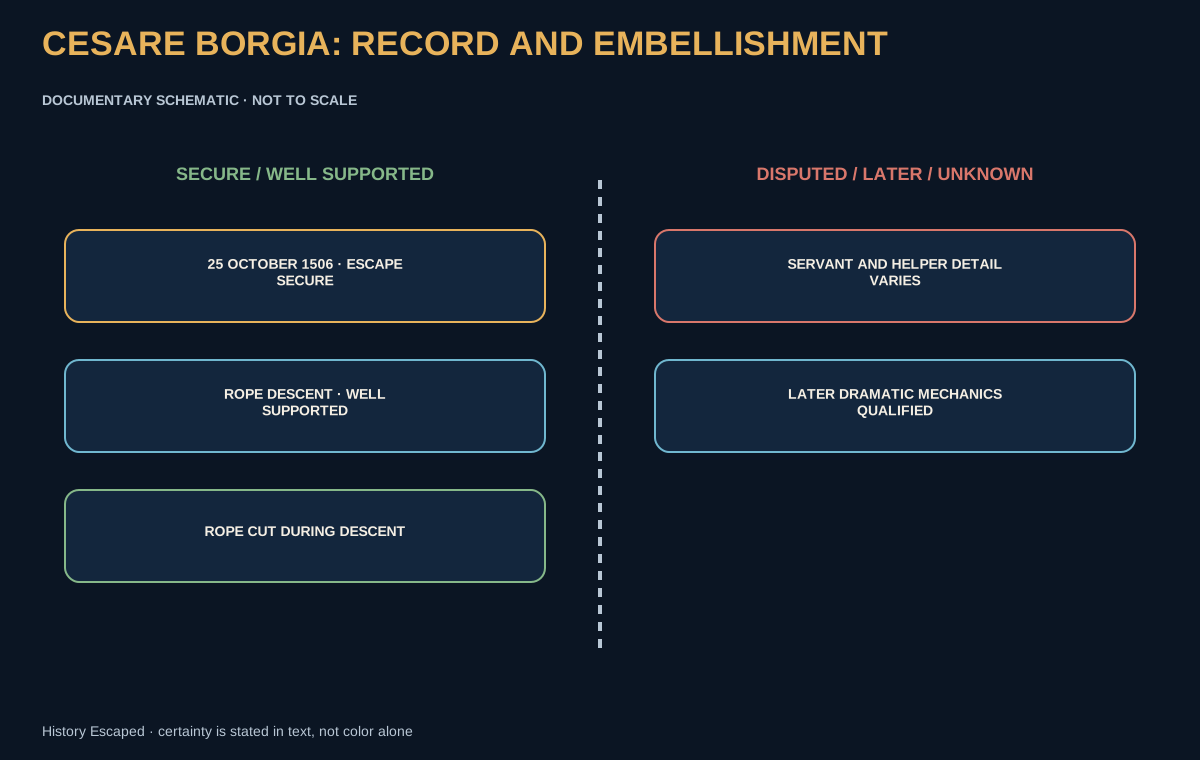
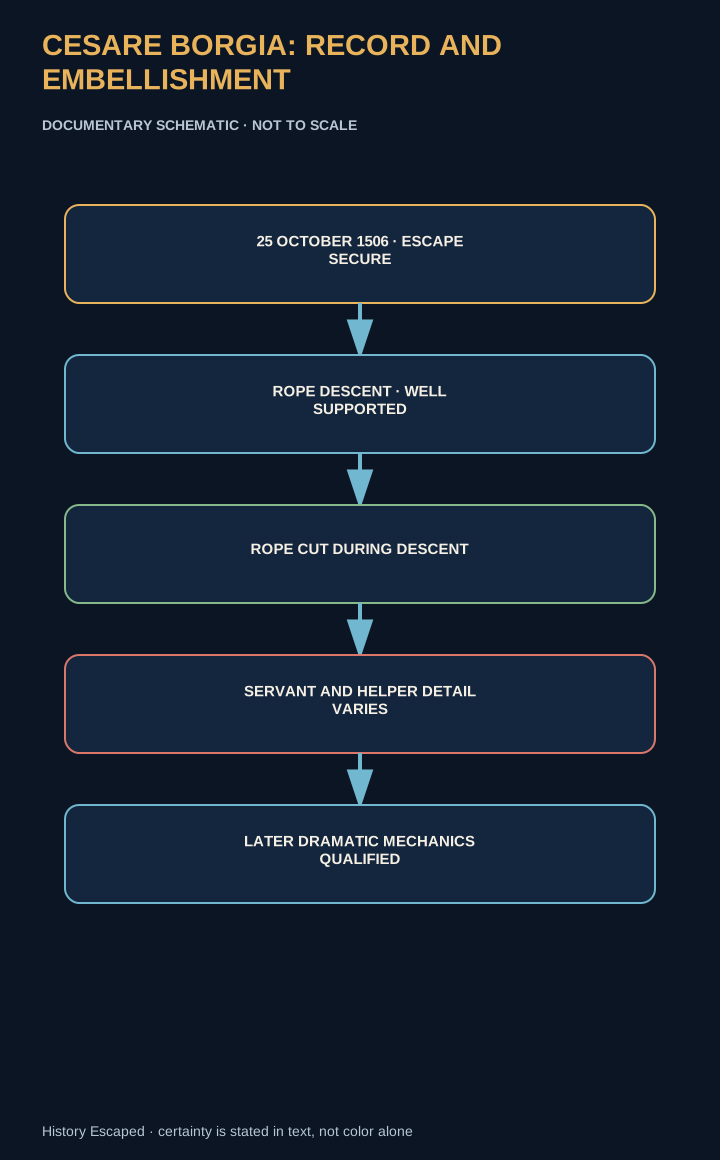
Simplified evidence-led editorial reconstruction based on the cited record; not to scale. Uncertainty is stated directly in the visual and adjacent text.
