
Alexander Pearce entered the history of Van Diemen’s Land through two escapes from Macquarie Harbour, but the surviving evidence is less tidy than the legend built around him. The broad outline is secure: an Irish transportee repeatedly punished in the colony, Pearce was sent to the remote penal station in 1822, escaped with seven other men that September, survived a disastrous attempt to cross the western wilderness, was recaptured, and later escaped again with Thomas Cox in November 1823. Cox was killed during the second attempt, and Pearce was ultimately convicted of his murder.
Cannibalism is inseparable from the case because Pearce repeatedly confessed to it and because evidence from the second escape made the allegation far harder for colonial authorities to dismiss. Yet the exact sequence of the first escape depends heavily on accounts attributed to Pearce and written down by other men. Those accounts disagree in important details. The history therefore has to distinguish what the colonial record establishes from what Pearce said happened in the bush.
At a Glance
- Who: Alexander Pearce, an Irish convict transported to Van Diemen’s Land, and the men who escaped with him from Macquarie Harbour.
- First escape: September 1822, with seven other convicts.
- Second escape: November 1823, with Thomas Cox.
- Setting: Macquarie Harbour Penal Station and the remote west of Van Diemen’s Land, now Tasmania.
- Outcome: Pearce was recaptured after both escapes. After the second, he was tried for Cox’s murder, convicted in June 1824, and executed on 19 July 1824.
- Evidence problem: Several surviving narratives of the 1822 escape derive from Pearce’s own statements but were recorded or reworked by others, and they do not agree on every victim, sequence, or circumstance.
From transportation to Macquarie Harbour
Pearce was convicted at Armagh in 1819 of stealing six pairs of shoes and sentenced to seven years’ transportation. He arrived in Van Diemen’s Land aboard the Castle Forbes in 1820. His colonial record then accumulated punishments for theft, drunkenness, absence, and other offences.
In 1822 Pearce absconded in the settled districts and was later convicted of being illegally at large and of forging an order. The result was transfer to Macquarie Harbour, a secondary penal station established on Tasmania’s west coast for convicts considered especially troublesome. Sarah Island was the administrative centre, but labour was also carried out at stations around the harbour.
The location itself was part of the system of confinement. Macquarie Harbour was separated from the more developed east of the colony by difficult country, while access by sea passed through a narrow entrance exposed to dangerous conditions. Convicts were employed in timber work, shipbuilding, and other labour. Punishment was severe, and contemporary and later official accounts record frequent flogging, deprivation, and repeated attempts to abscond.
Eight men leave Macquarie Harbour
The best-supported modern reconstruction places the first escape on 20 September 1822, although some historical studies give 18 September. The surviving manuscript collection at the State Library of New South Wales identifies the event simply as an escape in September. Because the sources are not unanimous, the exact day is less secure than the month and year.
Eight men were involved: Pearce, Robert Greenhill, Matthew Travers, John Mather, Thomas Bodenham, Alexander Dalton, William Kennely, and Edward Brown. Accounts attributed to Pearce describe seven men taking boats from a work area on the eastern side of the harbour and collecting Greenhill from the coal works. From there the party attempted to get away from the penal station and cross the country toward the settled districts.
They carried only limited food. Once the provisions were exhausted, the problem of escape changed from evading custody to staying alive in a landscape the fugitives did not know well enough to support themselves. Hunger, exposure, rivers, dense vegetation, and the physical condition of the men steadily reduced their options.
The surviving narratives agree that the party broke apart and that men were killed as the group collapsed. They do not provide a single perfectly consistent sequence. In some versions Thomas Bodenham is the first man killed; in others Alexander Dalton occupies that place. Pearce’s later statements also differ over when Kennely, Brown, and Dalton separated from the others.
This conflict matters because later retellings often present the sequence as a settled chain of events. It is not. The strongest conclusion is narrower: the eight-man escape fragmented under extreme hunger; several men separated; Pearce later admitted participating in killings and consuming human flesh; and Pearce was the only member of the group known to reach the settled districts alive.
The confessions and the problem of evidence
No diary written by Pearce survives, and the principal narratives are not documents in his own hand. One important account in the State Library of New South Wales was based on an interrogation by the Reverend Robert Knopwood. Another was a deposition made before Lieutenant John Cuthbertson at Macquarie Harbour. A later confession was reported by the Reverend Philip Conolly shortly before Pearce’s execution.
The library that preserves the manuscripts explicitly notes factual differences between them. That makes Pearce both indispensable and difficult as a source. He was the only surviving participant able to describe much of what happened after the party fragmented, but the versions of his story were filtered through interrogators, clerks, clergy, and later publication.
Across those versions, several elements recur. Greenhill possessed an axe and appears as a dominant figure in the group. Men were killed after the party’s food had failed. Pearce acknowledged consuming the bodies of dead companions. He eventually killed Greenhill after the others were gone and continued alone.
The details around each killing are less certain. The reported drawing of lots, the reason a particular man was selected, the exact order of deaths, and some of the dialogue attributed to the fugitives should therefore be treated as claims from particular narratives rather than as independently witnessed facts.
That distinction does not erase the violence. It prevents a later storyteller’s certainty from being mistaken for contemporary proof.
Back in custody
Pearce eventually emerged from the wilderness and reached the more settled side of the island. He associated for a time with men living outside the law before being captured in January 1823. Modern biographical reconstruction puts his period at large at roughly 113 days, although only part of that time was spent in the western wilderness.
After capture, Pearce described the deaths and cannibalism to colonial authorities. The story was not accepted in full. Officials suspected that some of the other escapees might still be alive and that Pearce was concealing their whereabouts. He was therefore returned to Macquarie Harbour rather than prosecuted for the killings he described.
This episode is central to the case because it shows how little external evidence the authorities possessed for the first escape. Pearce’s account was extraordinary, but there were no recovered bodies and no surviving witness from the core group to confirm his version. His confession alone did not settle the question.
The second escape
In November 1823 Pearce escaped again, this time with Thomas Cox. Later reconstructions commonly date their absconding to 13 November and Pearce’s return to custody to 22 November, while higher-level institutional biographies more cautiously state that he was taken within ten days. The short duration is secure; the day-by-day sequence rests more heavily on later transcriptions of the colonial record.
The two men took a different approach from the 1822 party, moving northward from Macquarie Harbour rather than attempting the same long crossing toward the east. They again ran short of food. They reached the King River area, where Cox was killed.
Pearce later gave more than one explanation for the killing. One version associated it with Cox’s inability to swim and a dispute over how to continue. Another emphasized starvation. The final confession relayed by Conolly described Pearce killing Cox while Cox slept after days without food.
Unlike the first escape, the death of Cox produced physical evidence. When Pearce came back into custody, human flesh was reported among his possessions, and Cox’s body was subsequently located. Pearce admitted killing him. The colonial case that followed therefore did not depend solely on an uncorroborated account of events far inside the wilderness.
Trial and execution
Pearce was tried before the new Supreme Court of Van Diemen’s Land for the murder of Thomas Cox. The trial was reported in the Hobart Town Gazette in June 1824. Even amid the sensational public discussion surrounding Pearce, the prosecution told the jury to decide the charge on evidence rather than on rumours about his reputation.
The charge before the court was Cox’s murder. Cannibalism intensified the public horror of the case, but it was not the offence for which Pearce was convicted. The jury found him guilty on 21 June 1824.
Pearce was hanged in Hobart on 19 July. His body was sent for dissection, as the law then permitted or required in cases of murder. Artist Thomas Bock made pencil studies of Pearce after the execution; those posthumous drawings are among the most direct surviving visual records associated with him.
A report published after the execution relayed Conolly’s account of Pearce’s final confession. It returned at length to the 1822 escape and named the companions who had died. That statement is historically important, but it remains a mediated confession delivered through a clergyman and printed after Pearce’s death.
What can be said with confidence
Pearce’s notoriety has encouraged versions of the story in which every step is presented as known. The source record supports a more careful reconstruction.
He was a transported convict who accumulated further punishments in Van Diemen’s Land and was sent to Macquarie Harbour in 1822. He escaped from the penal station with seven other men that September. The group disintegrated in the western wilderness, and Pearce emerged as the only member known to reach the settled districts alive. He repeatedly stated that members of the party had killed one another for food and that he had taken part in eating the dead.
The exact first victim and parts of the death sequence remain disputed because Pearce’s surviving accounts differ. Claims about private conversations, motives, and the precise mechanism by which decisions were made cannot be treated as independently established.
In November 1823 Pearce escaped again with Thomas Cox. Cox was killed, physical evidence connected Pearce to the body, and Pearce confessed. He was convicted of Cox’s murder and executed the following year.
The history is grim without embellishment. Macquarie Harbour was designed to isolate men whom the colonial penal system had already marked as difficult, and Pearce’s escapes exposed them to a wilderness in which their plans failed catastrophically. The enduring value of the case lies not in treating suffering as spectacle, but in showing how confinement, desperation, violence, and imperfect evidence combined to produce one of the most contested escape narratives of colonial Australia.
Evidence discipline
What the record supports
Status labels distinguish secure conclusions from uncertainty and rejected claims. Color is never the only signal.
DISPUTED
The first Macquarie Harbour escape occurred on exactly 20 September 1822.
People Australia and related National Centre of Biography entries use 20 September, while a University of Tasmania historical study citing earlier research gives 18 September. The archival manuscript title identifies only September 1822.
Sources: SRC-001, SRC-002, SRC-008WELL-SUPPORTED
Eight men took part in the first Macquarie Harbour escape.
The archival narrative is titled as the escape of eight convicts, and institutional biographical research identifies Pearce and seven companions.
Sources: SRC-001, SRC-002DISPUTED
The exact order of killings during the 1822 escape is known.
Accounts attributed to Pearce differ, including over whether Thomas Bodenham or Alexander Dalton appears as the first victim. The State Library of New South Wales notes factual differences between surviving manuscript narratives.
Sources: SRC-001, SRC-002WELL-SUPPORTED
Pearce participated in cannibalism during the 1822 escape.
Pearce repeatedly confessed to consuming dead companions in accounts recorded by different colonial intermediaries. The lack of surviving independent witnesses limits reconstruction of individual episodes, but the repeated admission is central to the source record.
Sources: SRC-001, SRC-004, SRC-005DOCUMENTED
Pearce killed Thomas Cox during the November 1823 escape.
Pearce admitted killing Cox, physical evidence connected him to the death, and he was convicted of Cox’s murder in 1824.
Sources: SRC-002, SRC-005, SRC-006DISPUTED
Pearce killed Cox because Cox could not swim.
That explanation appears in some accounts, while the final confession relayed by Conolly emphasizes prolonged hunger and describes Cox as asleep when attacked.
Sources: SRC-002, SRC-005Documentary reconstruction
Two Macquarie Harbour escapes compared
A case-local editorial visual separates the documented sequence from uncertainty without implying exact modern geography or operational detail.
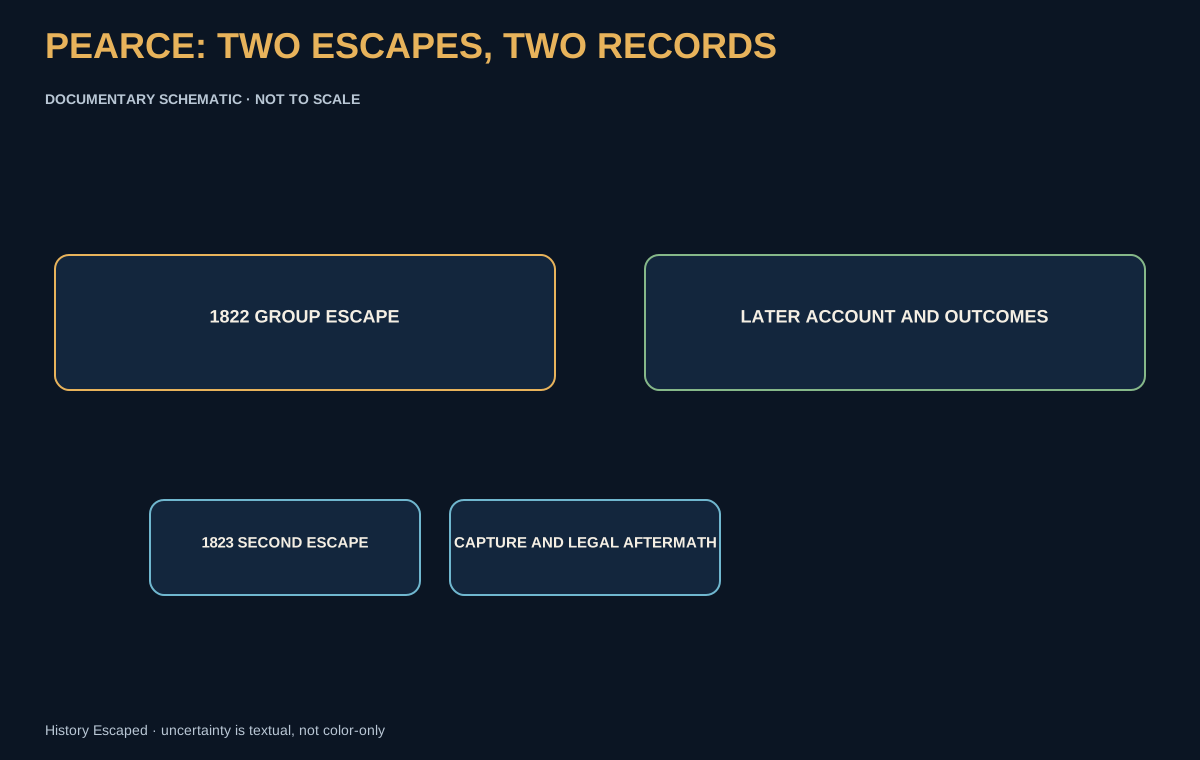
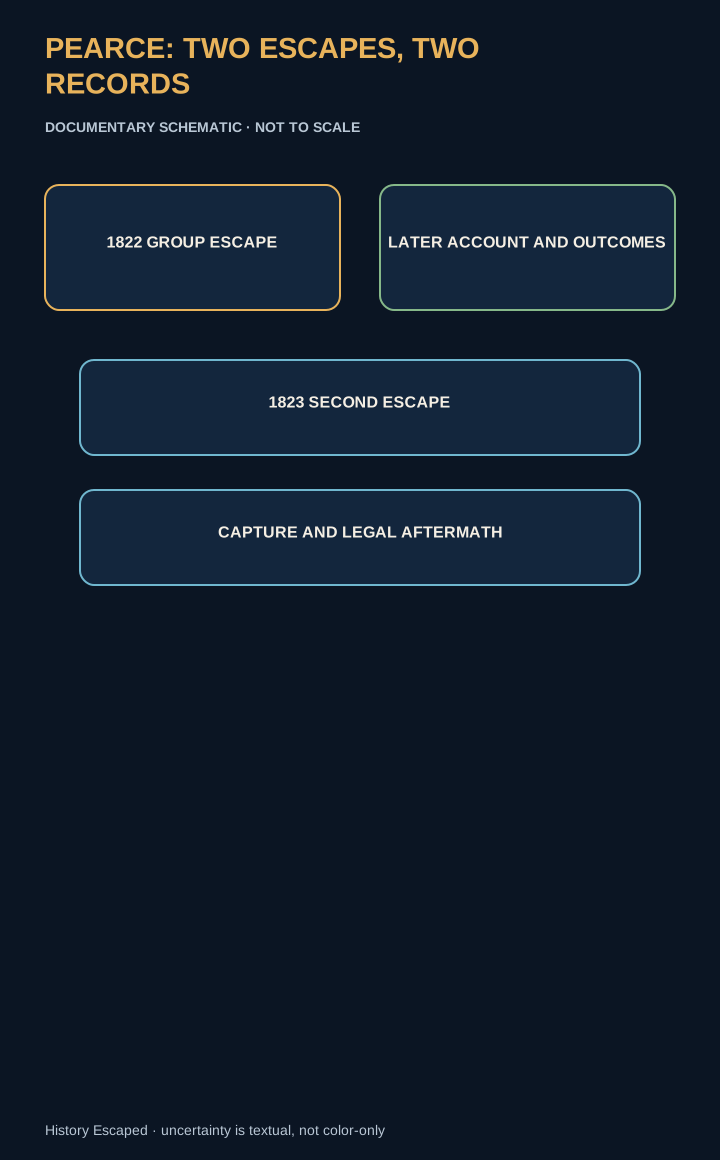
Simplified editorial reconstruction based on the cited historical record; not to scale. Uncertainty is stated directly in the visual and adjacent text.
