
Theodore Cole and Ralph Roe disappeared from Alcatraz in the middle of the afternoon on 16 December 1937. At 1:00 p.m. they were accounted for in the prison’s industrial area. By the next count, about half an hour later, both men were gone.
What followed became one of Alcatraz’s earliest unresolved escape stories. Prison investigators could reconstruct how Cole and Roe got out of the Model Industries Building and through the perimeter fence. They could not establish what happened after the men reached the shoreline. Officials believed the pair entered San Francisco Bay and were swept out through the Golden Gate, but no bodies were recovered, and later reports of sightings kept the case open in the public imagination.
At a Glance
- Date: 16 December 1937
- Place: Alcatraz Federal Penitentiary, San Francisco Bay, California
- Escapees: Theodore Cole, inmate 258-AZ, and Ralph Roe, inmate 260-AZ
- Work assignment: Mat shop in the Model Industries Building
- Documented escape mechanism: Breached waterside window followed by a forced fence lock
- Last secure point in the record: The shoreline below the industrial area
- Outcome: Both men disappeared; officially missing and presumed dead, but their deaths were never conclusively demonstrated
Why Cole and Roe Were on Alcatraz
Both men had records that made federal prison officials particularly concerned about escape.
Cole was serving a fifty-year federal kidnapping sentence. His earlier criminal history was longer and more complicated than that single label suggests, but for the Alcatraz record the kidnapping sentence is the relevant custody fact. Later biographical research also documents repeated escape attempts before his transfer to the island.
Roe was serving a ninety-nine-year sentence for bank robbery. He too had a history of escaping custody. National Archives records identify Cole as Alcatraz inmate 258 and Roe as inmate 260, placing them next to each other in the institution’s numerical register.
Their backgrounds mattered because Alcatraz had been designed precisely for prisoners whom ordinary federal institutions had trouble controlling. The island’s physical isolation, strict counting system, controlled work details, guard towers, and cold surrounding water were supposed to make a successful disappearance exceptionally difficult.
Yet the prison’s industrial buildings were not equally secure. The Model Industries Building predated the federal penitentiary and had not originally been designed to hold the government’s highest-risk prisoners. The National Park Service later noted that repeated escape attempts from this building contributed to construction of the more secure New Industries Building.
The Model Industries Building
Cole and Roe were assigned to the mat shop at the northwest end of the island. The location gave them access to a waterside portion of the Model Industries Building that prison administrators already regarded as problematic because tower guards could not see every exterior surface equally well.
The most authoritative detailed reconstruction is Erwin N. Thompson’s National Park Service historic resource study, which drew on Bureau of Prisons records and contemporary reporting. Thompson states that Cole and Roe were present for the 1:00 p.m. count on 16 December but absent at the 1:30 p.m. count.
Investigators found a physical route out of the shop. Cole and Roe had broken glass from a waterside window, cut or sawed through metal components of the window opening, and passed through it. They then reached a wire perimeter fence and used a Stillson wrench to defeat the lock.
The exact dimensions of the opening appear in contemporary newspaper-derived accounts, but those measurements add little to understanding the escape and are unnecessary to the reconstruction. The historically important fact is that investigators found a breached shop window and a forced fence lock that explained how the two men left the secured work area.
Thirty Minutes in the Fog
The escape took place during exceptionally poor visibility. Contemporary newspapers emphasized dense fog, while the modern Bureau of Prisons summary also describes severe weather and unusually strong currents in the bay.
Fog was important because it reduced the effectiveness of long-distance observation from guard positions. It did not, by itself, guarantee that Cole and Roe could cross the water. Once outside the fence, the escape shifted from a prison-security problem to a survival problem.
Officials first considered whether the men might still be hiding around the island’s shoreline or in caves. According to Thompson’s reconstruction, Bureau of Prisons director James V. Bennett reported that high water made many of those hiding places implausible. Searches by prison staff, police, and the Coast Guard failed to locate either man.
The search therefore converged on the bay. Warden James A. Johnston believed the men had entered the water and been carried toward the Golden Gate by the ebb tide. A San Francisco city engineer familiar with local tides and eddies reportedly supported the view that the current that afternoon made a successful swim to the mainland extremely unlikely.
That conclusion was reasonable, but it was not proof of death.
The Last Documented Point
The distinction between escape and survival is essential in this case.
Cole and Roe indisputably got out of the prison work area. The evidence also strongly supports that they passed through the perimeter and reached the rocky shoreline below. After that point, the record becomes inferential.
No verified witness account establishes both men swimming all the way from Alcatraz. No authenticated boat pickup was documented. No body was recovered. No personal effects conclusively proved a particular water route. Later stories proposed inner tubes, tires, oil cans, an improvised raft, or assistance from a boat, but the strongest official reconstruction did not establish any one of those mechanisms.
Even former inmates disagreed. Years later, an FBI interview recorded Al Capone’s opinion that Roe might have survived while Cole had not, and also preserved prison talk that the pair may have used inner tubes. Capone could not explain why the two would have had different outcomes, and his comments were recollection and rumor rather than eyewitness proof.
The historical record therefore supports a firm line: the escape from custody was successful; the escape from the island and the men’s survival are unknown.
Why Officials Thought They Drowned
The federal conclusion rested on conditions, not recovered remains.
The outgoing tide was unusually strong. The water was cold. Visibility was poor enough to hinder both swimmers and any hypothetical outside helper. Warden Johnston doubted the men could have arranged a boat pickup from inside the tightly controlled institution, and the broad search produced no confirmed vessel, landing site, or accomplice.
The Bureau of Prisons still summarizes the case as an escape during bad weather in which Cole and Roe were probably swept out to sea. Officially, it lists them as missing and presumed dead.
That wording matters. “Presumed dead” is not the same as “bodies recovered” or “drowning documented.” It represents the institution’s conclusion from the circumstances.
Later events also showed why the bay itself cannot be treated as an automatic death sentence. On 16 December 1962—twenty-five years to the day after Cole and Roe vanished—John Paul Scott escaped Alcatraz and reached rocks near Fort Point before being found suffering from severe exposure and hypothermia. Scott’s survival does not prove that Cole and Roe survived under different tidal and weather conditions. It only demonstrates that reaching the mainland from Alcatraz was physically possible.
Sightings, Leads, and the Growth of a Legend
The absence of bodies ensured that the case did not end in December 1937.
Contemporary reporting treated the men as fugitives even while prison officials argued that drowning was the most likely outcome. Police agencies checked possible sightings around northern California. In the following years, tips placed the pair in Oklahoma and elsewhere. In 1939, Time reported that the FBI included Cole and Roe among a list of dangerous fugitives, evidence that authorities did not simply erase them from active law-enforcement concern after declaring them probably dead.
The most famous later story placed them in South America. Thompson’s historic resource study records newspaper reports claiming that Cole and Roe had crossed the bay with improvised flotation and later communicated from abroad. The study presents these as stories, not verified outcomes.
Other rumors placed one or both men back in Oklahoma. A 2026 Encyclopedia of Arkansas biography of Cole reviews later claims that he had been seen alive and notes that none produced a confirmed resolution.
These reports are historically useful because they show how uncertainty became legend. They are not independent proof of survival. Tips, newspaper stories, coded-message tales, and recollections all sit below the evidentiary threshold required to rewrite the outcome.
Did They Escape Alcatraz?
The answer depends on what “escape” means.
If escape means leaving federal custody and getting beyond the prison perimeter, Cole and Roe succeeded. The National Park Service historic study even called theirs the first successful escape from the island while immediately qualifying that they probably did not reach the mainland.
If success means reaching lasting freedom, the answer is unknown.
That distinction is more accurate than either of the familiar extremes. Saying they certainly drowned turns a strong official inference into a documented death. Saying they successfully vanished into new lives turns decades of rumors into evidence.
The record supports neither claim.
What can be reconstructed is impressive enough without embellishment. During a roughly thirty-minute interval on a fogbound December afternoon, two prisoners with long histories of escape exploited a vulnerable work area, passed through a modified window, forced their way through the industrial perimeter, and reached the edge of Alcatraz. Then the evidence stops.
Their disappearance remained unresolved because the bay supplied no bodies and the world beyond the island supplied no verified survivors.
Evidence discipline
What the record supports
Status labels distinguish secure conclusions from uncertainty and rejected claims. Color is never the only signal.
UNKNOWN
Cole and Roe definitely drowned on 16 December 1937.
Prison officials believed drowning was overwhelmingly likely, but no bodies were recovered and no direct evidence established their deaths.
Sources: SRC-001, SRC-002, SRC-005UNKNOWN
Cole and Roe successfully reached lasting freedom.
Later sightings and South America stories were never verified strongly enough to demonstrate survival.
Sources: SRC-001, SRC-006LATER CLAIM
They used an oil-can raft or other improvised flotation device.
Stories involving oil cans, tires, or inner tubes circulated later, but the strongest official reconstruction does not establish a specific flotation method.
Sources: SRC-001, SRC-008UNKNOWN
A waiting boat collected the escapees.
Contemporary officials considered possible outside assistance but found no verified pickup vessel or accomplice.
Sources: SRC-001, SRC-005MYTH
The bay was physically impossible to survive under all circumstances.
Federal prison history notes that trained swimmers could cross under suitable conditions, and John Paul Scott reached the Fort Point area alive in 1962. That does not prove Cole and Roe survived the much different conditions of 1937.
Sources: SRC-002Documentary reconstruction
Secure perimeter escape, unresolved fate
A case-local editorial visual separates the secure historical sequence from uncertainty without exposing reusable modern operational detail.
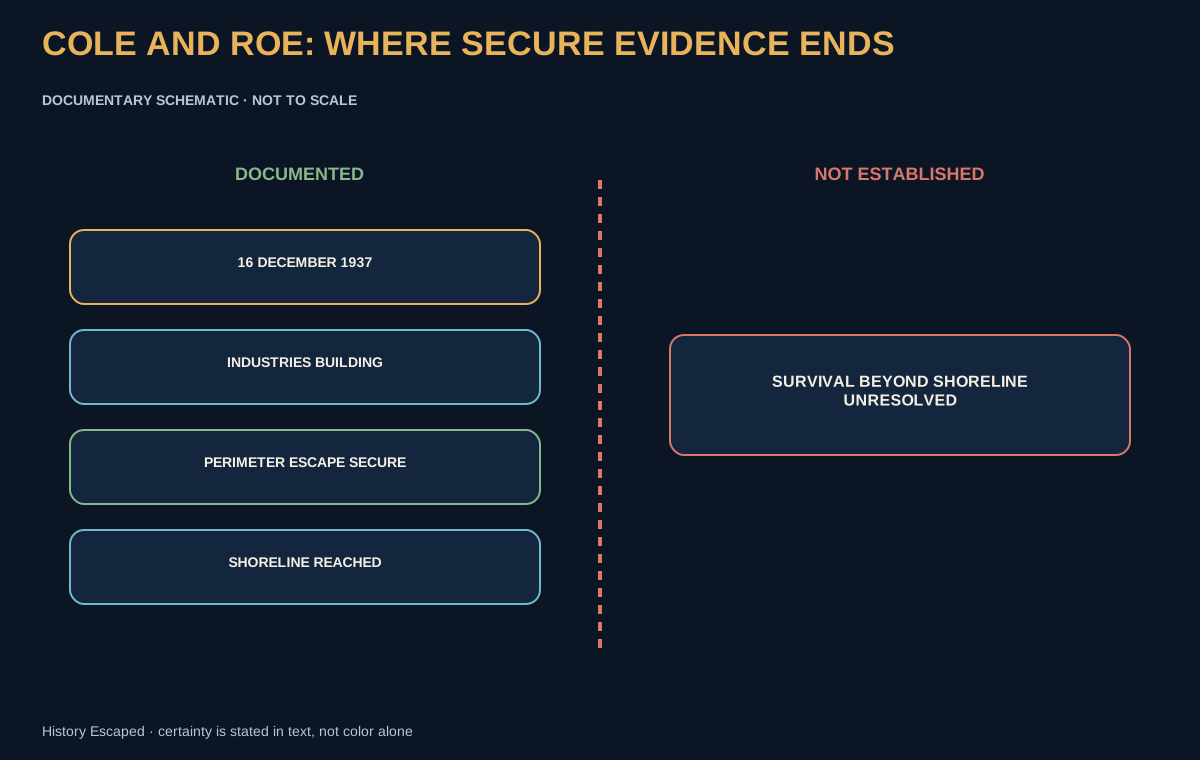
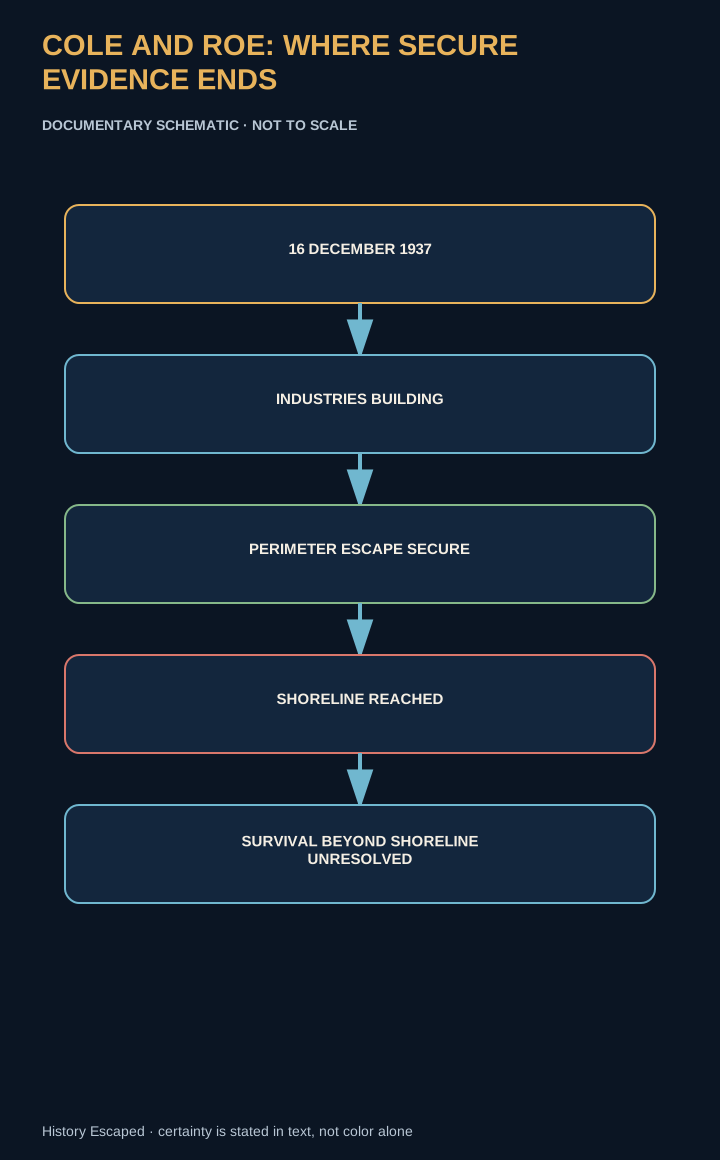
Simplified evidence-led editorial reconstruction based on the cited record; not to scale. Uncertainty is stated directly in the visual and adjacent text.