On 15 June 1970, a group of Soviet citizens gathered around a plan that they knew could end in prison or worse. Most were Jewish activists who wanted to leave the Soviet Union for Israel and had encountered the state’s restrictive emigration system. Their scheme, later known as Operation Wedding, was to take every passenger place on a small domestic aircraft, remove its crew at a scheduled stop, and have former pilot Mark Dymshits fly the group out of the Soviet Union to Sweden.
The aircraft never became theirs. Soviet security organs already knew of the plan. One part of the group was arrested near Priozersk; the other was seized at Smolnoye Airport outside Leningrad before the aircraft could be taken over. Nobody was killed, the aircraft never left Soviet control, and the intended border crossing never began.
The failed escape nonetheless became a major Cold War political event. Eleven civilians went on trial in Leningrad in December. Dymshits and Eduard Kuznetsov received death sentences; the remaining defendants received long terms in prison or corrective-labor camps. International protest followed almost immediately. On 31 December, the Supreme Court of the Russian Soviet Federative Socialist Republic commuted both death sentences to fifteen years and reduced several other terms.
The history is therefore larger than either of the labels commonly attached to it. It was a genuine plan to seize an aircraft, not merely a fabricated Soviet accusation. It was also an escape attempt driven for most of the principal participants by a desire to leave a state that would not permit them to emigrate. Both facts belong in the same reconstruction.
Before the “Wedding”
Jewish emigration from the Soviet Union was tightly controlled. After the 1967 Arab-Israeli War, interest in Jewish identity and emigration to Israel increased among some Soviet Jews, while Soviet political hostility toward Zionism also sharpened. Applicants for exit visas could face refusal, professional penalties, surveillance, and prolonged uncertainty.
Several of the people later tried in Leningrad said they had already attempted to leave legally. The underground Chronicle of Current Events, reporting the trial from information circulated inside the USSR, recorded repeated applications by Sylva Zalmanson, Eduard Kuznetsov, Yosif Mendelevich, Anatoly Altman, Boris Penson, Mendel Bodnya, and others. At trial, nine of the eleven civilian defendants said the intended seizure of the aircraft was aimed at reaching Israel.
That motive was not universal. Yuri Fyodorov and Alexei Murzhenko, the two non-Jewish defendants in the first trial, had different personal and political histories. Calling the entire group simply “sixteen Jewish refuseniks” therefore obscures both the composition of the final party and the different motives within it.
The project itself also changed before June. Mark Dymshits, a former military and civil aviator, had been looking for a way to leave the USSR clandestinely. Earlier ideas involved a much larger aircraft and many more passengers posing as wedding guests. Members of the Leningrad Jewish underground debated the idea, and an earlier version was rejected as too dangerous to the broader movement. A smaller group nevertheless continued with a revised plan.
The wedding cover survived, giving the operation its enduring name.
The Final Group of Sixteen
A recent Latvian public-media reconstruction drawing on archival material, memoirs, and scholarship on the Soviet Jewish movement identifies sixteen people in the final operation: Mark Dymshits; his wife Alevtina and daughters Yulia and Elizaveta; Eduard Kuznetsov; Yosif Mendelevich; Vulf Zalmanson; Izrail Zalmanson; Sylva Zalmanson; Anatoly Altman; Mendel Bodnya; Boris Penson; Arie Khnokh; Meri Khnokh; Yuri Fyodorov; and Alexei Murzhenko.
That is the most useful total for the planned escape party, but it is not the number later tried together.
The Antonov An-2 used on the regular local route had twelve passenger places. The operation was therefore divided into two groups. One part would take the scheduled flight from the Leningrad area; another would wait near the intermediate stop at Priozersk. The plan was to leave the regular crew behind there without killing them, combine the groups, and fly west toward Sweden, where the participants expected to surrender themselves and publicize why they had left the Soviet Union.
The trial record shows that violence was a serious legal and moral issue inside the plan itself. Defense counsel for Kuznetsov emphasized instructions that the crew were not to be harmed. The prosecution, however, treated the preparations as grave crimes against the Soviet state and as an attempted seizure of state property.
The more granular arrangements—specific weapons, restraints, evasion tactics, and low-level flight concepts preserved in memoirs or court testimony—are unnecessary to understanding why the attempt mattered.
Arrested Before the Aircraft Was Seized
The KGB had advance knowledge.
On the morning of 15 June, security forces were waiting. A later Latvian archival reconstruction places the arrest of the Priozersk group several hours before the airport arrests. At Smolnoye, the remaining participants were detained around the time passengers were being called toward the flight.
The most important factual boundary is straightforward: the conspirators did not gain control of the aircraft. Contemporary dissident reporting later noted that the case had been interrupted before the plan reached the stage of execution, language that became important when the death sentences were reviewed.
This makes the word “hijacking” both accurate and potentially misleading. There was an actual conspiracy to seize an aircraft. But no aircraft was hijacked in the completed sense: it remained under Soviet control, the crew were not removed, and no escape flight occurred.
“Aircraft escape attempt” captures the event’s place within a history of escape, while “Dymshits-Kuznetsov hijacking affair” and “Leningrad airplane case” remain essential historical names.
The First Leningrad Trial
The first major trial ran from 15 to 24 December 1970 in the Leningrad City Court. Eleven civilian defendants were tried: Mark Dymshits, Eduard Kuznetsov, Sylva Zalmanson, Yosif Mendelevich, Izrail Zalmanson, Yuri Fyodorov, Alexei Murzhenko, Anatoly Altman, Arie Khnokh, Boris Penson, and Mendel Bodnya.
They faced a combination of charges under the RSFSR criminal code, including betrayal of the motherland in connection with preparation or attempt, anti-Soviet agitation and propaganda, and attempted theft of state property. The defense disputed both the treason characterization and the prosecution’s claim that the group intended permanently to steal the aircraft.
The sentences were severe. Dymshits and Kuznetsov were condemned to death. Mendelevich and Fyodorov received fifteen years; Murzhenko fourteen; Khnokh thirteen; Altman twelve; Sylva Zalmanson and Penson ten each; Izrail Zalmanson eight; and Bodnya four.
These were the original trial sentences, not the final appellate terms.
Vulf Zalmanson belonged to the same June operation but was not one of the eleven civilian defendants. Because he was serving in the Soviet armed forces, a Leningrad military tribunal tried him separately on 5–6 January 1971 and sentenced him to ten years of strict-regime corrective labor.
Meri Khnokh had been arrested in connection with the June plan, but proceedings against her were discontinued because she was pregnant. Alevtina Dymshits and the Dymshits daughters were also not defendants in the First Leningrad Trial.
These distinctions explain why accounts alternately refer to sixteen participants, twelve principal accused, or eleven defendants. They are counting different operational and legal groups.
Death Sentences and the Appeal
The death sentences transformed the case.
Within the Soviet Union, dissidents including Andrei Sakharov appealed against the executions. Outside the USSR, protests came from Jewish organizations, political leaders, intellectuals, religious figures, and others who regarded capital punishment for an uncompleted aircraft seizure as disproportionate. The affair also drew attention to the larger issue of Soviet restrictions on emigration.
The United States response was more complicated than later victory narratives sometimes suggest. Nixon administration records show both concern for the defendants and unease about appearing soft on aircraft hijacking, a major international security issue in 1970. Henry Kissinger told President Richard Nixon that reports described a KGB trap involving people trying to flee. Nixon replied that governments should be tough on hijackers while directing that the case be examined. Later State Department records show that Washington also pursued the emigration issue as part of a broader diplomatic relationship with Moscow.
On 30–31 December the RSFSR Supreme Court heard the appeals. On the second day it ruled that because the criminal activity had been interrupted before reaching the stage of execution and because the death penalty was exceptional, capital punishment would not be applied.
Dymshits and Kuznetsov each received fifteen years instead.
The court also reduced Mendelevich’s sentence from fifteen to twelve years, Khnokh’s from thirteen to ten, and Altman’s from twelve to ten. The surviving Chronicle records an inconsistency concerning Izrail Zalmanson: the first-instance sentence was eight years, while a Supreme Court telegram to the Leningrad court gave seven. That discrepancy should remain visible rather than be silently harmonized.
Did Operation Wedding “Open the Gates”?
The most consequential claim about Operation Wedding is also the easiest to overstate.
The trial and death sentences unquestionably generated international attention. Amnesty International later wrote that the protests were apparently among the reasons Soviet authorities increased opportunities for emigration to Israel, helping lay foundations for larger emigration from the USSR. Modern scholarship likewise treats the affair as pivotal in mobilizing international support for Soviet Jewish emigration.
The numbers of people permitted to leave rose sharply in the early 1970s. Yet it would be too simple to describe that change as the automatic result of one attempted escape. Soviet emigration policy was shaped by multiple forces: internal activism, foreign diplomatic pressure, broader détente politics, Soviet calculations about international reputation, and changing relations with the United States and Israel.
Operation Wedding mattered because it made those pressures harder to ignore.
The participants themselves understood the event through different lenses. For some, forcing the emigration issue into international view was part of the objective even if the escape failed. That interpretation is supported by later participant testimony, but it should remain their interpretation rather than a claim that every member joined expecting arrest.
Prison, Release, and the Long Aftermath
The sentences scattered participants through the Soviet penal system.
Sylva Zalmanson was released early in 1974 and allowed to leave for Israel. A photograph from the Israeli Government Press Office shows her being carried through the crowd at Ben-Gurion Airport after her release—an image of one eventual outcome without implying that the 1970 escape plan itself had succeeded.
Dymshits and Kuznetsov remained imprisoned until April 1979. They were among five Soviet dissidents exchanged for two Soviet intelligence agents held in the United States, then left the USSR. Other participants were released or permitted to emigrate at different times; Yosif Mendelevich, for example, remained imprisoned until 1981.
The failed flight thus ended in several different kinds of outcome. As an escape operation, it failed before the aircraft was taken. As a legal case, it produced long imprisonment and two death sentences that were reversed only after the trial had become an international issue. As part of the Soviet Jewish movement, it became a reference point for the demand that Soviet citizens be allowed to leave the country.
Those outcomes should not be merged into a simple victory story.
What the Record Supports
Operation Wedding was neither a harmless theatrical protest nor a completed act of aerial piracy.
The group intended to seize a real passenger aircraft. They expected to remove its crew and take it out of Soviet territory without state permission. That plan carried obvious risks, even though the participants said the crew were not to be harmed and selected a small flight whose passenger places they could fill themselves.
The Soviet response, in turn, did not merely prosecute an aircraft-security offense. The charges incorporated treason and anti-Soviet activity, and the first court imposed death sentences even though the aircraft had never been seized. The appeal court itself cited the fact that the plan had been stopped before execution when it commuted those sentences.
That tension is the heart of the case.
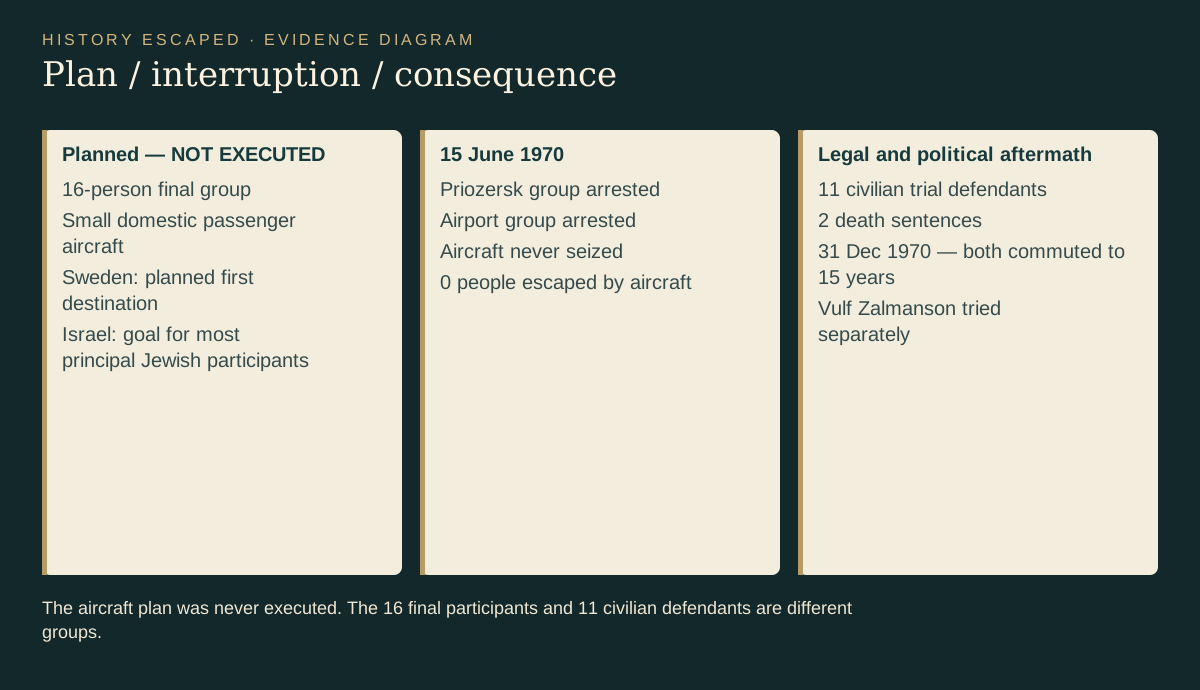
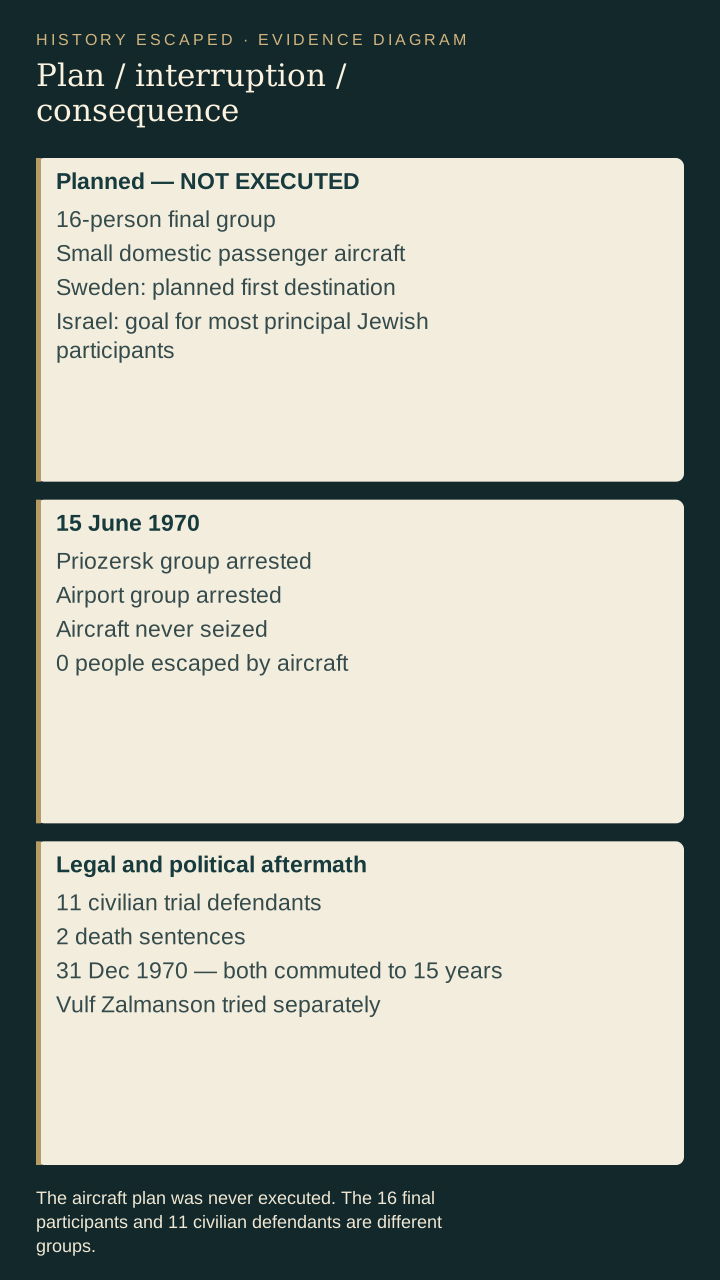
Sixteen people entered the final escape plan. Eleven civilians faced the First Leningrad Trial. One additional participant, Vulf Zalmanson, went before a military tribunal. The aircraft never left Soviet control. Nobody escaped on 15 June 1970.
Yet the attempt escaped the secrecy around it. Within months, the Leningrad airplane case had become an international argument about emigration, punishment, dissent, and the limits of Soviet power over the movement of its own citizens.
Evidence diagram
Plan / interruption / consequence
The aircraft plan was never executed. The 16 final participants and 11 civilian defendants are different groups.
- 01
Reduce the plan to a small domestic flight
After a larger concept was rejected as too dangerous, the remaining group organized around a small domestic aircraft and a sixteen-person escape party. WELL-SUPPORTED. Sources: SRC-004, SRC-007.
- 02
Split the group
The final party divided between passengers leaving from the Leningrad area and participants waiting near the scheduled intermediate stop at Priozersk. WELL-SUPPORTED. Sources: SRC-001, SRC-004.
- 03
Move into position
On 15 June 1970, the participants moved into their assigned positions at the airport and Priozersk. DOCUMENTED. Sources: SRC-001, SRC-004.
- 04
Security forces intervene
Soviet security forces arrested the groups before the aircraft could be seized or flown out of the country. DOCUMENTED. Sources: SRC-001, SRC-002, SRC-004.
The aircraft plan was never executed. The 16 final participants and 11 civilian defendants are different groups.
Problem → response
Escape was a sequence of problems
Each response solved a practical obstacle while often creating the next one.
- 01→
Obstacle
State emigration controls
Most principal Jewish participants sought a route out after legal emigration efforts had failed or appeared closed.
Response
They moved from petitions and applications toward an illegal aircraft-escape plan.
- 02→
Obstacle
Security surveillance
Soviet security organs had learned of the plan before 15 June.
Response
The participants continued, but arrests prevented the aircraft seizure from beginning.
- 03→
Obstacle
Internal opposition within the Jewish movement
An earlier version was rejected by other activists who feared that an aircraft seizure could damage the broader emigration movement.
Response
A smaller circle proceeded with a revised plan.
The final accounting
Outcome
Escaped by aircraft
No participant escaped the USSR through the planned flight on 15 June 1970.
First-trial death sentences
Dymshits and Kuznetsov received death sentences that were commuted on appeal.
Civilian defendants in first trial
The First Leningrad Trial involved eleven civilians.
Selected chronology
Selected chronology
Operation Wedding stopped
Security forces arrested the Priozersk and airport groups before the aircraft was taken over.
First Leningrad Trial
Eleven civilian defendants were tried on charges including treason-related preparation, anti-Soviet activity, and attempted theft of state property.
Death sentences imposed
Dymshits and Kuznetsov were condemned to death; the other defendants received prison and corrective-labor terms.
Death sentences commuted
The RSFSR Supreme Court replaced both death sentences with fifteen-year terms and reduced several other sentences.
Vulf Zalmanson tried separately
A Leningrad military tribunal sentenced the Soviet serviceman to ten years of strict-regime corrective labor.
Sylva Zalmanson reaches Israel
After early release, Zalmanson arrived in Israel.
Dymshits and Kuznetsov released
They were among five Soviet dissidents exchanged for two Soviet intelligence agents held in the United States.
Evidence discipline
What the record supports
Status labels distinguish secure conclusions from uncertainty and rejected claims. Color is never the only signal.
MYTH
Sixteen people were convicted together in the First Leningrad Trial.
Sixteen people belonged to the final escape party, but eleven civilians were tried together. Vulf Zalmanson was tried separately by a military tribunal; several family members were not defendants in the first trial.
Sources: SRC-001, SRC-003, SRC-004MYTH
No genuine aircraft seizure was planned and the entire case was invented by the KGB.
Contemporary dissident trial reporting records detailed admissions and disputes over the legal meaning of an actual plan to seize an An-2 and reach Sweden. KGB foreknowledge does not negate the existence of the plan.
Sources: SRC-001, SRC-002, SRC-006MYTH
The group successfully hijacked an aircraft.
They were arrested before gaining control of the aircraft. The planned seizure was never executed.
Sources: SRC-001, SRC-002, SRC-004MYTH
All participants had identical motives and were Jewish refuseniks.
Most principal participants were Jewish activists seeking emigration to Israel, but Fyodorov and Murzhenko were non-Jewish and the trial record reflects different personal motives.
Sources: SRC-001, SRC-004DISPUTED
Operation Wedding alone caused the subsequent rise in Soviet Jewish emigration.
The affair was pivotal in international mobilization and Amnesty later judged the protests apparently one reason for increased emigration opportunities, but policy changes also reflected broader diplomatic, domestic, and Cold War pressures.
Sources: SRC-005, SRC-008, SRC-011DISPUTED
Izrail Zalmanson’s final sentence was unambiguously eight years.
The first-instance sentence was eight years, but the Chronicle records a Supreme Court telegram listing seven years after appeal.
Sources: SRC-002