
Amir Khusrau’s capture by a Mongol raiding force in 1285 was not a late legend attached to a famous poet. Khusrau himself wrote about it.
He had spent about five years at Multan in the service of Prince Muhammad, the favored son and heir of Sultan Ghiyath al-Din Balban. The prince commanded the Delhi Sultanate’s northwestern frontier, where Mongol incursions were a recurring danger. In the last month of 683 AH, corresponding to early 1285, another major raid reached the Punjab. Prince Muhammad rode out to meet it, and the battle killed the prince, shattered part of his following, and left Khusrau among the prisoners.
What happened next survives in the autobiographical preface to Khusrau’s Ghurrat al-Kamal and in poetry associated with the disaster. He describes being bound, stripped, driven on foot beside a mounted Mongol captor, and pushed onward despite exhaustion, thirst, and badly damaged feet. At a stream, Khusrau says, he drank cautiously. His captor and the captor’s horse drank heavily, collapsed, and died; Khusrau then escaped.
The core story is unusually close to the event. The exact duration of captivity, the destination intended for the prisoners, and some later claims about ransom or a two-year imprisonment in Balkh are much less secure.
A Poet on the Mongol Frontier
Khusrau was already an established Persian poet when he entered Prince Muhammad’s service. Muhammad governed Multan and the northwestern frontier for his father Balban, and his court attracted poets, scholars, musicians, and religious figures while sitting close to a zone repeatedly exposed to Mongol raids.
The setting matters because Khusrau was not a civilian traveler who happened to be swept up by a raid. He belonged to the prince’s establishment and accompanied a military household responsible for frontier defense. Khusrau’s friend and fellow poet Amir Hasan Sijzi was also associated with the prince’s circle.
Khusrau later remembered the Multan years as a major period of his literary life. The catastrophe of 1285 ended that phase abruptly.
The Battle Near Lahore
The exact topography of the battle is not completely secure. Khusrau’s own elegy and later chronicles place the fighting in the Punjab after Prince Muhammad hurried from Multan toward the Lahore–Dipalpur sector, while modern reconstructions generally put the engagement near the Ravi in the Lahore region.
The date is stronger than some modern references make it appear. Khusrau’s elegy says Prince Muhammad died on the last day of Dhu al-Hijja 683 AH. A contemporary elegy by Amir Hasan has been used by historians to identify the day as Friday, 9 March 1285.
Some reference works label the event “683/1284,” because the Hijri year 683 began during 1284. That is not necessarily a contradiction. The battle came at the end of that Islamic year, which falls in March 1285 in the Common Era.
For this case, 9 March 1285 is the best-supported specific date, while “March 1285” is the safest uncontested modern-calendar description.
Prince Muhammad’s Death
The battle did not unfold as a simple Mongol victory. Wahid Mirza’s reconstruction, based on Khusrau, Barani, and other early sources, describes the Sultanate forces pushing the Mongols back before pursuit and disorder opened a dangerous gap.
Prince Muhammad was left with a reduced body of troops near the river, and a Mongol force then struck his position. Khusrau’s elegy describes Muhammad fighting until he was killed. The prince’s death transformed what had looked like successful resistance into disaster for the men immediately around him.
Many were killed and others were taken prisoner. Khusrau was among them.
Khusrau’s Own Captivity Account
The most important evidence comes from Khusrau himself. In the preface to Ghurrat al-Kamal, assembled within a few years of the battle, he recalls the Mongol disaster and states that a cord was bound around his neck.
His imagery is highly literary, but the physical suffering underneath it is unmistakable. He describes prisoners tied and driven together, says fear drained the blood from his body, and recalls being forced to run for a long distance until his feet blistered and tore open.
His captor remained mounted. Khusrau portrays the man in deliberately hostile, grotesque language, part testimony and part the anti-Mongol rhetoric of a court poet whose patron had just been killed.
The practical relationship is clear enough: Khusrau was on foot, his captor on horseback, and the poet believed that slowing down could bring a weapon down on him.
The Stream
Khusrau’s account turns at a water source. He and the mounted captor were both suffering from thirst, and Khusrau says he restrained himself, taking only enough water to wet his lips and revive himself gradually.
The captor and horse drank much more. According to Khusrau, both then died.
A modern medical reconstruction is impossible and unnecessary. The text does not allow a confident diagnosis of whether the deaths resulted from overdrinking while severely overheated, another physiological crisis, an existing wound, exhaustion, contaminated water, or literary compression.
What matters for the escape is the opportunity their collapse created. Khusrau says that God allowed him to survive and that he escaped from the path on which he had expected to die.
Flight Back to Multan
The sources do not preserve a detailed route from the stream back to friendly territory. Wahid Mirza’s biography, which follows Khusrau’s autobiographical material closely, says simply that the poet returned to Multan, where the city was in mourning for Prince Muhammad and for the soldiers and attendants killed or carried away.
That lack of route detail is important. There is no secure basis for a step-by-step reconstruction of Khusrau evading Mongol camps, crossing specific rivers, changing disguises, receiving a chain of named helpers, or traveling through a known sequence of villages.
The surviving primary account becomes vivid during captivity and then suddenly sparse once he is free. The escape was successful, but its post-breakaway geography is largely unknown.
Was He Taken to Balkh?
A much longer version of the story appears in later biographical tradition. Some writers say Khusrau was carried all the way to Balkh and remained a prisoner for as long as two years, while other popular accounts say he was released after payment of a ransom.
Neither version sits comfortably with the autobiographical account used by Mirza. Khusrau describes the mounted captor dying during the forced march and his own subsequent escape, while Mirza then places him back in Multan amid the immediate mourning after Prince Muhammad’s death.
Modern scholar Sunil Sharma likewise summarizes the captivity as brief. That does not prove that every later detail about movement toward Central Asia is impossible, because the Mongol force was withdrawing northwest with captives, but the claim of a two-year Balkh captivity requires evidence beyond the late biographical tradition.
It should therefore remain a LATER CLAIM, not the controlling historical outcome. The ransom story is weaker still because it directly competes with Khusrau’s own description of escape after the captor’s death.
Amir Hasan and the Other Prisoners
Khusrau was not the only literary witness to the battle. Amir Hasan Sijzi, his friend and fellow poet at Prince Muhammad’s court, composed an elegy that later historians used for the chronology of the prince’s death, and some historical works also list Hasan among the captives.
The broader prisoner column is visible in Khusrau’s poetry even when individuals cannot be named securely. He describes captives bound together and driven away after the collapse around the prince.
That matters because the escape was not the release of an isolated celebrity. Khusrau was one survivor inside a larger military disaster involving killed, wounded, scattered, and captured members of the prince’s following.
His fame preserved his version, while most of the other prisoners left no comparable account.
Memory, Hatred, and Literary Exaggeration
Khusrau’s testimony is powerful precisely because it is personal, but it is not emotionally neutral. The Mongols had killed his patron, destroyed a courtly circle in which he had flourished, and subjected him to frightening captivity.
His later writings often use violent anti-Mongol imagery. Modern historians therefore have to separate different kinds of information in the same passage.
Capture, binding, forced movement, exhaustion, a mounted captor, a stream, the captor’s collapse, and Khusrau’s flight form a coherent autobiographical sequence. The animal comparisons, physical caricature, theological interpretation, and poetic multiplication of suffering belong partly to literary expression.
The same caution applies to his elegy for Prince Muhammad. It is a near-contemporary witness to the catastrophe, but it is also a court poem of grief, loyalty, and religious rhetoric.
Primary does not mean unfiltered.
The Return from the Disaster
Khusrau’s return did not restore the world he had lost. Prince Muhammad had been Balban’s favored heir, and his death created a political succession problem for the aging sultan.
Multan’s court had also lost the patron around whom its literary society had formed. Khusrau mourned him intensely.
Mirza quotes poetry in which the poet says that escaping the captor’s cord meant little when the chain of his friends had been broken. It is one of the clearest reminders that the event was remembered by Khusrau not as an adventurous triumph but as survival inside a catastrophe.
Afterward he spent time away from that destroyed courtly world before attaching himself to new patrons. He eventually became the most famous Persian poet associated with the Delhi Sultanate and served successive dynasties until his death in 1325.
The captivity remained part of his autobiographical identity.
What Can Be Reconstructed Securely
The strongest version of the case is also the simplest. In March 1285, Amir Khusrau accompanied the household of Prince Muhammad against a Mongol incursion in the Punjab; the prince was killed and Khusrau was captured with other members of the defeated force.
Khusrau says he was bound and driven on foot by a mounted captor. At a stream, he drank cautiously while the rider and horse drank heavily and died; the poet then fled and made his way back to Multan.
Everything after that core requires different levels of confidence. The exact distance he covered as a captive is unknown, the exact stream is unknown, and the intended destination is unknown.
A prolonged imprisonment at Balkh is a later tradition, and release by ransom conflicts with the autobiographical escape account. That evidentiary boundary makes the case stronger rather than weaker.
Amir Khusrau really was captured by a Mongol force. He really did describe the experience himself. The best surviving account says his escape came not through a negotiated release or a prison breakout, but through a sudden opening on a brutal forced march.
Evidence discipline
What the record supports
Status labels distinguish secure conclusions from uncertainty and rejected claims. Color is never the only signal.
MYTH
Khusrau’s Mongol captivity is only a late legend.
Khusrau himself describes the captivity in the autobiographical preface to Ghurrat al-Kamal, assembled within roughly a decade of the event, and early Sultanate historical tradition corroborates the capture.
Sources: SRC-001, SRC-002, SRC-003, SRC-006LATER CLAIM
Khusrau spent two years as a prisoner in Balkh before returning.
This appears in later biographical tradition. Khusrau’s own account and modern scholars following it instead describe escape during the forced march and a comparatively short captivity.
Sources: SRC-001, SRC-002, SRC-004DISPUTED
Khusrau was released after a ransom was paid.
Some modern popular retellings repeat a ransom story, but it conflicts with Khusrau’s autobiographical account in which his captor dies and he flees.
Sources: SRC-001, SRC-002UNKNOWN
The captor and horse certainly died from water intoxication.
Khusrau says both drank heavily and died soon afterward, but the source cannot support a modern medical diagnosis. Heat illness, exhaustion, injury, contaminated water, narrative compression, or other causes cannot be excluded.
Sources: SRC-001, SRC-002UNKNOWN
The exact forced-march route and stream can be mapped.
The primary account does not securely identify the stream or provide enough geographical detail for a precise route.
Sources: SRC-001, SRC-002DISPUTED
The battle occurred in 1284 rather than 1285.
Some references label it 683/1284 because the Hijri year 683 began in 1284. Khusrau’s and Hasan’s late-Dhu al-Hijja chronology is conventionally converted to March 1285.
Sources: SRC-002, SRC-003Evidence diagram
A first-person core and later traditions
Khusrau's own account anchors the capture and escape, while the two-year Balkh stay and ransom story belong to later traditions.
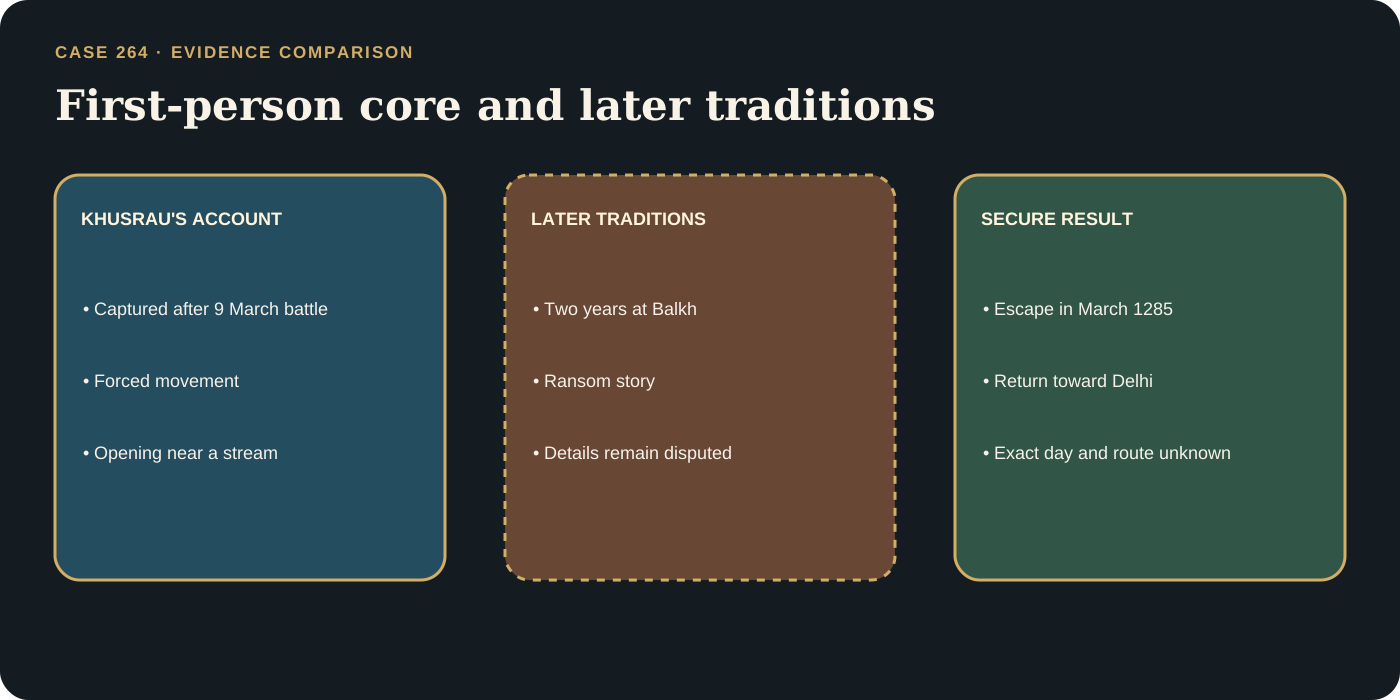
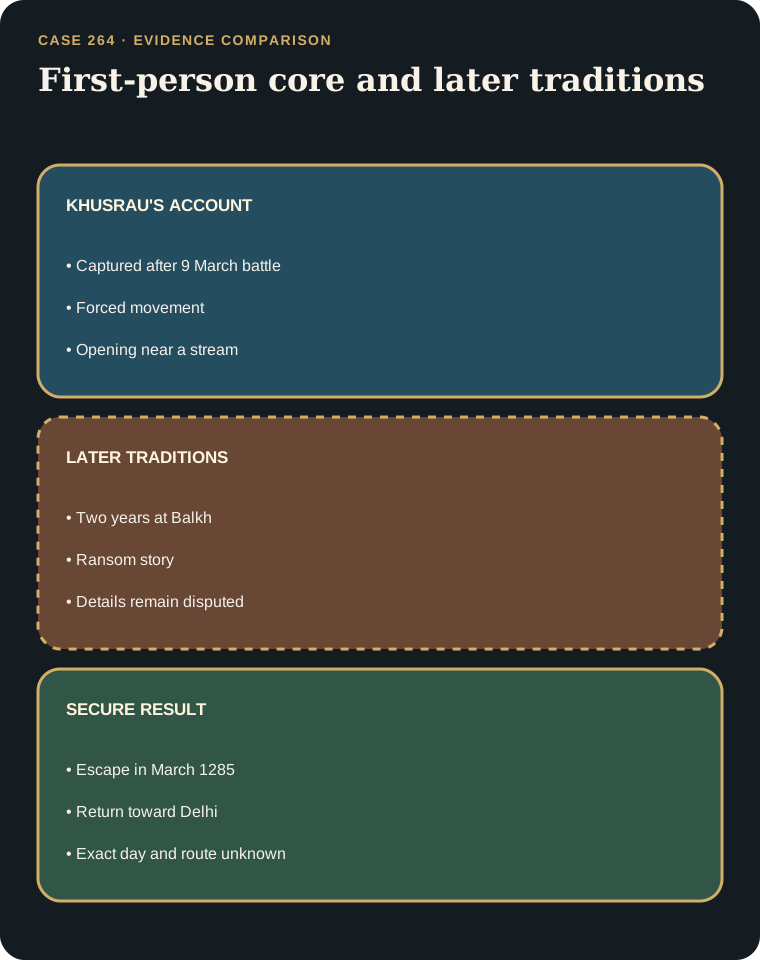
Khusrau's own account anchors the capture and escape, while the two-year Balkh stay and ransom story belong to later traditions.
